Balocco Brand Guidelines
The Fossano pastry shop that became a biscuit and panettone maker.
Aa
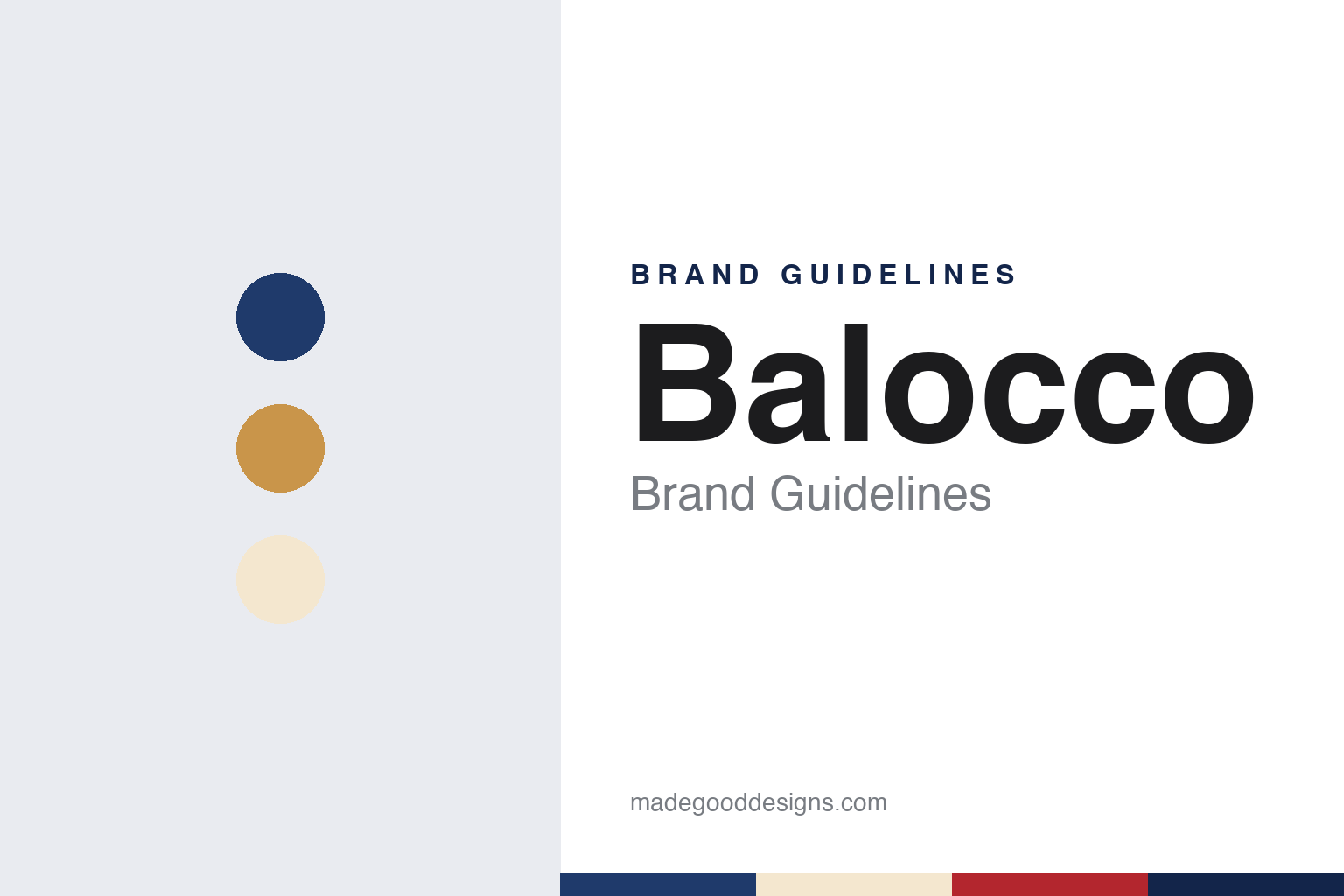
Two constants: a Balocco blue, gold and cream palette and a pasticceria serif register. Abstract homage — not a Balocco product or mark; no pack, logo or packaging is reproduced.
A pastry shop on the castle square
Fossano, opposite the castle of the Princes of Acaja.
Balocco began as a pastry shop in Fossano, a town in the province of Cuneo in Piedmont. Italian Wikipedia dates the company to 1927 and names its founder as Francesco Antonio Balocco, whose shop stood opposite the Castello dei Principi d’Acaja, the town’s castle. The company’s own history fills in the background: it says Francesco Antonio began a pastry cook’s apprenticeship at the age of eleven and worked in well-known Piedmontese pastry shops in Bra and Turin, including the Confetteria De Coster.
The company tells the start as a family story. It says Francesco Antonio first opened a pastry shop on Via Marconi in Fossano in 1923 with his brother Alfredo, and that when Alfredo moved to Ventimiglia in 1927, Francesco Antonio took over a pastry shop on Piazza Castello — the 1927 shop the business counts as its beginning. A second shop followed on the central Via Roma; Italian Wikipedia says two years later, while the company dates it to 1933, and describes it as furnished in Empire style.
After the Second World War the business changed character. Italian Wikipedia says Francesco Antonio’s son, Aldo Balocco, took charge at 23 and turned the family workshop into an industrial concern, making panettoni, pandori, Easter colombe, biscuits and wafers from 1948. The company says it began producing dry pastries that could be sold wholesale and in 1949 moved production into a 5,000-square-metre plant with 30 workers.
Colour
Mandorlato, Carosello and the Santa Lucia plant.
The product that made the name was a Christmas cake. The company says that in the 1950s it installed its first ovens for panettone and experimented with natural leavening and with glazing panettone with hazelnuts, sugar and toasted almonds, creating the Mandorlato Balocco, which it calls an immediate success and, later, the symbol of the company.
Growth needed a bigger site. The company says it bought 70,000 square metres of land in the Santa Lucia area of Fossano in 1964 and moved production there in 1969; Italian Wikipedia gives 1970 for the move. The company is still based there, and Balocco says that by 1987 its production area had reached 32,000 square metres with 135 staff, and by 2003, 44,000 square metres. Italian Wikipedia adds that the plant was enlarged in 1987 and that in December 2017 work began on a €10 million expansion aimed at export products.
Biscuits became a larger part of the business later. The company says it entered the market for frollini, the shortbread-style breakfast biscuits sold in Italian supermarkets, in 2003. Its website now lists several frollini lines — among them Classici, Ricchi, Integrali and Novellini — alongside wafers, amaretti, savoiardi and sfogliatine, as well as its Christmas and Easter cakes.
Advertising has been central to how Balocco presents itself. The company says its first television spot ran on Carosello, then Italian television’s only advertising slot, on 1 December 1975, with the Kessler twins promoting the Mandorlato, followed in the 1980s by the dancer Heather Parisi. In 2006, it says, it launched the “Il Signor Balocco” campaign, set in an old-fashioned factory with a magical atmosphere; Italian Wikipedia says the actor Cosimo Cinieri played Signor Balocco from 2008 and Aldo Stella from 2017. Italian Wikipedia gives its slogan as “Fate i buoni” — “be good.”
Typography
Design and documentation.
The seven brands in this group all make biscuits, and they come from four countries: LU and St Michel from France, Loacker, Balocco and Mulino Bianco from Italy, Arnott’s from Australia, and Pepperidge Farm from the United States. Biscuit brands in general sit at many different points in the trade, from family firms that still bake in the town where they started to names that have passed between food groups several times, and a single packet can carry the history of more than one owner.
A biscuit brand’s identity is usually carried less by a recipe than by a pack, a shape and a name, because the biscuit on the shelf may be baked a long way from the place the name recalls. That makes the questions behind each name worth asking plainly: who started it, who owns it now, how its packaging came to look the way it does, and where its biscuits are actually made.
Each guide separates what independent sources record from what the company says about itself — its founding story, its owners over time, its pack and where it bakes — and marks plainly what rests only on the company’s own word.
Aa
A pasticceria serif — a pastry shop grown into a factory. (Specimen set in Playfair Display, a serif STAND-IN; NOT the Balocco logo.)
Balocco
Four generations in Fossano.
Balocco has stayed a family company. The company says Alessandra and Alberto Balocco, Aldo’s children, joined in 1990; Italian Wikipedia says Aldo became chairman and Alberto chief executive, and that on 2 June 2010 the President of Italy, Giorgio Napolitano, named Aldo a Cavaliere del Lavoro. The brand also went into sport: the company says its name appeared on the shirts of Juventus in the 2010–11 and 2011–12 Serie A seasons and on the Maglia Rosa of the Giro d’Italia from 2013 to 2015.
The leadership changed quickly in the 2020s. After Alberto Balocco died in August 2022, la Repubblica reported in October 2022 that Alessandra had become chairman and chief executive. Following her death in August 2025, reported by the Cuneo news site Targatocn, Italian Wikipedia says leadership passed to Diletta Balocco, Alberto’s eldest daughter; it lists Ruggero Costamagna as chairman. The company says the fourth generation — Diletta and Alessandra’s son Marco — joined in 2022.
One episode drew national attention. In December 2023 Italy’s competition authority, the AGCM, fined Balocco S.p.A. €420,000 over a Christmas 2022 pandoro sold under the influencer Chiara Ferragni’s brand, finding the promotion misleading about a charity donation to Turin’s Regina Margherita children’s hospital, Italian Wikipedia says, citing the authority; it says Balocco’s €50,000 donation had been fixed months before the launch, regardless of sales.
The company reports steady growth. Italian Wikipedia, citing Foodweb in 2018, put 2017 revenue at €185 million; the company says turnover reached €262 million in 2025, with exports at €37 million, or 15% of sales. The company gives its registered and administrative office as Via Santa Lucia in Fossano, and Fossano is the only production site named in the sources we checked.
For a design guide, Balocco shows how a town pastry shop can build a national brand on television characters and seasonal cakes. Compare Ferrero Rocher, from Alba in the same province of Cuneo, and Niederegger, another family confectioner tied to its town. For this guide we use a deep blue, biscuit gold and cream with a serif, an unofficial interpretation; no product or logo is reproduced.
Explore & save
Keep Balocco’s identity on hand — save it to a board in the Made Good inspiration library.
Balocco identity set
Pin the Balocco blue, gold and cream palette and the pasticceria serif register to your own board.