Paterson’s Brand Guidelines
The Rutherglen oatcake baker of 1895, now baking shortbread in Livingston.
Aa
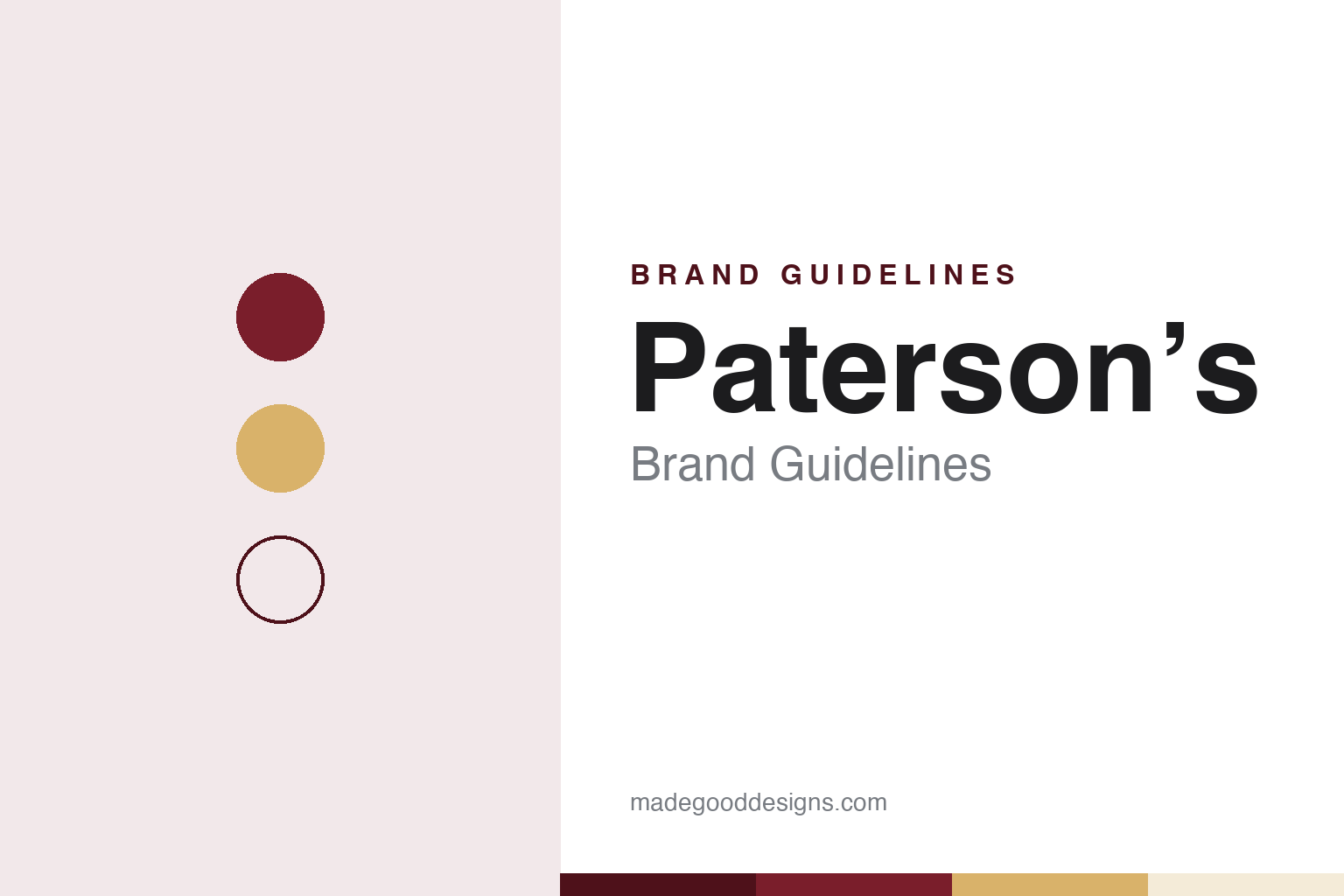
Two constants: a Paterson’s red, butter gold and oatmeal palette and a classic serif register. Abstract homage — not a Paterson’s product or mark; no pack, logo or biscuit is reproduced.
A horse-drawn van in Rutherglen
Oatcakes first, shortbread later.
Paterson’s began in 1895, when John and Isabella Paterson founded a bakery in the Royal Burgh of Rutherglen, just south-east of Glasgow, and sold their oatcakes from a horse-drawn van. The company’s 2018 website described them as a “husband and wife team selling home baked oatcakes”, and its owner today tells the same story on the brand’s page. According to the Rutherglen Heritage Society, drawing on a 1990 article in the Glasgow Herald, John Paterson won the premier silver medal for oatcakes at the Scottish Food Exhibition every year from 1908 to 1911, after which the organisers struck a special gold medallion for him. The same account names shortbread and Abernethy biscuits among the bakery’s other staples.
The bakery grew in Rutherglen between 1914 and 1937, the current owner’s timeline says. English Wikipedia’s article on the town records that the Royal Burgh Bakery was home to Paterson’s from 1895 until 1971, when the factory had become outdated and production moved to Livingston, the new town in West Lothian. The Livingston plant kept the old name: FBC UK lists Paterson Arran’s Royal Burgh Bakery in Livingston among its sites.
In 1994 Paterson’s bought Arran Provisions, a food company on the Isle of Arran, and the combined business became Paterson Arran Ltd. Arran Provisions had started in 1970 as the Arran Mustard Company, founded by Ian Russell, a retired police officer, to make mustard for his gift shop in Brodick; it took the Arran Provisions name in 1984. The owner lists the Arran operation today as Arran Fine Foods in Lamlash.
The town has not forgotten the firm. The Rutherglen Heritage Society’s history of oatcake making in the burgh uses Paterson’s as its main example, and English Wikipedia’s article on Livingston names Paterson Arran among the food manufacturers there, with its bakery still called the Royal Burgh Bakery.
Colour
From independent to FBC UK.
For most of its history Paterson’s was independent. In 2018 its website called Paterson Arran “one of our country’s best known independent food companies” and said its output had risen by more than 80% since 2006 — the company’s own figure. Its brands then were Paterson’s shortbread and oatcakes, Arran Fine Foods and Brontë biscuits.
That changed in 2019, when Paterson Arran Ltd and Dorset Village Bakery Ltd were bought by Burton’s Foods Ltd, the maker of Jammie Dodgers and Wagon Wheels, according to the timeline published by the current owner. Burton’s was itself sold in 2021: English Wikipedia says it was bought by Ferrero in June that year, while the company describes the buyer as a Ferrero-affiliated company. Fox’s Biscuits had been acquired by a Ferrero-affiliated company in 2020, and in 2022 Fox’s and Burton’s merged to form FBC UK, which calls itself “a Ferrero related company”. The old paterson-arran.com address now redirects to the Paterson’s page on the FBC UK website.
FBC UK says Paterson’s is “the nation’s favourite” shortbread, and in 2018 the company called it the “number 1 shortbread brand in Britain”; both are the company’s own claims. The range it shows today centres on shortbread fingers, including a clotted cream version, alongside Royal Edinburgh shortbread fingers, a Burton’s brand that FBC UK’s timeline links to its Edinburgh bakery. Oatcakes, the product the Patersons started with, were still listed as a Paterson’s range on the 2018 site.
Within FBC UK, Paterson’s sits beside the group’s other Scottish names: the company’s brand list includes Paterson’s, Arran and Brontë, alongside Fox’s and Burton’s own brands. Its Paterson’s page opens with the 1895 founding and the horse-drawn van, the same two details that start the company’s timeline.
Typography
Shortbread, oatcakes and ownership.
The seven brands in this group all make biscuits, and they come from three parts of Britain: Border Biscuits, Paterson’s, Island Bakery and Crawford’s from Scotland, Duchy Originals and Fudges from England, and Burton’s from Britain more widely. Biscuit brands in general sit at many different points in the trade, from everyday packets on a supermarket shelf to small-batch boxes sold through delicatessens, and a single company can work at both ends at once.
A biscuit brand’s identity is usually carried less by a single mark than by a recipe, a wrapper and the familiar shape of the biscuit inside, and the name on the front may have outlived the bakery, the family or the town that first made it. That makes the questions behind each name worth asking plainly: who started it, who owns it now, which larger groups it has passed through, and where its biscuits are actually baked today.
Each guide separates what independent sources record from what the company says about itself — its founding story, its owners over time, its recipes and where its biscuits are made — and marks plainly what rests only on the company’s own word.
Aa
A classic serif — a Victorian bakery’s register. (Specimen set in Libre Baskerville, a serif STAND-IN; NOT the Paterson’s logo.)
Paterson’s
Palm oil, an orangutan and awards.
Before the 2019 sale, Paterson Arran built much of its public image around sustainability. Its 2018 website said it had removed palm oil from its oatcake range in 2002, that it was a lifetime member of the Orangutan Foundation, and that a sculpture by the Scottish artist Lex McFadyen, named Tangy, stood at the bakery. The same site said the business had held ISO 14001 environmental certification since 2009. It reported top place for sustainable practice at the VIBES Scotland awards in 2017 and the Environmental Sustainability Award at that year’s Scotland Food & Drink Excellence Awards; these are as reported by the company. It also described a Macmillan Cancer Support partnership launched in 2016, which it said reached its £100,000 target by summer 2017.
In the sources we checked we found no published brand guidelines or official colour values for Paterson’s, and no documented account of who designed its logo or packs.
For a design guide, Paterson’s shows how a Victorian family bakery’s founding story can carry a brand through relocation, a merger and two changes of owner. Compare Nairn’s, another Scottish oatcake maker that moved to Livingston, and Fox’s Biscuits, its partner in FBC UK. For this guide we use a deep red, a butter gold and an oatmeal cream with a serif, an unofficial interpretation; no product or logo is reproduced.
Explore & save
Keep Paterson’s’s identity on hand — save it to a board in the Made Good inspiration library.
Paterson’s identity set
Pin the Paterson’s red, butter gold and oatmeal palette and the classic serif register to your own board.