Nairn’s Brand Guidelines
The Scottish oatcake maker that began in a Strathaven bakery in 1896.
Aa
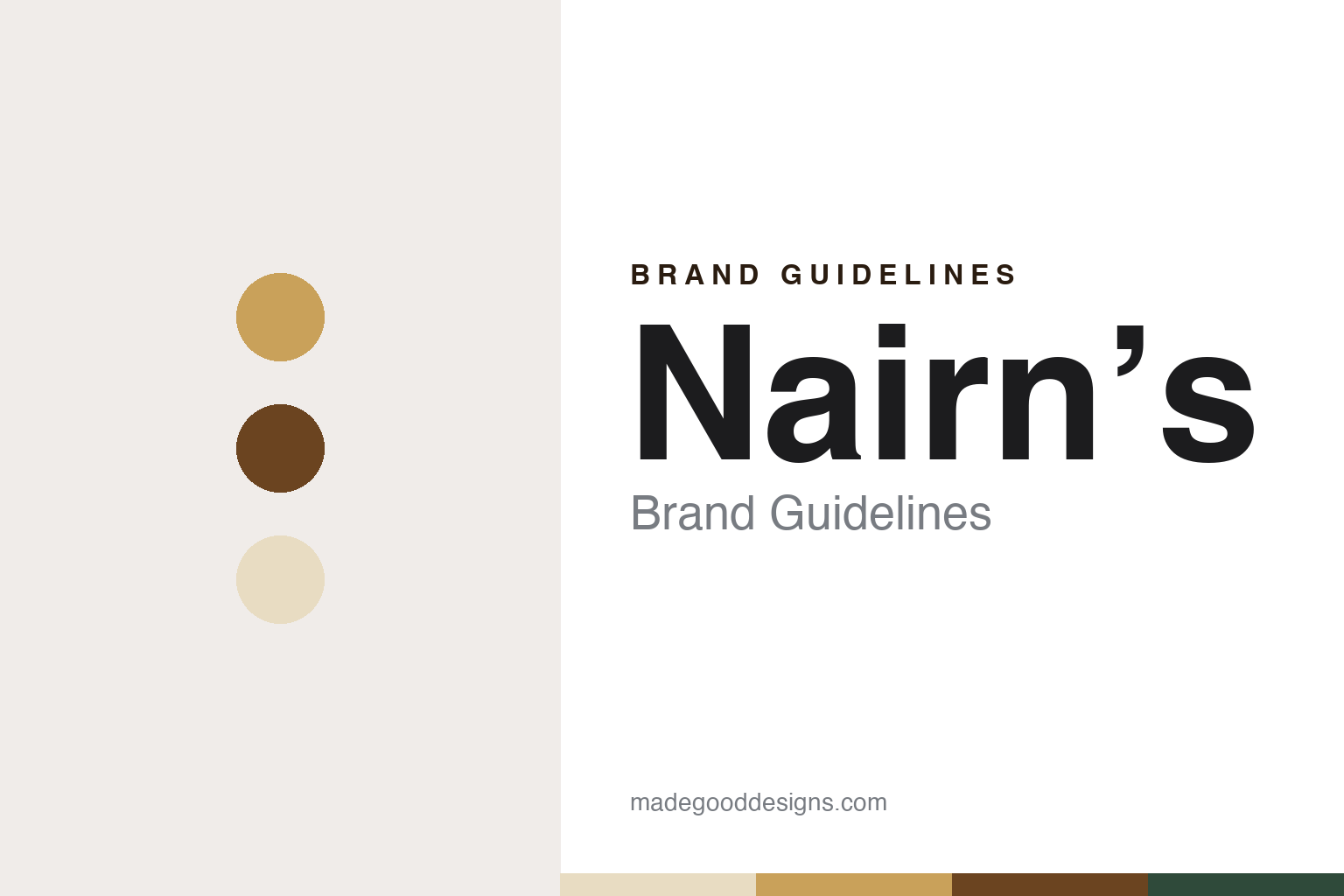
Two constants: a Nairn’s oat gold, toasted brown and green palette and a warm bakery serif register. Abstract homage — not a Nairn’s product or mark; no pack, logo or wordmark is reproduced.
Strathaven to Rutherglen
A family bakery in Lanarkshire.
Nairn’s dates itself to 1896. The company says it has been baking with oats “since 1896 when John and Sarah Nairn first opened their bakery in Strathaven, Lanarkshire,” a market town south of Glasgow. The local history group the Rutherglen Heritage Society, in its history of oatcake making in the town, gives the same start: “Nairn’s Oatcakes started business in 1896 when John and Sarah Nairn opened their first bakery in Strathaven.” We found no independent record from the 1890s itself, so the founding year rests on those two accounts.
The business did not stay in Strathaven. According to the Rutherglen Heritage Society, it moved to Rutherglen, on the south-eastern edge of Glasgow, where it set up the Cathkin Bakery on Cathcart Road. The society says the firm grew over the years, with the Nairns’ son Robert taking over the running of it and, in turn, his son Ian assuming control — three generations of one family at the head of the bakery.
Rutherglen was an oatcake town. The heritage society’s page names Nairn’s alongside Paterson’s and McMurdo’s among the bakeries a local man remembered passing on his way to school in the 1950s, and it reproduces a 1953 map showing John Nairn’s Cathkin bakery. It quotes William Ross Shearer’s Rutherglen Lore of 1922 on the town: “To-day the aroma of oat-cakes alone dominates the atmosphere at all seasons of the year.” The same page illustrates old Nairn’s and Paterson’s oatcake tins from the town’s bakeries.
English Wikipedia’s article on Rutherglen, citing the Daily Record in 2015 and the heritage society, also records the Cathkin Bakery as “the production facility for Nairn’s (oatcakes and biscuits) until 1978.”
Colour
Simmers, Livingston and Edinburgh.
The family era in Rutherglen ended in 1978. The Rutherglen Heritage Society says the Cathkin Bakery closed that year and that, “like Paterson’s a few years earlier, production moved to Livingston, under the ownership of Simmers” — the Edinburgh biscuit baker whose name English Wikipedia also gives as a commercial maker of Abernethy biscuits. We found no dated press report of the terms of that change of ownership in the sources we could reach.
The company register fills in part of the later story. The UK’s Companies House shows that the business now trading as Nairn’s Oatcakes Ltd was incorporated in Scotland in May 1996 and was called Simmers of Edinburgh Limited from June 1996 until May 2007, when it took the Nairn’s name; the company’s own Modern Slavery Statement says it was “formed in June 1996.” The register lists its business as the manufacture of rusks and biscuits, and records a Scottish holding company, Peffermill Holdings Limited, as holding 75 per cent or more of its shares, notified in April 2016.
Where the oatcakes are made today is stated by the company. Its website says that “at our two Edinburgh bakeries we have a devoted team, sometimes spanning generations of local families,” and its Modern Slavery Statement for the year to May 2024 says it operates “across two factory sites.” Its page on oats says “Nairn’s oatcakes are made in Edinburgh, where they’ve been made for over 80 years” — a line that sits awkwardly with the heritage society’s and Wikipedia’s accounts of production in Rutherglen until 1978, so we give both.
The statement describes the firm as “a leading UK manufacturer of oat-based products under the Nairn’s brand and retailer’s own brands,” and is signed by its managing director, Colin Dingwall.
Typography
Crispbreads, crackers and oatcakes.
The seven brands in this group all make crispbreads, crackers or oatcakes — the dry, savoury side of the biscuit aisle — and they come from four countries: Ryvita, Peter’s Yard and Carr’s from England, Nairn’s from Scotland, Wasa and Leksands from Sweden, and Finn Crisp from Finland. Brands of this kind sit at many different points in the trade, from long-established supermarket staples to younger names sold through delicatessens, and a single maker can bake under its own name and for other people’s labels at the same time.
A cracker brand’s identity is usually carried less by the product itself, which can look much the same from one maker to the next, than by a grain, a pack and the story told about where it began. That makes the questions behind each name worth asking plainly: who started it, who owns it now, and where its crispbreads, crackers or oatcakes are actually baked today.
Each guide separates what independent sources record from what the company says about itself — its founding story, its owners over time and where it bakes — and marks plainly what rests only on the company’s own word.
Aa
A warm bakery serif for a brand whose oatcakes carry a golden edge. (Specimen set in Fraunces, a serif STAND-IN; NOT the Nairn’s logo.)
Nairn’s
Oats first, and a golden halo.
Nairn’s builds its story around one grain. The company says oats are “the number one ingredient in everything we make,” that it sources the majority of them from farmers in the Scottish Borders, and that “for over 40 years” it has trusted the milling to John Hogarth Ltd of Kelso. It says oats can be milled in five textures, which it uses for the different crunch of its rough and fine-milled oatcakes, and that the way it mixes its dough “remains a closely guarded secret unchanged for decades.”
It also has its own word for the look of the product. “If many a Nairn’s oatcake has already passed your lips you may have noticed the lovely golden colour around the outside,” the company writes. “We call this the halo.” That toasted edge is the starting point for the palette on this page.
The range now goes well beyond the plain oatcake. The company’s site lists oatcakes, oat biscuits, biscuit breaks, flatbreads, wholegrain crackers, cereals and snacks, with gluten-free versions of many of them; it says its gluten-free oats come from specialist British farms that grow them separately from wheat and barley. The company describes itself as “the largest producer of oatcakes in the UK” and “one of the UK’s leading and most trusted gluten free brands,” and says its range is exported to over 30 countries, with country pages for markets including Australia, Canada, the Netherlands, New Zealand, South Africa, the UAE and the USA. Those are the company’s own descriptions, and we did not find independent market figures to test them.
On recognition, the company says its organic Super Seeded Oatcakes are certified by the Soil Association and have won one of that body’s BOOM (Best of Organic Market) awards; it does not give the year on that page. It also says all the palm oil it uses is certified by the Roundtable on Sustainable Palm Oil. Its current website credits The Lane Agency with the site’s design; we found no published record of who drew the Nairn’s wordmark or its packs, and no official typeface or colour values.
For a design guide, Nairn’s shows how a brand can carry a family bakery’s name through a change of owner, a change of town and a change of company name, and still lead with the founders’ 1896 bakery. Compare Walker’s Shortbread, another Scottish family bakery name, and Tunnock’s, the Uddingston baker. For this guide we use oat gold, toasted brown and a Borders green with a serif, an unofficial interpretation; no product or logo is reproduced.
Explore & save
Keep Nairn’s’s identity on hand — save it to a board in the Made Good inspiration library.
Nairn’s identity set
Pin the Nairn’s oat gold, toasted brown and green palette and the warm bakery serif register to your own board.