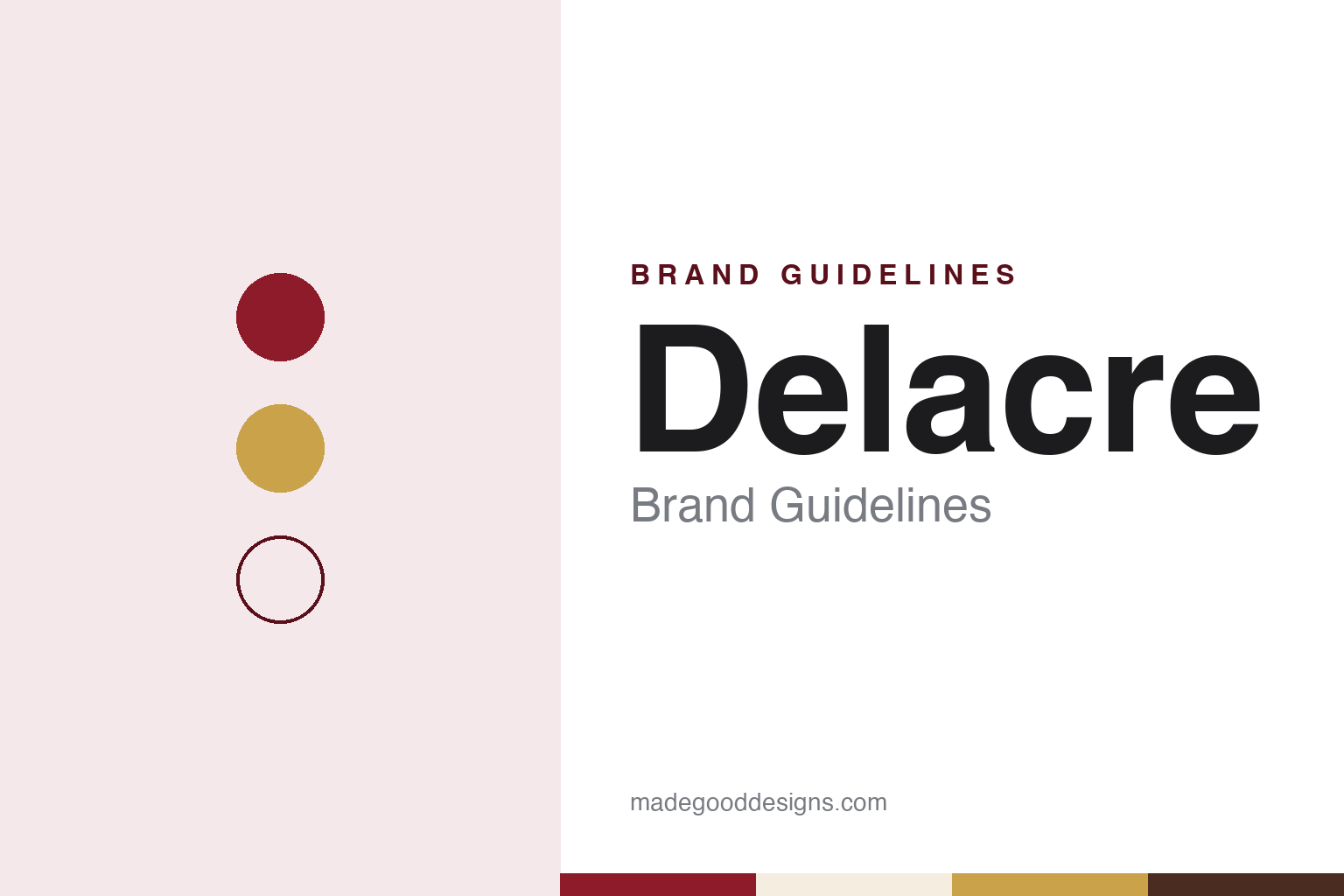
Delacre Brand Guidelines
From a Brussels pharmacy to the royal biscuit tin.
Aa
Two constants: a red, gold and cocoa palette and a court serif register. Abstract homage — not a Delacre product or mark; no biscuit, tin, logo or wrapper is reproduced.
The pharmacy
Chocolate as medicine, then as a treat.
Delacre began in a pharmacy. Charles Delacre, a pharmacist — from Dunkirk, French Wikipedia and the Lille edition of 20 Minutes say — set up his dispensary in Brussels near the Royal Palace, the company says, at a time when chocolate was sold as a fortifying remedy. French Wikipedia dates his first chocolate sales to 1870; Dutch Wikipedia gives his dates as 1826–1907. As chocolate came to be seen as a treat, he opened a chocolate shop near the Grand-Place, and French Wikipedia says that in 1873 he set up a factory and registered the Delacre name for chocolate bars; Dutch Wikipedia places the move of his chocolate works to Ixelles in 1872.
Royal patronage came early. In 1879 Delacre received the title of Supplier to the Court of Belgium, and the company says the title still appears on its packaging; it now gives 1879 as its founding year. In 1880, the company says, Charles built a new chocolate factory at Vilvoorde, north of Brussels, after the workshops in Ixelles could no longer keep up.
Biscuits followed. The company says the first Delacre biscuit, the Pacha, went on sale in 1891, a date French Wikipedia ties to the Vilvoorde works and to fine biscuits coated in chocolate, meant to accompany tea or coffee. In 1906, French Wikipedia says, citing Le Soir, Charles passed the pharmacy to his elder son, Ambroise, and the biscuit business to his younger son, Pierre. The company says the 1914–18 occupation forced it to cut production for the first time, and that after the war it turned exclusively to fine biscuits.
Colour
Cigarettes Russes and royal tins.
Delacre’s best-known biscuits date from that turn. The company names the Cigarettes Russes, the Suprêmes Sablés and the Biarritz among the fine biscuits created in this period, and in April 2025 it marked eighty years of the Cigarette Russe — the rolled biscuit it calls one of its most iconic — with a speculoos-flavoured version, describing its heritage as “franco-belge.” French Wikipedia lists Délichoc, Cigarette Russe, Biarritz and Marquisettes as its main products.
The packaging carries the royal connection. Dutch Wikipedia says Delacre is known for its biscuit tins decorated with pictures of the Belgian royal family, and the company says the “Supplier to the Court” title is printed on its current packs. The brand’s look has a long history in print: an 1896 poster for Delacre biscuits and chocolate by the Art Nouveau artist Henri Privat-Livemont illustrates French Wikipedia’s article.
More recently, the company says it modernised its visual identity to make the brand warmer and more contemporary while keeping its heritage, and added a festive range, Etoile, for Christmas and Easter, and a line called La Biscuiterie, inspired by French patisserie. It also runs what it calls the Fine Lab, an innovation centre in Brussels.
Where the biscuits are made has changed over time. French Wikipedia says Delacre opened factories at Lambermont, near Verviers, and at Nieppe, in northern France, in the second half of the twentieth century; Dutch Wikipedia names the same two plants. In November 2011 20 Minutes reported that the Nieppe factory, then fifty years old, employed about 310 people, produced about 12,000 tonnes of biscuits a year and was the only plant making the Cigarette Russe. The company’s English pages now say Delacre biscuits are made in three factories; its French pages say both two, in France and Belgium, and three.
Typography
Biscuits and ownership.
The seven brands in this group all make biscuits, and they come from four countries: Kambly from Switzerland, Delacre from Belgium, Lambertz and Griesson from Germany, Lazzaroni and Matilde Vicenzi from Italy, and De Beukelaer, whose story runs through Belgium and Germany. Biscuit makers in general sit at many different points in the trade, from family bakeries that still carry a founder’s name to large groups that own several brands and plants, and a single name can move from one kind of owner to another over a century or more.
A biscuit brand’s identity is usually carried by a tin, a wrapper and a recipe it promises has not changed, while the company behind the name may have been sold, merged or renamed more than once, and the biscuits themselves may be baked a long way from the town on the packet. That makes the questions behind each name worth asking plainly: who started it, who owns it now, and where its biscuits are actually made.
Each guide separates what independent sources record from what the company says about itself — its founding story, its owners over time, its signature products and where they are baked — and marks plainly what rests only on the company’s own word.
Aa
A court serif — for a house that has carried a royal warrant since 1879. (Specimen set in Playfair Display, a serif STAND-IN; NOT the Delacre logo.)
Delacre
From Campbell to United Biscuits to a Ferrero-related holding.
Delacre has changed hands several times. Dutch Wikipedia says the company built a presence in North America in partnership with Pepperidge Farm, and that after Campbell Soup bought Pepperidge Farm, Campbell acquired a majority stake in Delacre in 1961. In 1998 Delacre passed to United Biscuits, the British group that also owned the Dutch maker Verkade, according to French and Dutch Wikipedia. In 2014 United Biscuits, Delacre included, was bought by Turkey’s Yıldız Holding for about $2.6 billion, French Wikipedia says.
In 2016 Delacre left Yıldız. French Wikipedia, citing Les Échos of 28 October 2016, says the Ferrero group bought it for an undisclosed sum, and De Morgen reported in December 2016 that the biscuits were “in Italian hands.” The company’s own wording is more precise: it says that in December 2016 Delacre was acquired by CTH Invest, “a Ferrero-related Belgian holding company.” It says Delacre later joined Kelsen Group, another CTH Invest acquisition, to form the Fine Biscuits Company Group; that group’s careers site says it was established in 2020, brings together Kelsen, Biscuits Delacre and the Fine Lab, describes itself as part of “the Ferrero ecosystem” and counts more than 1,000 employees in eight countries, with brands including the Danish butter cookies Royal Dansk and Kjeldsens.
French Wikipedia puts Delacre’s headquarters at Grand-Bigard, near Brussels, with 335 employees in Belgium, and its revenue at €128.4 million in 2011, citing La Libre Belgique. The company says its biscuits are sold in more than thirty countries.
For a design guide, Delacre shows how a royal warrant can become a brand’s most durable graphic asset. Compare Lotus Biscoff, another Belgian biscuit, and Verkade, Delacre’s one-time stablemate at United Biscuits. For this guide we use red, gold, cocoa and cream with a serif, an unofficial interpretation; no product or logo is reproduced.
Explore & save
Keep Delacre’s identity on hand — save it to a board in the Made Good inspiration library.
Delacre identity set
Pin the Delacre red, gold and cocoa palette and the court serif register to your own board.