Karen Volf Brand Guidelines
The Hellerup baker whose name became Denmark’s biscuit tin.
Aa
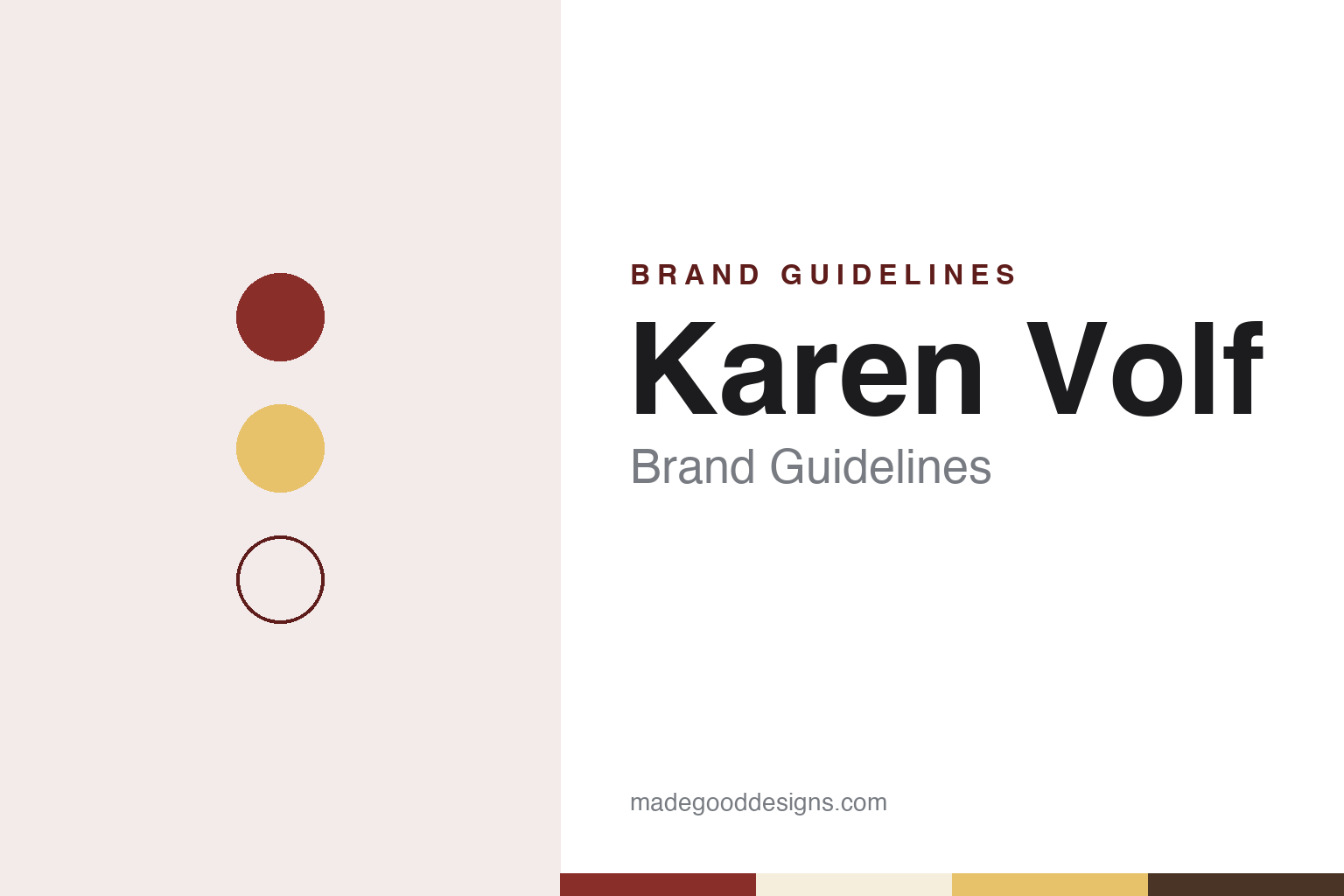
Two constants: a Karen Volf red, crumb and cream palette and a bakery serif register. Abstract homage — not a Karen Volf product or mark; no pack, logo or tin is reproduced.
A shop on Strandvejen
A farmer’s daughter, a milk trader and a counter in Hellerup.
Karen Volf is one of the few Danish food brands named after a real woman who ran the business. Karen Kirstine Volf, born Hansen in 1864, was a farmer’s daughter from Truelstrup, between Roskilde and Ringsted, according to Danish Wikipedia and the brand’s own timeline. The brand’s site says she trained in housekeeping at Ledreborg and worked as a head cook in Copenhagen, including at the Casino theatre, before meeting the milk trader Christen Adolf Wolff.
In 1890, aged 26, she opened a shop on Strandvejen in Hellerup, just north of Copenhagen. The company says the couple started with 800 kroner and sold milk, bread and, as something new, the sand cakes and honey cakes that Karen baked herself; they married in Gentofte Church that July. English Wikipedia notes that a woman setting up a bakery business there was unusual at the time. The cakes sold well, and the company says that by 1893 the business had moved to larger premises on Strandvejen and added a konditori, a café-bakery, at a time when calling on friends for coffee and cake had become fashionable.
Delivery was part of the story from early on. Around 1900, the brand says, the konditori had its own cake car with advertising on its sides, and customers could telephone an order and have it brought to the door. English Wikipedia describes the car deliveries as the step that let the business serve the whole of Copenhagen. Danish Wikipedia adds that the house made sand and honey cakes on a factory scale and soon added small pastries and waffles.
Colour
Kildegårdsvej, a family firm and a national market.
The family name changed spelling along the way. The brand’s timeline says that from 1916 the couple wrote Volf with a V rather than Wolff with a W, and the old spelling survives in the first company name that Danish Wikipedia records, Chr. A. Wolffs Biscuit-Fabrik. Sources differ slightly on the next move: the company dates a new konditori on the corner of Kildegårdsvej, opened with her son Holger, to 1917, while both Wikipedias place a purpose-built factory there around 1924. Either way, the Kildegårdsvej site, later Kildegårds Plads, became the base for larger-scale production, with a tea room beside it. Danish Wikipedia records a visit from Crown Prince Frederik, later Frederik VIII, with princesses and a prince of the royal family.
Two of the couple’s five children, Harriet Volf Jensen and Holger Volf, joined the business, and the company says they later ran it as managing director and co-director. From the 1920s, Danish Wikipedia says, Karen Volf products were sold through retailers across Denmark, and by the time she died in 1946 she had built a nationwide company. Her husband had died in 1935. The brand quotes from her memoir, Mit Livs Historie, on its timeline page.
The Copenhagen buildings have gone. Danish Wikipedia says the Margrethevej factory was demolished in the 1960s and the Kildegårdsvej buildings were cleared for the Helsingør motorway. In 2022, the brand says, Karen Volf was one of ten women honoured in a PostNord stamp series.
Typography
Danish baked goods and the coffee table.
The seven brands in this group all bake biscuits, and they come from two countries: Royal Dansk, Kjeldsens, Karen Volf and Bisca from Denmark, and Jules Destrooper, Dandoy and Vermeiren from Belgium. Biscuit brands in general sit at many different points in the trade, from tins stacked high in a supermarket at Christmas to paper bags filled over the counter of a single shop, and a name that began in one town’s bakery can now be owned by a group based a long way from it.
A biscuit brand’s identity is usually carried by a recipe, a shape and a pack — a tin, a wrapper, a mould pressed into the dough — more than by any single product, and the name on the lid does not always tell you who owns it or where the oven is. That makes the questions behind each name worth asking plainly: who started it, who owns it now, and where its biscuits are actually baked.
Each guide separates what independent sources record from what the company says about itself — its founding story, its owners over time and where its biscuits are made — and marks plainly what rests only on the company’s own word.
Aa
A warm bakery serif — a brand built on a founder’s name. (Specimen set in Playfair Display, a serif STAND-IN; NOT the Karen Volf logo.)
Karen Volf
A founder’s name kept on the pack.
The name outlived the family firm. According to Bisca’s company history, the international group OTA bought the recipe and name rights to Karen Volf in 1956, and in 1967 the Copenhagen wholesaler Poul Spangsberg bought the rights to the mark. Production moved to Stege on the island of Møn in 1968, where the company says it has stayed. Spangsberg’s business became Karen Volf A/S in 1972 and was renamed Bisca A/S in 1997; Danish Wikipedia says Karen Volf continues as the trademark for the company’s cakes and that the brand has no connection to the founder’s heirs.
Ownership has changed twice since. Bisca was part of the Norwegian group Scandza from 2010, and in March 2024 the Danish private equity firm Erhvervsinvest announced that it had acquired Bisca A/S, which the company describes as putting it back in Danish hands. Bisca calls Karen Volf’s kammerjunkere, small crisp biscuits eaten with koldskål, a true summer classic, and says its Møn bakery can make up to 230,000 of them an hour. The brand’s timeline names butter cookies as Karen Volf’s biggest success at home and abroad from the 1980s, and Bisca says it sells its butter cookies abroad under the Bisca name.
The brand also says it stopped using cage eggs at its 125th anniversary in 2015 and launched its first organic biscuits the following year. The brand describes Karen Volf as the founder of Denmark’s first cake factory.
For a design guide, Karen Volf shows how a founder’s own name and story can carry a mass-market biscuit brand more than a century after she ran the shop. Compare the family bakery story of Walker’s Shortbread and the Swiss biscuit house Kambly. For this guide we use deep red, crumb gold, butter cream and cocoa with a serif, an unofficial interpretation; no product or logo is reproduced.
Explore & save
Keep Karen Volf’s identity on hand — save it to a board in the Made Good inspiration library.
Karen Volf identity set
Pin the Karen Volf red, crumb and cream palette and the bakery serif register to your own board.