Duchy Originals Brand Guidelines
The 1990 oaten biscuit brand that became Waitrose Duchy Organic.
Aa
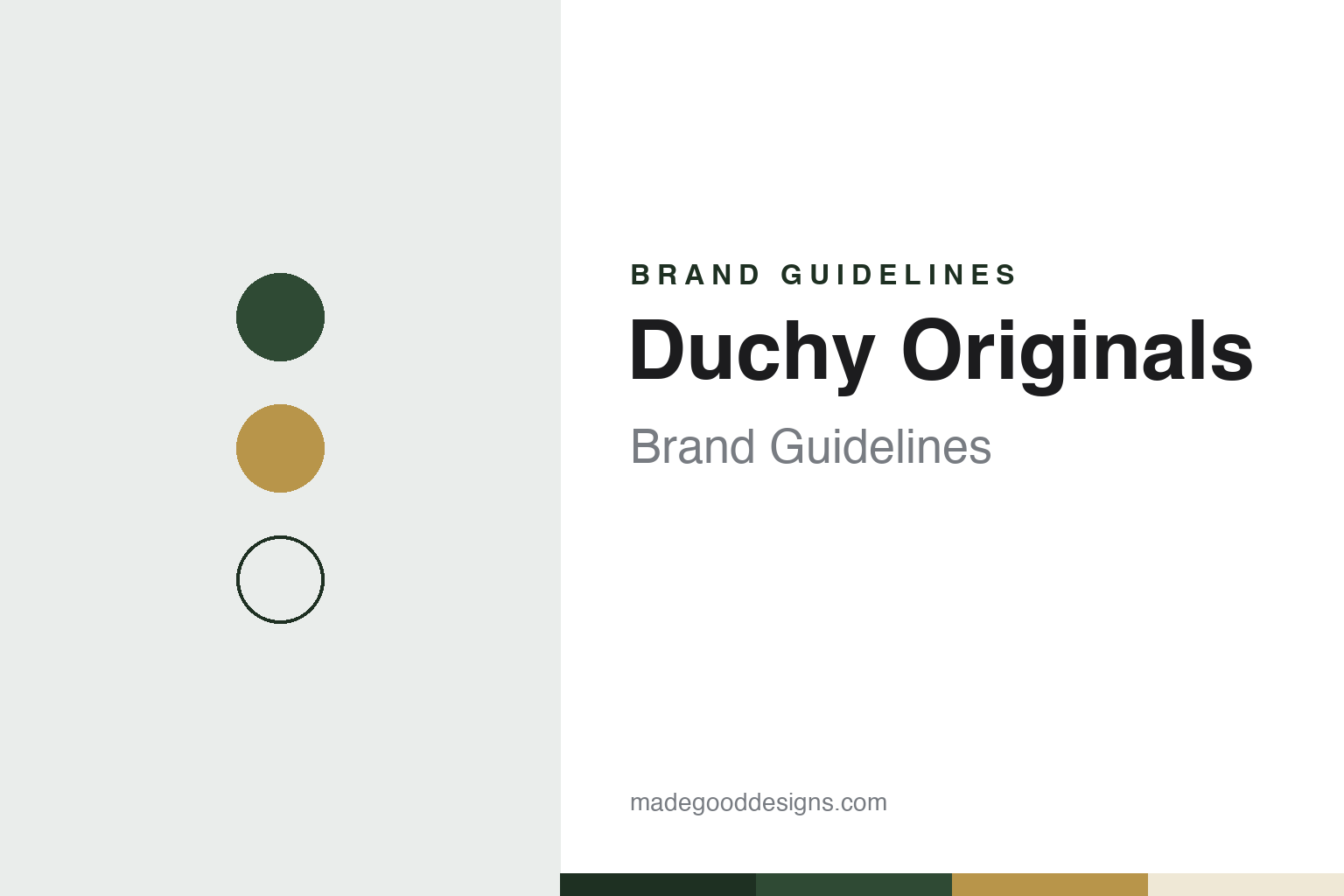
Two constants: an estate green, oat gold and cream palette and a refined serif register. Abstract homage — not a Duchy Originals or Waitrose product or mark; no pack, logo or biscuit is reproduced.
An oaten biscuit from Highgrove
A brand built on licences, not factories.
Duchy Originals was set up in 1990 by Charles, then Prince of Wales and Duke of Cornwall, and took its name from the Duchy of Cornwall estates. English Wikipedia, drawing on Sally Bedell Smith’s 2017 biography, says it was conceived as an outlet for organic food from the Highgrove estate and its Home Farm in Gloucestershire. Its first product was an oaten biscuit: the King Charles III Charitable Fund, which receives the brand’s income, says it was “a biscuit made from wheat and oats grown organically on Home Farm at Highgrove”. The first biscuits were sold through Harrods and Fortnum & Mason, according to the same biography.
From the start the company did not make or sell the goods itself. English Wikipedia says products were made and sold by licensees that paid royalties, and that its one manufacturing venture, a bakery in Launceston, Cornwall, opened in 2006 and was sold in 2009, as Just Food reported in 2010. In the 1990s the range spread to farm shops and independent delicatessens, and in the 2000s to the major supermarkets, with Waitrose its largest customer, The Daily Telegraph reported in 2013.
The King Charles III Charitable Fund, formerly the Prince of Wales’s Charitable Fund, says the first product was created with a “virtuous circle” in mind: a company that would help small farmers find a new market, offer natural, high-quality food and promote farming that protects the soil and the environment. English Wikipedia, again citing Smith, says more than £7 million had been raised for the Prince of Wales’s Charitable Fund by 2008.
Colour
The Waitrose years.
By 2009 the business was losing money. The Daily Telegraph reported in February 2010 that Duchy Originals had an operating loss of £3.3 million on turnover of £2.2 million in 2008–09, and English Wikipedia, citing Smith, says the business was losing around £3 million in 2009. In September 2009 the charitable fund and its trading subsidiary licensed the brand exclusively to Waitrose, the fund says. Waitrose then developed the range that became Waitrose Duchy Organic, which the fund now puts at more than 200 products.
In August 2010 the range was relaunched as Duchy Originals from Waitrose, and it grew from about 200 lines to more than 300, according to Waitrose material cited by English Wikipedia; Smith’s biography says sales doubled in the first three years. By 2013 the products were sold in about 30 countries, including Australia and Japan, The Daily Telegraph reported, and the brand had raised some £11 million for charity by then. In the summer of 2015 it was renamed Waitrose Duchy Organic, the name it carries today.
The latest change came in 2024, when, the King Charles III Charitable Fund says, ownership of the brand passed to Waitrose “in line with the original 2009 agreement”. The fund, formerly the Prince of Wales’s Charitable Fund, says its trading company, KCCF Trading Limited, still receives royalty income from sales and gift-aids all of its profits to the fund. James Bailey, an executive director of Waitrose, is quoted by the fund recalling that the first Duchy Organic oaten biscuits were made from wheat and oats grown organically on the Highgrove estate.
Typography
Oaten biscuits, licences and royalties.
The seven brands in this group all make biscuits, and they come from three parts of Britain: Border Biscuits, Paterson’s, Island Bakery and Crawford’s from Scotland, Duchy Originals and Fudges from England, and Burton’s from Britain more widely. Biscuit brands in general sit at many different points in the trade, from everyday packets on a supermarket shelf to small-batch boxes sold through delicatessens, and a single company can work at both ends at once.
A biscuit brand’s identity is usually carried less by a single mark than by a recipe, a wrapper and the familiar shape of the biscuit inside, and the name on the front may have outlived the bakery, the family or the town that first made it. That makes the questions behind each name worth asking plainly: who started it, who owns it now, which larger groups it has passed through, and where its biscuits are actually baked today.
Each guide separates what independent sources record from what the company says about itself — its founding story, its owners over time, its recipes and where its biscuits are made — and marks plainly what rests only on the company’s own word.
Aa
A refined serif — an estate brand’s register. (Specimen set in Cormorant Garamond, a serif STAND-IN; NOT the Duchy Originals or Waitrose logo.)
Duchy Originals
Good food, good farming, good causes.
The brand’s long-running tagline, as recorded in English Wikipedia, was “Good Food, Good Farming, Good Causes”. Over time the name was stretched well beyond biscuits — English Wikipedia says the licensed range at various points took in products such as mineral water and garden tools — with sub-brands including Duchy Selections and Duchy Collections, and in Canada proceeds went to Prince’s Charities Canada, which English Wikipedia says was receiving more than C$1 million a year by 2012. In 2013 the brand set up the Duchy Future Farming programme with the Soil Association, English Wikipedia says.
The farm behind the first biscuit changed too. Yahoo News UK reported in August 2020 that the lease on Home Farm at Highgrove, which had been leased from the Duchy of Cornwall since the mid-1980s, was not being renewed, and that the new tenant would continue the relationship with the brand.
The financial record is patchy but public. The Daily Telegraph put turnover at around £1 million at the end of the 1990s and reported profits of £2.8 million in 2013, while English Wikipedia, citing Companies House accounts, gives turnover of £4.86 million in 2006–07; the Financial Times reported a profit of £3.6 million in 2021.
In the sources we checked we found no published brand guidelines or official colour values for Duchy Originals or Waitrose Duchy Organic, and no documented account of who designed the original packaging. The Financial Times reported in 2022 that the brand operates separately from the Duchy of Cornwall estate, and English Wikipedia records that its only venture into manufacturing, a pastry bakery at Launceston in Cornwall opened in 2006, was sold in 2009, citing Just Food.
For a design guide, Duchy Originals shows how a brand can be built entirely on licensing, with its name and its story doing the work while other companies make and sell the products. Compare Carr’s, the Carlisle maker of table water crackers, and Nairn’s, the Scottish oatcake baker. For this guide we use an estate green, an oat gold and a cream with a serif, an unofficial interpretation; no product or logo is reproduced.
Explore & save
Keep Duchy Originals’s identity on hand — save it to a board in the Made Good inspiration library.
Duchy Originals identity set
Pin the Duchy Originals estate green, oat gold and cream palette and the refined serif register to your own board.