Carr’s Brand Guidelines
The Carlisle biscuit maker behind Table Water crackers.
Aa
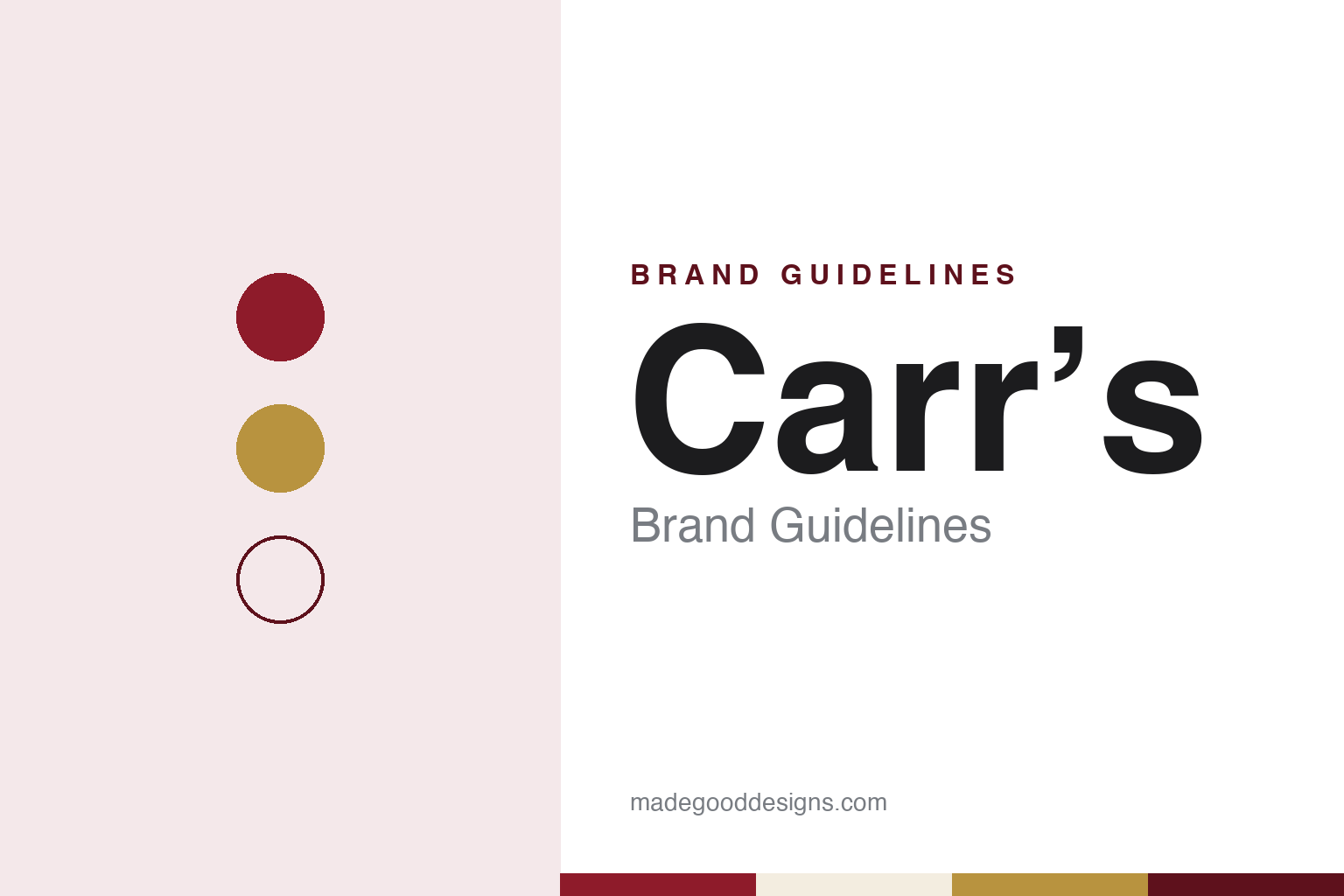
Two constants: a Carr’s red, cream and gold palette and a Heritage serif register. Abstract homage — not a Carr’s product or mark; no pack, crest or wordmark is reproduced.
Carr of Carlisle
A grocer’s son from Kendal, a mill and a bakery.
Carr’s was founded in 1831 in Carlisle, in what was then Cumberland, by Jonathan Dodgson Carr. A company history published by Carr’s Milling Industries describes him as the son of a Quaker grocer who walked from his home in Kendal to Carlisle determined to succeed, and as a vigorous campaigner against slavery and the Corn Laws. It says he began milling flour in 1836 to supply his biscuit factory, and credits him with being the first to recognise the value of high-quality Canadian wheat — a claim made by the milling business that grew from his mill, not an independent finding. Wikipedia adds, citing the BBC, that Carr protested against the Corn Laws because their tariffs on imported wheat kept bread expensive even in times of famine.
That combination is the core of the Carr’s story. Wikipedia, citing a 1997 article in The Independent, describes the business as both a mill and a bakery — an early example of vertical integration — that produced bread by night and biscuits by day. The biscuits were loosely based on the dry biscuits sailors took on long voyages; packed in tins, they stayed crisp and could travel by canal and railway despite their fragility.
Growth was rapid. The firm received a royal warrant in 1841, according to a history page once published by United Biscuits, and the Carr’s Milling history says that within 15 years Carr’s had become one of the largest baking businesses in Britain. Carr died in 1884; by 1885, according to Grace’s Guide, the company was making 128 varieties of biscuit and employed about 1,000 workers.
Colour
From family firm to United Biscuits and pladis.
The company was registered as Carr and Co. Ltd. in 1894 and became a private company again in 1908. In the same year, the Carr’s Milling history records, Carrs Flour Mills Limited was incorporated and demerged from Carr & Co. when it acquired the flour-milling assets. Biscuits and flour then went separate ways, each keeping the Carr name, and Wikipedia notes that the biscuit side remained a family business even though Jonathan’s four sons were less skilled at managing it.
The biscuit company stayed in family hands until 1964, when it became part of Cavenham Foods. In 1972 Cavenham sold it to United Biscuits, together with its other biscuit brands Wright’s and Kemps, for a reported $10 million. United Biscuits was in turn sold by its private equity owners to the Turkish group Yıldız Holding in 2014, and in 2016 its brands, Carr’s among them, were combined with Yıldız’s other snack brands to form pladis.
The brand is split by territory. Wikipedia says Carr’s products are marketed in the United States by Kellogg’s, and an archived 2014 version of the American Carr’s website carried a United Biscuits (UK) notice alongside links to Kellogg’s and Keebler. That American site described the 1841 warrant as Queen Victoria’s, granted only ten years after the bakery opened.
Production has stayed in Carlisle. The Caldewgate factory is officially known as a McVitie’s site but locally still called Carr’s, Wikipedia says. It has been hit by floods twice: in 2005 it lost two months’ production, and on 6 December 2015 floodwater more than five feet deep damaged its brick ovens, leading to shortages of Carr’s water biscuits in shops, The Independent reported in January 2016.
Typography
Crispbread and crackers.
The seven brands in this group all make crispbreads, crackers or oatcakes — the dry, savoury side of the biscuit aisle — and they come from four countries: Ryvita, Peter’s Yard and Carr’s from England, Nairn’s from Scotland, Wasa and Leksands from Sweden, and Finn Crisp from Finland. Brands of this kind sit at many different points in the trade, from long-established supermarket staples to younger names sold through delicatessens, and a single maker can bake under its own name and for other people’s labels at the same time.
A cracker brand’s identity is usually carried less by the product itself, which can look much the same from one maker to the next, than by a grain, a pack and the story told about where it began. That makes the questions behind each name worth asking plainly: who started it, who owns it now, and where its crispbreads, crackers or oatcakes are actually baked today.
Each guide separates what independent sources record from what the company says about itself — its founding story, its owners over time and where it bakes — and marks plainly what rests only on the company’s own word.
Aa
A Heritage serif for a biscuit maker founded in 1831. (Specimen set in Libre Caslon Text, a serif STAND-IN; NOT the Carr’s logo.)
Carr’s
A crest swapped on the pack.
The most documented design change on a Carr’s pack concerns its crest. In March 2012 the Cumberland News reported that Carr’s Table Water biscuits had lost their royal warrant, a change attributed to changing tastes in the royal households. According to Wikipedia, Carr’s then licensed the coat of arms of the City of Carlisle to replace the royal arms on its packaging — swapping one heraldic seal of approval for a local one that ties the product to its home city. Carr’s Table Water biscuits had long been advertised nationally; a 1922 advertisement for them in The Guardian is reproduced on Wikipedia.
One naming trap matters for anyone researching the brand. Carr’s Group PLC, still based in Carlisle, is not the biscuit maker. It is the descendant of Carrs Flour Mills, which became Carrs Milling Industries in 1950, listed on the London Stock Exchange in 1972 and moved into agricultural supplies and engineering. Its flour-milling division was sold to Whitworths in 2016, according to Wikipedia. The shared name reflects the 1908 split, not common ownership today.
No official colour values or typeface for the Carr’s brand are published, so the palette and type here are our own reading.
For a design guide, Carr’s shows how a 19th-century biscuit name can keep its place of origin at the centre of its identity through two centuries and several owners. Compare McVitie’s, its stablemate at United Biscuits and pladis, and Jacob’s, another cracker maker whose brand is split between owners. For this guide we use a deep red, cream and a crest gold with a serif, an unofficial interpretation; no product or logo is reproduced.
Explore & save
Keep Carr’s’s identity on hand — save it to a board in the Made Good inspiration library.
Carr’s identity set
Pin the Carr’s red, cream and gold palette and the Heritage serif register to your own board.