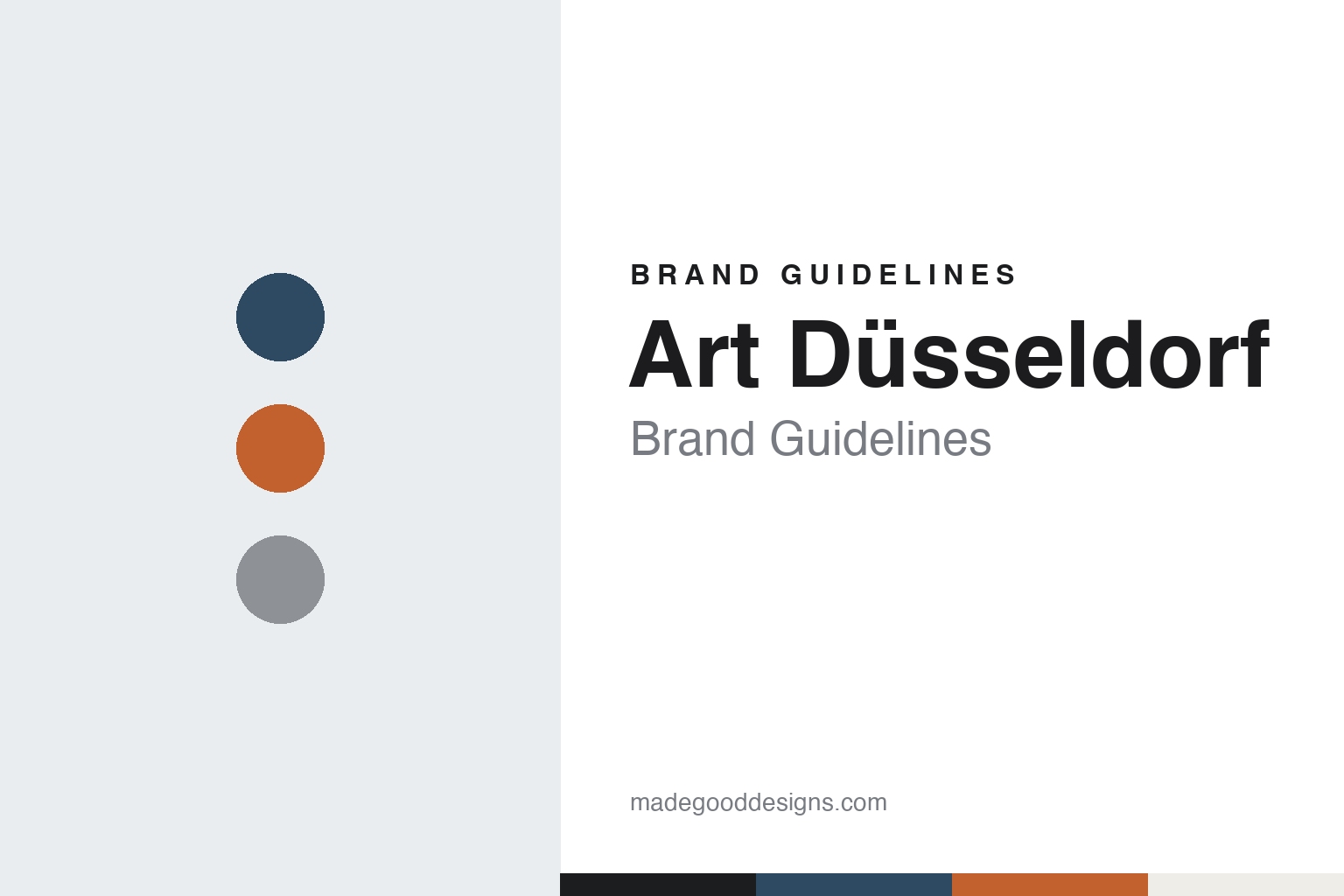
Art Düsseldorf Brand Guidelines
The 2017 fair in the forge halls of Areal Böhler.
Aa
Two constants: a forge grey, Rhine blue and furnace orange palette of our own and an industrial grotesque sans register. Abstract homage — not an Art Düsseldorf asset; no logo, campaign image or artwork is reproduced.
From Cologne to Düsseldorf
Two Cologne fair organisers start again down the Rhine.
Art Düsseldorf opened in November 2017. The Art Newspaper reported on 9 February 2017 that the new fair would run from 16 to 19 November that year, organised by art.fair International, the company of Andreas Lohaus and Walter Gehlen, which had run a contemporary art fair in Cologne for the previous 14 years. Writing in November 2019, the same paper said the pair had organised Art Fair Cologne each September from 2003 to 2016, a smaller autumn event and a different fair from Art Cologne, which takes place in April. German Wikipedia gives the same 2003–2016 dates for their Cologne fair.
The fair began with a Swiss partner. In February 2017, The Art Newspaper reported, the Basel-based MCH Group, owner of Art Basel, acquired a 25.1 per cent stake in art.fair International, while Lohaus and Gehlen kept 74.9 per cent; MCH already held a majority stake in India Art Fair at the time. Quoted in the same report, the founders said that Cologne and Düsseldorf had moved perceptibly closer to one another in recent years, especially in art.
Gehlen returned to that idea two years later. In the November 2019 review he said both cities deserved a yearly event that spotlights their history in contemporary art, and that it made sense for the two to be complementary. The paper set the fair in a city it associated with the Zero movement, founded there in 1957, and with the Düsseldorf School of Photography.
The company is still based in Cologne. The fair’s website names art.fair International GmbH, with an office in Cologne, as its operator, and German Wikipedia says Gehlen has been sole managing director and director of the fair since 2018. The website names him as director today, alongside an artistic director who shapes the curatorial themes of each edition.
Colour
Two steel halls, a set of sections and a spring date.
The venue has stayed the same. Art Düsseldorf is held in the Areal Böhler, which German Wikipedia describes as the disused forge halls of a former Böhler steelworks that closed in the early 2000s, a site now used by start-ups, restaurants, leisure businesses and trade fairs. Reviewing the third edition, The Art Newspaper described exhibitors showing in wide, fluid aisles under an industrial glass-and-steel roof. The fair itself describes two halls with about 8,000 square metres of floor space and daylight along their full length.
The first and third editions were held in November. The third ran from 15 to 17 November 2019 with 97 exhibitors from 24 countries, ten more than the year before, The Art Newspaper reported; nearly a third were taking part for the first time and most visitors were German. In that report Gehlen described an even split between German and foreign exhibitors as the right size for a fair held in a crowded autumn calendar. The review named galleries such as Meessen De Clercq of Brussels and 313 Art Project of Seoul, and a platform for young galleries called “Next Generation—rsvp.” It also noted that several private collections and foundations in and around the city, among them the Langen Foundation and the Philara Collection, had used the fair to unveil a joint initiative called Rhineland Independent.
The fair now opens in spring. A Visit Düsseldorf article dated 15 April 2026 said the eighth edition would run from 17 to 19 April 2026 with 119 galleries, 32 of them showing for the first time. It listed the sections Solo, for single-artist presentations; Next, for new and young gallery programmes; and Paper, in its second year with seven galleries, including a solo presentation of the Japanese artist Keiichi Tanaami. Galleries pictured in that article included Esther Schipper and Gebrüder Lehmann.
Themes have become part of the format. The same article said the 2026 edition was framed by three curatorial themes, among them “Cosmic Feel” and “Ōjigi,” the Japanese word for a bow, read there as a gesture of respect between work, space and viewer. In earlier editions such themes had mainly appeared in the Solo & Projects section; in 2026 every exhibiting gallery could submit work for them.
Typography
How mid-sized and city art fairs present themselves.
A mid-sized or city art fair is usually organised in one of two ways. Some are set up by galleries themselves, or by a foundation or association that grew out of them: Melbourne Art Fair says it was founded by a group of galleries in 1988 and is now run by the nonprofit Melbourne Art Foundation. Others are run by an exhibition company or a private organiser: Newsis has described Art Busan, held at BEXCO, as a privately run fair. Either way, the organiser selects the galleries; Art Busan, for example, tightened its screening criteria for its 2025 edition, the Asia Business Daily reported.
The venue becomes part of how a fair is pictured. Convention halls offer open floors that can be divided into booths and rebuilt every year; some fairs instead use a tent, a former industrial site or a historic exhibition building, and several have moved between them. Melbourne Art Fair moved from the Royal Exhibition Building in the Carlton Gardens to a riverside convention centre, while Art Busan has stayed in the same exhibition centre since its first edition.
Each fair also holds a fixed place in the art calendar, usually the same month every year, and counts its editions rather than renaming them. Inside, the floor is divided into named sections: a main gallery section, a section for younger galleries or artists, curated areas for video, installation or design, and a programme of talks. These names are short, often set in capitals, and repeated on floor plans, in printed guides and on the website.
The visual identity follows the same split between what stays and what changes. The name, usually the word “Art” and a city, stays put, sometimes with a shortened form or a version in the local script. The campaign image, the colours of the season and the designed spaces inside the hall change from edition to edition, which lets a fair look new each year and still be recognised.
Aa
An industrial grotesque sans for a fair held in former steelworks halls. (Specimen set in Space Grotesk, a sans STAND-IN; NOT the Art Düsseldorf logo.)
Art Düsseldorf
A Cologne company, a Düsseldorf venue and a change of partners.
The ownership changed in 2019. On 29 May that year The Art Newspaper reported that MCH Group had sold its 25.1 per cent stake, in equal parts, to two fair organisers who had co-founded ArtHK in 2007, Sandy Angus and his business partner, as MCH withdrew from regional art fairs. Angus also bought a further 15 per cent from Gehlen and Lohaus, who kept 59.9 per cent according to that report; the November 2019 review put their share at 60 per cent and Angus’s at 27.5 per cent. The pair’s portfolio at the time included Taipei Dangdai, India Art Fair and Sydney Contemporary, the paper said.
The format has kept growing in sections rather than venues. Galleries could apply to the Main, Solo, Paper and Next sections and to a new one, Next+, for galleries between ten and thirteen years old; a jury of gallery and institution representatives decides on admission, the release said.
The identity leans on the short name and on the venue. The fair’s own pages describe its halls by their steel structure and daylight, and present each edition through its themes and sections rather than through a fixed image.
For a design guide, Art Düsseldorf shows how a young fair can build a clear place in the calendar from one industrial venue, a small set of sections and a yearly list of themes. Compare Art Cologne, the older fair in the neighbouring Rhineland city, and Art Basel, whose owner held a stake in Art Düsseldorf from 2017 to 2019. For this guide we use a forge grey, a Rhine blue and a furnace orange on daylight with a sans, an unofficial interpretation; no product or logo is reproduced.
Explore & save
Keep Art Düsseldorf’s identity on hand — save it to a board in the Made Good inspiration library.
Art Düsseldorf identity set
Pin the Art Düsseldorf forge grey, Rhine blue and furnace orange palette and the industrial grotesque sans register to your own board.
Source & notes
Frequently Asked Questions
What font can I use to match the Art Düsseldorf look?
This guide describes Art Düsseldorf’s type as “An industrial grotesque sans for a fair held in former steelworks halls”. Its type specimen is set in Space Grotesk from Google Fonts as a stand-in; Space Grotesk is not Art Düsseldorf’s own lettering.
What colours are in the Art Düsseldorf palette?
This guide’s Art Düsseldorf palette is Forge grey #4A4D52, Rhine blue #2E4A62, Furnace orange #C2612E, Daylight #EFEDE8 and Ink #1C1D1F. The tones are the guide’s own unofficial interpretation, not official Art Düsseldorf hex codes.
When was Art Düsseldorf founded?
Art Düsseldorf was founded in 2017 (first edition November 2017), in Düsseldorf, Germany.