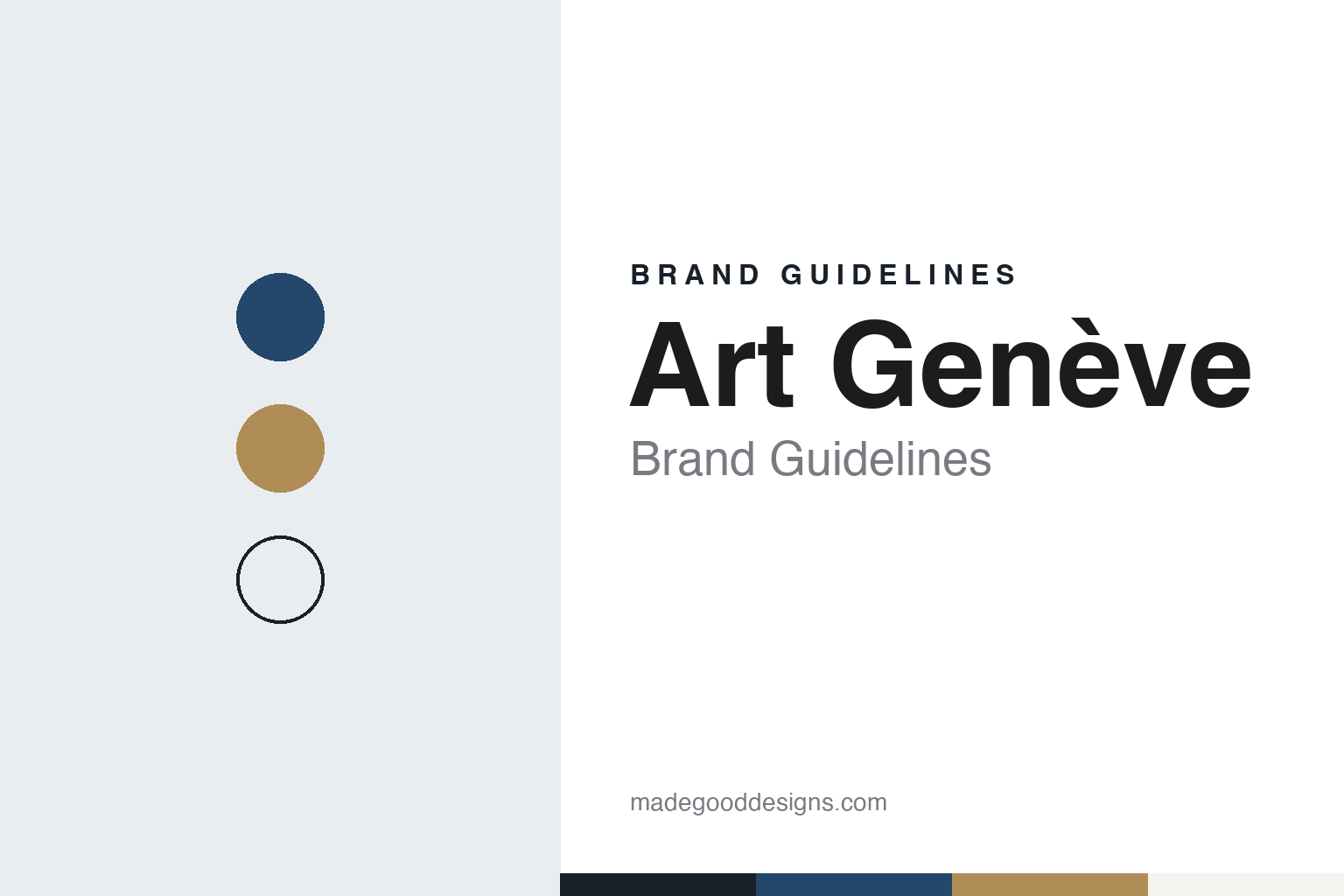
Art Genève Brand Guidelines
Palexpo’s 2012 winter art salon in Geneva.
Aa
Two constants: a lake blue, winter white and brass palette of our own and a salon display serif register. Abstract homage — not an Art Genève asset; no logo, campaign image or artwork is reproduced.
A salon at Palexpo
Not a fair, its founders said, but a salon.
Art Genève began in 2012 at Palexpo, the exhibition and congress centre beside Geneva’s airport. In a press release of 16 August 2023, Palexpo SA said it had conceived and created the fair in 2012, and that since 2016 it has also produced a sister fair, artmonte-carlo, held in early July at the Grimaldi Forum in Monaco. Reporting on the second edition in January 2013, swissinfo.ch described the director, Thomas Hug, as having revived the event together with its president, Simon Lamunière, a former curator of Art Unlimited, the large-format section of Art Basel. One Geneva dealer told the paper she had taken part when the event was still part of the Salon du Livre, the city’s book fair.
From the start it called itself a salon. “This is not a fair, but a salon,” Lamunière told swissinfo.ch in 2013, saying he wanted an intimate atmosphere. The paper described a circular plan with generous passageways, lounge spaces and occasional sculptures, built with partitions that belonged to Art Basel. The second edition had 60 galleries, up from 45 the year before, according to the same report, alongside Geneva’s MAMCO and Centre d’Art Contemporain and the HEAD art school, and a partnership with the Antigel festival brought performances into the programme.
The name has changed its spelling. It was long written in lower case as one word, artgenève, the form Palexpo used in its 2023 release and that swissinfo.ch and Artforum used in 2013 and 2015. By the 14th edition in January 2026, the fair’s website and press releases wrote it as Art Genève, and the website footer names the fair together with Palexpo SA.
Colour
Galleries, institutions and a January date.
The date moved to the start of the year. Le Temps reported in January 2014 that the third edition, from 30 January to 2 February 2014 in Palexpo’s Hall 1, had definitively separated from the Salon du livre et de la presse and now opened the European season of art fairs. It covered 9,000 square metres, about half as much again as in 2013, with 61 selected galleries, two thirds of them from abroad, and spaces for non-commercial organisations such as MAMCO, HEAD Genève and the Kunsthalle Basel. The paper also described an area for art-book publishers, coordinated by Editions Macula, with about a dozen talks, and a monumental work as an emerging tradition.
The mix of selling and showing became its pattern. Writing for Artforum in March 2015 about the fourth edition, a critic noted that Palexpo had housed the fair since its inception, that the number of exhibiting galleries was capped at seventy, and that galleries shared the floor with private collections, local institutions and non-profit spaces; Hug said that mix had been there from the start. In January 2018 Le Temps described a 9-metre inflatable Felix the Cat by the English artist Mark Leckey, lent by the Syz collection, at the top of Palexpo’s escalators; a garden of six sculptures by Max Bill laid out over 2,000 square metres in Hall 2; about 80 exhibitors; and a first partnership with PAD, the Paris art and design fair.
The 2026 edition kept the same structure. The fair’s press release of 9 January 2026 announced the 14th edition for 29 January to 1 February 2026 with 81 galleries and 27 institutional projects, including MAMCO and the Musée d’art et d’histoire, and named exhibitors including Hauser & Wirth, Pace Gallery and Templon; its Solo section had 16 single-artist shows. A music strand, Art Genève Musique, held a performance evening at the Temple de la Servette, a brutalist church opened in 1970. The organiser counted 28,000 visitors at the close, its release of 2 February 2026 said.
Typography
How mid-sized and city art fairs present themselves.
A mid-sized or city art fair is usually organised in one of two ways. Some are set up by galleries themselves, or by a foundation or association that grew out of them: Melbourne Art Fair says it was founded by a group of galleries in 1988 and is now run by the nonprofit Melbourne Art Foundation. Others are run by an exhibition company or a private organiser: Newsis has described Art Busan, held at BEXCO, as a privately run fair. Either way, the organiser selects the galleries; Art Busan, for example, tightened its screening criteria for its 2025 edition, the Asia Business Daily reported.
The venue becomes part of how a fair is pictured. Convention halls offer open floors that can be divided into booths and rebuilt every year; some fairs instead use a tent, a former industrial site or a historic exhibition building, and several have moved between them. Melbourne Art Fair moved from the Royal Exhibition Building in the Carlton Gardens to a riverside convention centre, while Art Busan has stayed in the same exhibition centre since its first edition.
Each fair also holds a fixed place in the art calendar, usually the same month every year, and counts its editions rather than renaming them. Inside, the floor is divided into named sections: a main gallery section, a section for younger galleries or artists, curated areas for video, installation or design, and a programme of talks. These names are short, often set in capitals, and repeated on floor plans, in printed guides and on the website.
The visual identity follows the same split between what stays and what changes. The name, usually the word “Art” and a city, stays put, sometimes with a shortened form or a version in the local script. The campaign image, the colours of the season and the designed spaces inside the hall change from edition to edition, which lets a fair look new each year and still be recognised.
Aa
A salon display serif for a fair that has always called itself a salon. (Specimen set in DM Serif Display, a serif STAND-IN; NOT the Art Genève logo.)
Art Genève
A new director, a narrower selection and the same hall.
The direction changed in 2023. Palexpo SA announced on 16 August 2023 that Charlotte Diwan, who had worked on the organisation of the Geneva and Monaco fairs for six years, had been appointed director of both, with an outside consultant engaged for the 2024 edition and for setting up an orientation committee. The Art Newspaper’s French edition reported in November 2023 that the 2024 edition, from 25 to 28 January at Palexpo and under the new director, was narrowing its selection from some 90 galleries in 2022 to about 70, adding a sector for large-format installations chosen by a guest curator and a section of 13 solo exhibitions.
The organisation is visible on the fair’s own pages. Its website lists a director, a project team, an orientation committee that includes the director of Palexpo SA, and a selection committee made up of gallerists from Geneva, Paris, London and Zurich. It describes about 80 galleries of modern and contemporary art, non-commercial projects by private collections, institutions, schools, art centres and museums, and events held outside the halls. Sections include Sur-Mesure, for monumental works, and Musique, for performances and sound installations, alongside an area for art publishers, a series of Art Talks and a magazine, Art Dispatch, which records projects made for the fair.
The identity rests on the format rather than on a single image: a short city name, a fixed January slot and a floor shared by galleries and museums, presented year after year in the same exhibition centre.
For a design guide, Art Genève shows how a fair can keep the vocabulary of a salon inside a large convention hall. Compare Art Basel, whose former Art Unlimited curator was the salon’s early president, and Liste, another Swiss fair with its own format. For this guide we use a lake blue, a winter white and a brass with a serif, an unofficial interpretation; no product or logo is reproduced.
Explore & save
Keep Art Genève’s identity on hand — save it to a board in the Made Good inspiration library.
Art Genève identity set
Pin the Art Genève lake blue, winter white and brass palette and the salon display serif register to your own board.
Source & notes
Frequently Asked Questions
What font can I use to match the Art Genève look?
This guide describes Art Genève’s type as “A salon display serif for a fair that has always called itself a salon”. Its type specimen is set in DM Serif Display from Google Fonts as a stand-in; DM Serif Display is not Art Genève’s own lettering.
What colours are in the Art Genève palette?
This guide’s Art Genève palette is Lake blue #24476B, Winter white #F5F3EE, Brass #B08D57, Mist #D9DEE4 and Ink #18202A. The tones are the guide’s own unofficial interpretation, not official Art Genève hex codes.
When was Art Genève founded?
Art Genève was founded in 2012 (as artgenève), in Geneva, Switzerland.