CHART Brand Guidelines
The gallery-founded Nordic fair at Charlottenborg since 2013.
Aa
Two constants: a harbour green, stone and red palette and a clean geometric sans register. Abstract homage — not a CHART asset or mark; no logo, campaign image or artwork is reproduced.
Five galleries, one building
A fair founded by the galleries themselves.
CHART was founded in 2013 by five Copenhagen-based galleries, according to ARTnews in 2024, Wallpaper* in September 2023 and the fair’s own website. Autre magazine, writing in September 2022, named the six gallerists behind it, from five galleries, and described the group as cross-generational. Among the founding galleries were V1 Gallery, Andersen’s, Galleri Bo Bjerggaard and Galleri Susanne Ottesen, whose principals still sit on the fair’s board, the fair says. Autre reported that the founders set the fair up as a not-for-profit, with the aim of putting an international spotlight on the region and strengthening the local and Nordic art market.
That structure has stayed. The fair describes itself today as a non-profit foundation with a professional board, and Autre reported that six new board members from the fields of technology, business and culture joined in 2022. In a 2024 interview with ARTnews, the director explained what that means in practice: each year the organisation applies for funding, sponsorship and partnerships to build the fair, while the fees paid by galleries cover the running costs and the staff.
The fair has kept to the same building and the same month. Wallpaper* described CHART in 2023 as an annual event in August, and that year’s edition was its 11th. It is held at Charlottenborg in central Copenhagen, which, as ARTnews and the art magazine Arterritory describe it, houses Kunsthal Charlottenborg, the Royal Danish Academy of Fine Arts and the fair’s own offices. The building has two courtyards, which the fair uses for its free public programme.
One edition took a different shape. In 2020, its eighth edition, the fair was spread across galleries in the Nordic capitals Copenhagen, Helsinki, Oslo, Reykjavík and Stockholm instead of gathering at Charlottenborg, Autre reported, with online talks and a printed reader for audiences who could not travel.
Colour
Rooms instead of booths.
The fair’s most distinctive feature is its floor plan, or the lack of one in the usual sense. Speaking to ARTnews in 2024, Julie Quottrup Silbermann, a former gallery director and art adviser who succeeded Nanna Hjortenberg as director in 2022, said CHART uses the existing rooms of Kunsthal Charlottenborg rather than rows of booths. Some rooms are taken over by one gallery and others by three, she said, so that visitors move between galleries as if through one large exhibition and gallerists share a space with their neighbours.
The galleries come by invitation. Silbermann told ARTnews that the fair selects galleries from across the Nordic countries, while the artists they show come from all over the world; in 2024 there were 36 galleries, from countries including Norway, Sweden, Finland and Iceland. Arterritory wrote in September 2025 that most participants come from Denmark and Sweden, with Norwegian, Finnish and Icelandic galleries as regulars, and that the space at Charlottenborg allows about 36 galleries. Wallpaper* counted 37 galleries, all from the Nordic region, in 2023, and the fair reported 37 again in 2026.
Around the main fair, the programme has grown in named sections. Autre reported that an Experimental section for artist-run and alternative spaces and the CHART Art Book Fair were introduced in 2021. A sculpture exhibition in Tivoli Gardens followed; Wallpaper* described the 2023 show there, with 16 site-specific works, as its second edition. In 2025, Arterritory reported, the fair added CHART Public, an installation filling the Charlottenborg courtyards chosen through an open call to scenographers, designers, architects and artists, as well as Special Projects placed in the foyer, the stairways, the courtyard and the building’s chapel, and a section called Please Notice for galleries with newer approaches.
The 13th edition took place in August 2025, and Arterritory, citing the fair’s office, gave attendance as 25,000 that year against 22,000 the year before. The fair reported 23,000 visitors for its 2026 edition, held from 27 to 30 August 2026.
Typography
How mid-sized and city fairs present themselves.
A mid-sized or city art fair is usually organised in one of two ways. Some are set up by galleries themselves, or by a foundation or association that grew out of them: Melbourne Art Fair says it was founded by a group of galleries in 1988 and is now run by the nonprofit Melbourne Art Foundation. Others are run by an exhibition company or a private organiser: Newsis has described Art Busan, held at BEXCO, as a privately run fair. Either way, the organiser selects the galleries; Art Busan, for example, tightened its screening criteria for its 2025 edition, the Asia Business Daily reported.
The venue becomes part of how a fair is pictured. Convention halls offer open floors that can be divided into booths and rebuilt every year; some fairs instead use a tent, a former industrial site or a historic exhibition building, and several have moved between them. Melbourne Art Fair moved from the Royal Exhibition Building in the Carlton Gardens to a riverside convention centre, while Art Busan has stayed in the same exhibition centre since its first edition.
Each fair also holds a fixed place in the art calendar, usually the same month every year, and counts its editions rather than renaming them. Inside, the floor is divided into named sections: a main gallery section, a section for younger galleries or artists, curated areas for video, installation or design, and a programme of talks. These names are short, often set in capitals, and repeated on floor plans, in printed guides and on the website.
The visual identity follows the same split between what stays and what changes. The name, usually the word “Art” and a city, stays put, sometimes with a shortened form or a version in the local script. The campaign image, the colours of the season and the designed spaces inside the hall change from edition to edition, which lets a fair look new each year and still be recognised.
Aa
A clean geometric sans for a five-letter name set in capitals. (Specimen set in DM Sans, a sans STAND-IN; NOT the CHART logo.)
CHART
A short name in capitals and a courtyard that changes each year.
The name itself is the fixed element. The fair writes it as CHART, in capitals, and uses the same word to label its offshoots: CHART Public, the CHART Book & Print Fair and CHART in Tivoli, as its website lists them. Not every outlet follows the capitals. ARTnews printed CHART in 2024, while Wallpaper* wrote “Chart Art Fair” in 2023, adding the words the short name leaves out.
What changes each year is the setting in the courtyards. The 2025 CHART Public installation, Re-Route, designed by the architect Samuel Charles Barratt, hung hundreds of red-and-white Danish traffic cones from a steel scaffold to form a canopy over the courtyard, Arterritory reported, and was built from materials meant to return to their original use afterwards. Il Sole 24 Ore counted 400 cones.
The public side of the fair is free. Silbermann told ARTnews in 2024 that the courtyard programme of about 15 talks, performances and music on Friday and Saturday nights needs no ticket. The fair also lists the institutions whose representatives came; for 2026 it named more than 80, among them the Louisiana Museum of Modern Art in Denmark.
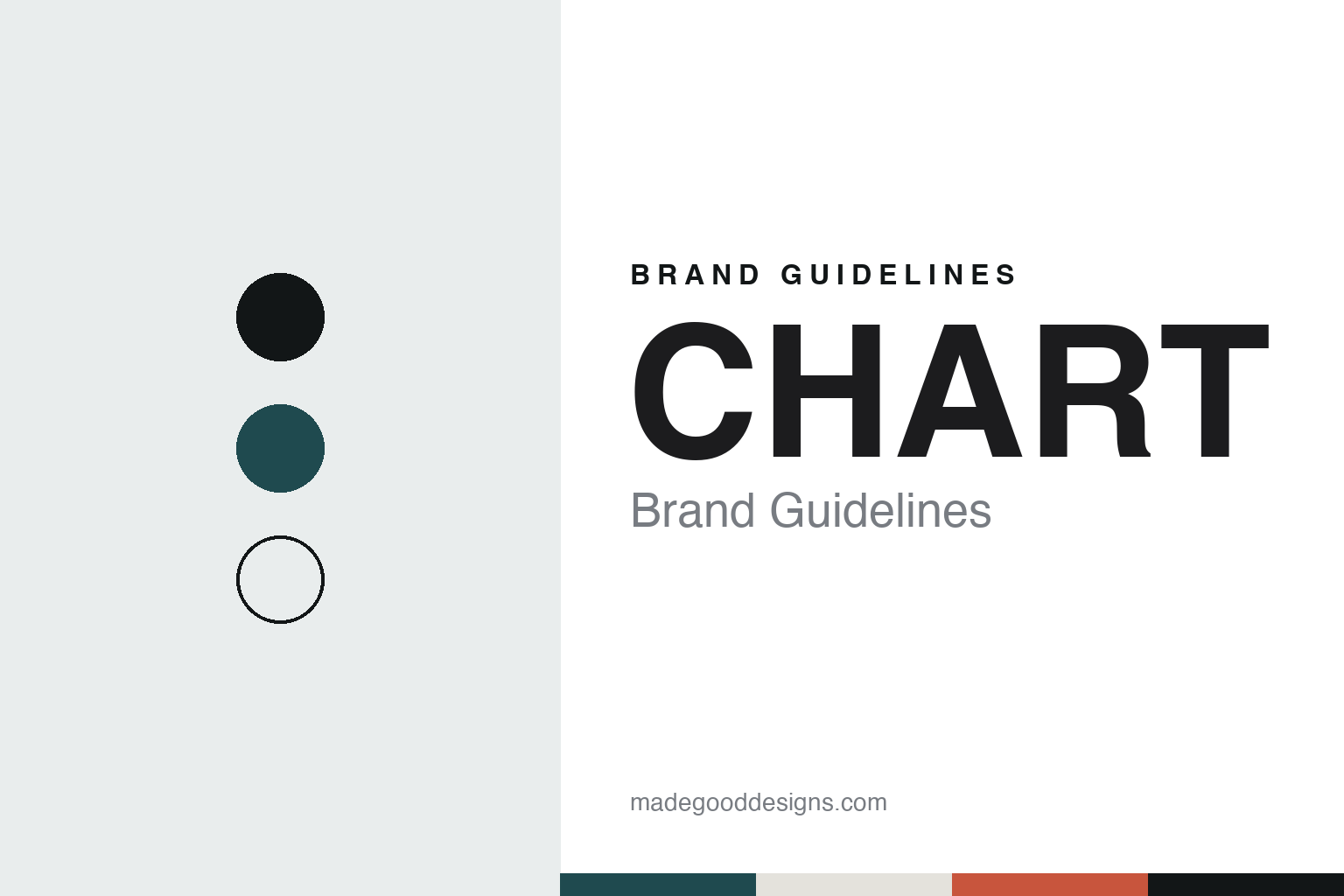
For a design guide, CHART shows how a fair founded by galleries can rest its identity on a five-letter name in capitals, one historic building and rooms used as found rather than built booths. Compare NADA, which Silbermann named in 2024 as another non-profit fair, and Louisiana Museum of Modern Art. For this guide we use a deep harbour green, a pale stone and a warm red accent with a sans, an unofficial interpretation; no product or logo is reproduced.
Explore & save
Keep CHART’s identity on hand — save it to a board in the Made Good inspiration library.
CHART identity set
Pin the CHART harbour green, stone and red palette and the clean geometric sans register to your own board.
Source & notes
Frequently Asked Questions
What font can I use to match the CHART look?
This guide describes CHART’s type as “A clean geometric sans for a five-letter name set in capitals”. Its type specimen is set in DM Sans from Google Fonts as a stand-in; DM Sans is not CHART’s own lettering.
What colours are in the CHART palette?
This guide’s CHART palette is Harbour green #1F4A4F, Ink #121617, Courtyard stone #E4E2DC, Cone red #C8553D and Paper #F6F5F1. The tones are the guide’s own unofficial interpretation, not official CHART hex codes.
When was CHART founded?
CHART was founded in 2013, in Copenhagen, Denmark.
Who founded CHART?
CHART was founded by Five Copenhagen-based galleries in 2013.