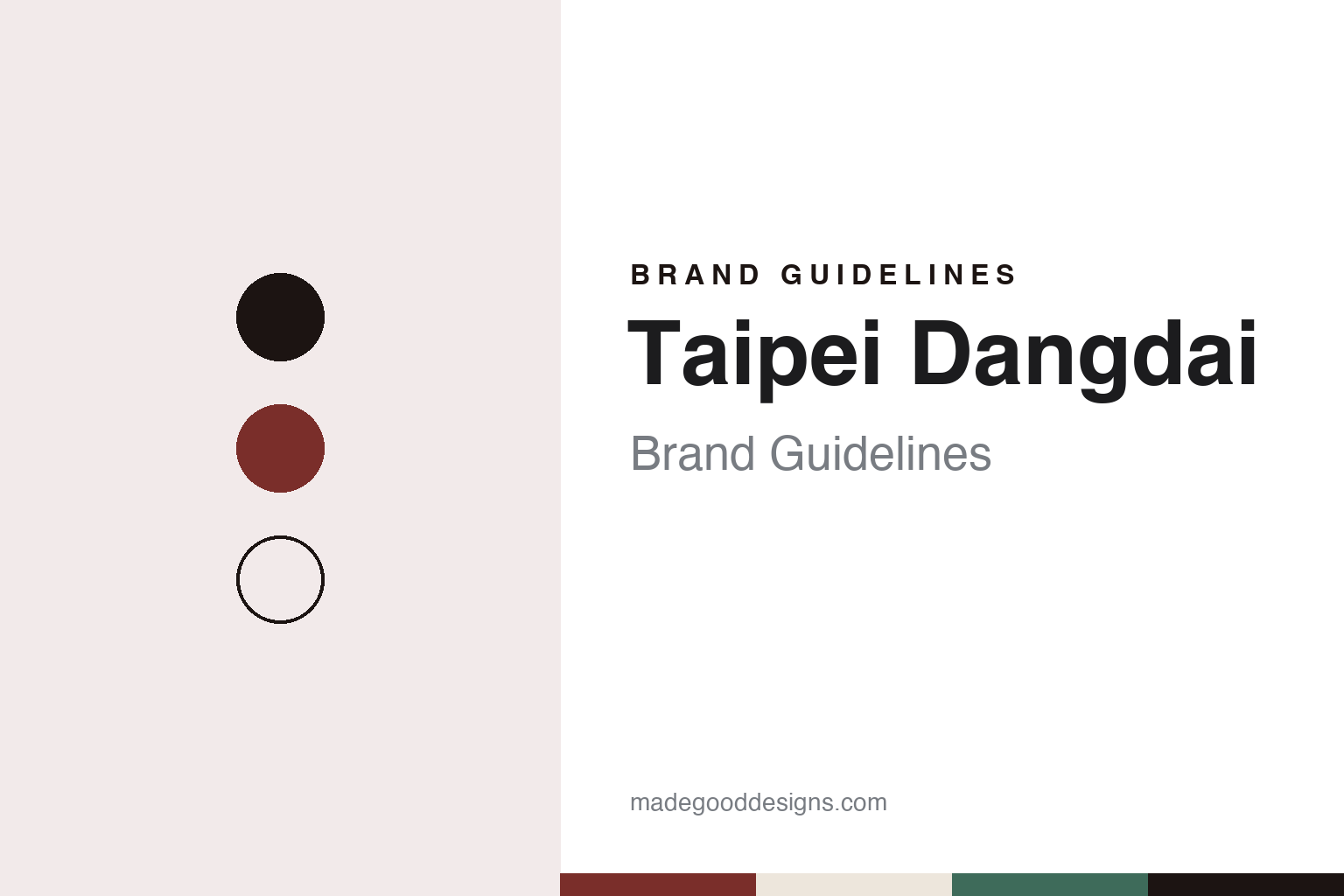
Taipei Dangdai Brand Guidelines
The Nangang art fair, held from 2019 to 2025.
Aa
Two constants: a lacquer red, rice paper and jade palette and a display serif register. Abstract homage — not a Taipei Dangdai logo, campaign image or artwork; no mark is reproduced.
The present moment
A Mandarin word for a Taipei fair.
Taipei Dangdai opened in January 2019 at the Taipei Nangang Exhibition Center, in the city’s eastern districts. The Art Newspaper, reporting from the first edition on 18 January 2019, gave its run as 17 to 20 January, with 90 participating galleries; a UBS media release of 19 January gave the public dates as 18 to 20 January. The art news site The Value placed the fair in Hall 1 of the exhibition centre.
The fair was organised by Angus Montgomery Arts, the events organiser Tim Etchells and Magnus Renfrew, who was also its director, and it was backed by UBS, The Art Newspaper reported. UBS described itself as presenting the fair. Renfrew had been the founding director of the Hong Kong fair ART HK and then of Art Basel in Hong Kong, The Value noted.
The name is Mandarin. The Art Newspaper glossed “dangdai” as the Mandarin term for contemporary art; The Value translated it as “the present moment,” and said the fair meant to give an immediate survey of contemporary art in Asia. Of the 90 galleries in the first edition, The Value counted 70 with their main space in Asia. Among the international names, The Art Newspaper listed Gagosian, David Zwirner, Hauser & Wirth and Lehmann Maupin, alongside galleries from Japan, Hong Kong, South Korea and Southeast Asia. Renfrew told the newspaper that the fair was aimed mainly at collectors in Taiwan. The Value added that 80 of the 90 galleries had permanent spaces somewhere in Asia, and quoted Renfrew’s view that Taipei had one of the most developed gallery and collector bases in the region.
The atmosphere of the first edition drew comment. Dealers used to the busier fairs of Shanghai and Hong Kong remarked on the quiet floor and orderly queues, The Art Newspaper reported. UBS, for its part, said it would host talks by gallerists, artists and art specialists on Taiwan’s art scene in its lounge, and run an education programme with a local community partner during the fair.
Colour
Sectors, a forum and a new name.
The first edition was divided into a main Galleries section and three smaller sectors, The Value reported: Young Galleries, for newer galleries; Solos, for single-artist presentations; and Salon, for works at more accessible levels.
Later editions moved to May and took a longer name. The Art Newspaper reported that the fifth edition, called Taipei Dangdai Arts & Ideas, ran from 10 to 12 May 2024. That year the organisers invited four curators from the fair’s lectures forum of the previous year to choose ten artists for Before Thunders, a non-commercial presentation funded through a grant programme of Taiwan’s Ministry of Culture for mid-career Taiwanese artists. The Hong Foundation, which has supported art, literature and music in Taiwan since 1971, also took part. The newspaper quoted the co-director Robin Peckham on the exhibition co-hosted with the ministry, and recorded 78 galleries, down from 90 the year before, with several smaller galleries joining that year.
The sixth edition ran from 9 to 11 May 2025, again at Nangang. Taiwan News reported 53 galleries from 24 nations, with 82% of exhibitors from outside Taiwan and 17% from Taiwan, and with UBS still the fair’s partner and notable groups of galleries from Japan, South Korea and Hong Kong. ArtAsiaPacific later wrote that exhibitors in 2025 reported a large turnout from the local public.
The fair had by then become part of a group. In 2024 The Art Newspaper described Taipei Dangdai as part of The Art Assembly, an affiliation of three fairs, and ArtAsiaPacific named the other two as ART SG in Singapore and Tokyo Gendai in Yokohama.
Typography
Design and documentation.
A younger or regional contemporary art fair usually introduces itself with very few words. Many simply put “Art” in front of a city, as Art Paris and Art Rotterdam do; others use a short coined name or a single word for “contemporary” in a local language, attached to a place. The name is the part that stays put. Editions are counted rather than renamed, so a fair can say that it is holding its 27th or 28th edition and still look like itself.
Behind the name there is usually a small company, a trade-fair organiser or a group of gallerists. Art Paris is run by a company called France Conventions, according to French Wikipedia, and Art Rotterdam grew out of a free slot in a Rotterdam port building, as its director told De Kunstbode in 2020. Venues matter as much as owners: a glass-roofed exhibition palace, a listed factory or the halls of a large events complex become part of how a fair is pictured, and Art Paris and Art Rotterdam have both changed venue more than once.
Inside, the fairs are built from named sections. A main section for established galleries sits beside sections for younger galleries and emerging artists — Promises at Art Paris, the New Art Section at Art Rotterdam — and beside curated programmes for video, sculpture, design or photography, often with their own invited curators. These section names are short and are usually written as titles, and they recur on floor plans and in catalogues.
Around the fair itself sits a steady set of printed and online material: an exhibitor list, a catalogue, a floor plan or map, a programme of talks and, at some fairs, an online magazine. The campaign image and the themed programme usually change with every edition, while the name, the season and the city stay the same, and that combination is what lets a fair remain recognisable from one year to the next.
Aa
A display serif for a two-word name. (Specimen set in DM Serif Display, a serif STAND-IN; NOT the Taipei Dangdai logo.)
Taipei Dangdai
A pause after six editions.
The sixth edition was followed by a pause. In its September 2025 issue ArtAsiaPacific reported that in late July 2025 Taipei Dangdai had announced the cancellation of its 2026 edition. The organisers said they would carry out a “strategic re-evaluation” of the fair, covering “the model, timing, scale, and format of any future activities.” The magazine also reported that the 2025 edition marked the departure of Peckham, co-director since the fair’s start, and that gallery numbers in 2025 were about 40 percent below the 2019 debut. The report gave no date for a return; the last edition held was the sixth, in May 2025.
Its name stayed constant across the editions reported here: the city plus a single Mandarin word, written in Latin letters, and the later suffix “Arts & Ideas” added the forum and talks to the name without replacing it. The venue also stayed the same: every edition reported here was held at the Nangang exhibition centre.
The partners also stayed steady. UBS presented the first edition in 2019 and was still named as partner in 2025, and Renfrew remained involved from launch, appearing in 2019 as fair director and on the ART SG website as co-director of Taipei Dangdai.
For a design guide, Taipei Dangdai shows how a short, translated word can carry an event’s identity across a change of season, a change of name and a smaller floor. Compare ART SG, its sister fair in Singapore, and Tokyo Gendai. For this guide we use a lacquer red, a rice-paper cream and a jade grey with a serif, an unofficial interpretation; no product or logo is reproduced.
Explore & save
Keep Taipei Dangdai’s identity on hand — save it to a board in the Made Good inspiration library.
Taipei Dangdai identity set
Pin the Taipei Dangdai lacquer red, rice paper and jade palette and the display serif register to your own board.
Source & notes
Frequently Asked Questions
What font can I use to match the Taipei Dangdai look?
This guide describes Taipei Dangdai’s type as “A display serif for a two-word name”. Its type specimen is set in DM Serif Display from Google Fonts as a stand-in; DM Serif Display is not Taipei Dangdai’s own lettering.
What colours are in the Taipei Dangdai palette?
This guide’s Taipei Dangdai palette is Lacquer red #7A2E2A, Ink #1C1412, Rice paper #EDE6DC, Jade grey #3E6B5A and Paper #F7F4EF. The tones are the guide’s own unofficial interpretation, not official Taipei Dangdai hex codes.