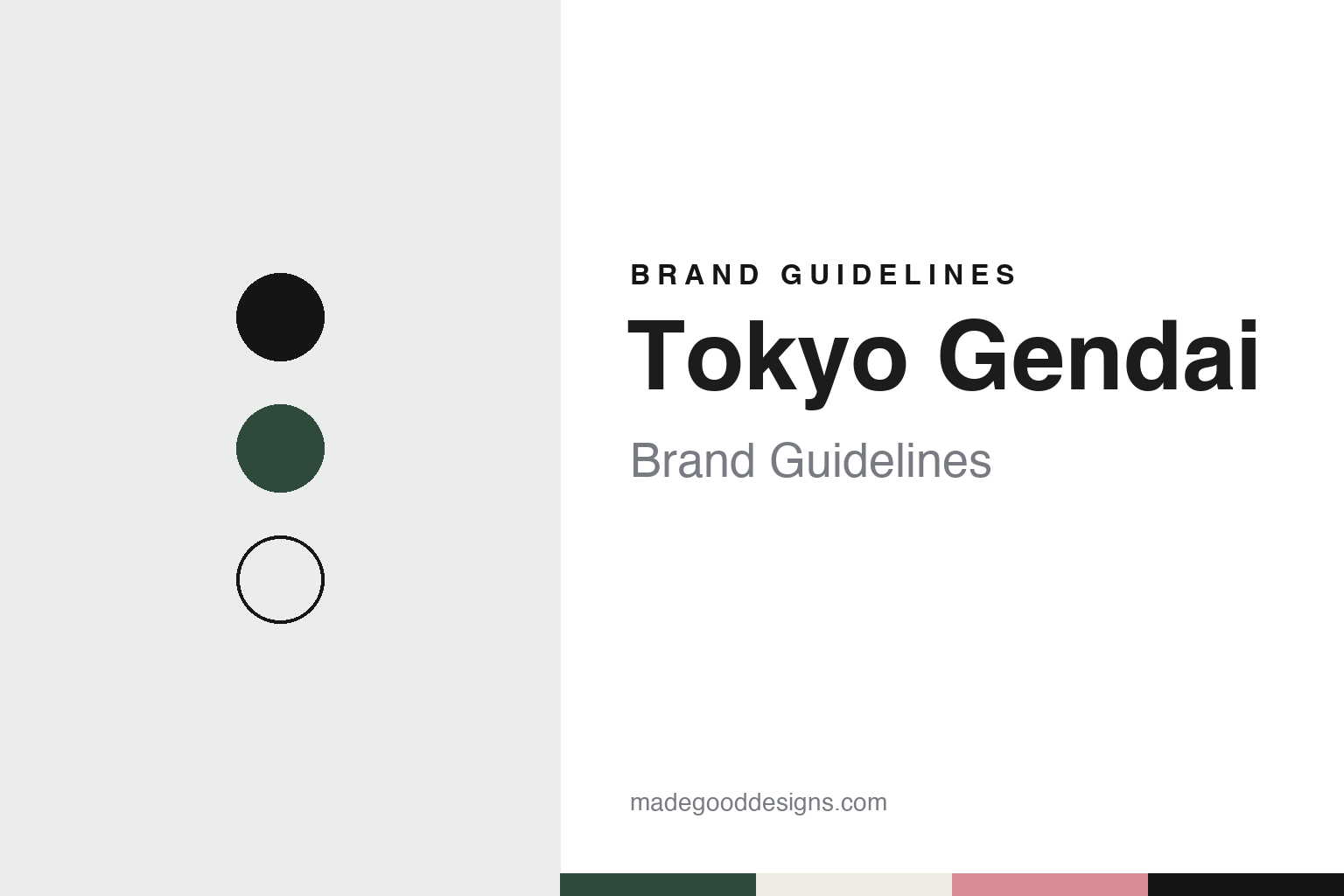
Tokyo Gendai Brand Guidelines
The contemporary art fair held at Pacifico Yokohama since 2023.
Aa
Two constants: a pine, washi and bud-pink palette and a Mincho serif register. Abstract homage — not a Tokyo Gendai asset or mark; no logo, campaign image or artwork is reproduced.
Gendai, in Yokohama
A Tokyo name on a Yokohama hall.
Tokyo Gendai is an international contemporary art fair first held in 2023. Gendai means “contemporary,” and the Japanese site Fashionsnap described the fair in 2022 as a new art fair built around that theme. Its organiser is The Art Assembly, which English Wikipedia describes as a joint venture between AngusMontgomery Arts and Tim Etchells; Artforum named Magnus Renfrew as the fair’s co-founder in June 2026.
Despite its name, the fair is not held in Tokyo. Fashionsnap reported on 9 June 2022 that the new fair would take place at Pacifico Yokohama from 7 to 9 July 2023. Pacifico Yokohama, officially the Pacific Convention Plaza Yokohama, is a convention and exhibition centre at the western tip of the Minato Mirai 21 waterfront district in Yokohama’s Nishi ward, according to English Wikipedia.
The fair set out its structure early. Fashionsnap’s 2022 report listed four sections. Galleries was for artists representing each gallery. Hana, “flower,” set no limits on artists’ ages or on how long a gallery had existed. Eda, “branch,” was planned around historically important artists and artists from Asia. Tane, “seed,” was for digital media such as NFTs, animation and virtual reality.
The first edition kept those dates. A June 2023 programme announcement, published by Tokyo Art Beat in partnership with the fair, gave the dates as 7 to 9 July 2023 with a VIP preview on 6 July. It added a curated strand, Tsubomi, “flower bud,” with an exhibition of contemporary Japanese women artists curated by two Tokyo museum curators; a section called Ne, “root,” showing the collections of Japanese foundations; and a new large installation by the artist Ryuichi Ohira built around a slot-car racetrack. The fair said it had permission to treat the whole exhibition space as a bonded area, so overseas exhibitors could bring in and show works free of customs restrictions for the duration of the fair, and listed the Agency for Cultural Affairs, the Japan Tourism Agency and the City of Yokohama among its supporters.
Colour
A summer fair becomes an autumn one.
For its first editions Tokyo Gendai took place in July. From 2025 the organisers moved it to September, citing the heat and humidity of the Tokyo summer, Artforum reported in June 2026. The third edition ran at Pacifico Yokohama in September 2025, with public days from 12 to 14 September, according to a Time Out Tokyo feature produced in association with the fair. That feature described Sato, “meadow,” as the fair’s zone for large-scale, site-specific installations and performance, and said the Tsubomi section had reached its third edition.
The fourth edition was scheduled for 11 to 13 September 2026 at Pacifico Yokohama, Artforum reported in its exhibitor announcement of 26 June 2026. That edition grouped artists by career stage. Hana was given over to early- and mid-career artists. A new section, Miki, “trunk,” was dedicated to works on paper, including prints, photography and drawing. Eda, the branch section, held solo and group shows by established artists. The main Galleries sector included Pace Gallery of New York, Sadie Coles HQ of London and the Tokyo galleries TARO NASU and KOTARO NUKAGA, the magazine reported.
The fair announced that the fourth edition opened to the public on 11 September 2026, after an invitation-only preview and vernissage on 10 September, with around 69 galleries from Japan and abroad divided into five sectors and the Tane section returning for digital work. Its announcement named Sumitomo Mitsui Financial Group as principal partner for the fourth consecutive year, with a fashion house, a champagne brand and a cosmetics company among its other partners.
Typography
How younger fairs present themselves.
A younger or regional contemporary art fair usually introduces itself with very few words. Many simply put “Art” in front of a city, as Art Paris and Art Rotterdam do; others use a short coined name or a single word for “contemporary” in a local language, attached to a place. The name is the part that stays put. Editions are counted rather than renamed, so a fair can say that it is holding its 27th or 28th edition and still look like itself.
Behind the name there is usually a small company, a trade-fair organiser or a group of gallerists. Art Paris is run by a company called France Conventions, according to French Wikipedia, and Art Rotterdam grew out of a free slot in a Rotterdam port building, as its director told De Kunstbode in 2020. Venues matter as much as owners: a glass-roofed exhibition palace, a listed factory or the halls of a large events complex become part of how a fair is pictured, and Art Paris and Art Rotterdam have both changed venue more than once.
Inside, the fairs are built from named sections. A main section for established galleries sits beside sections for younger galleries and emerging artists — Promises at Art Paris, the New Art Section at Art Rotterdam — and beside curated programmes for video, sculpture, design or photography, often with their own invited curators. These section names are short and are usually written as titles, and they recur on floor plans and in catalogues.
Around the fair itself sits a steady set of printed and online material: an exhibitor list, a catalogue, a floor plan or map, a programme of talks and, at some fairs, an online magazine. The campaign image and the themed programme usually change with every edition, while the name, the season and the city stay the same, and that combination is what lets a fair remain recognisable from one year to the next.
Aa
A Mincho-style serif for a name that pairs a city with a Japanese word. (Specimen set in Shippori Mincho, a serif STAND-IN; NOT the Tokyo Gendai logo.)
Tokyo Gendai
Sections named after a growing plant.
The name itself is bilingual: an English place name followed by a Japanese word, written in Latin letters. The sections take the same approach. From the 2022 announcement the core parts of the fair carried Japanese plant words — seed, branch and flower — glossed in English. The 2023 edition added the root and the flower bud. The installation zone took the word for a meadow, and in 2026 the trunk was added for works on paper, as reported by Fashionsnap, Tokyo Art Beat, Time Out Tokyo and Artforum.
Each name is tied to a kind of work. In 2022 Fashionsnap reported Tane as the section for digital media and Eda as the place for historically important artists and artists from Asia. In 2026 Artforum reported Hana as the section for early- and mid-career artists and Miki as the section for prints, photography and drawing. Sato, the meadow, holds large installations and performance, according to the 2025 Time Out Tokyo feature.
The venue has stayed the same since the first edition: Pacifico Yokohama, on the Minato Mirai waterfront. The calendar has moved once, from July to September in 2025, and the fair announced that it opened its fourth edition in September 2026.
For a design guide, Tokyo Gendai shows how a young fair can build an identity from a bilingual name and a set of section names drawn from one image. Compare Kiaf SEOUL, an older fair in the region that also holds its main edition in September, and Pace Gallery, named in the fair’s 2026 main sector. For this guide we use a deep pine green, a warm washi white and a soft bud pink with a serif, an unofficial interpretation; no product or logo is reproduced.
Explore & save
Keep Tokyo Gendai’s identity on hand — save it to a board in the Made Good inspiration library.
Tokyo Gendai identity set
Pin the Tokyo Gendai pine, washi and bud-pink palette and the Mincho serif register to your own board.
Source & notes
Frequently Asked Questions
What font can I use to match the Tokyo Gendai look?
This guide describes Tokyo Gendai’s type as “A Mincho-style serif for a name that pairs a city with a Japanese word”. Its type specimen is set in Shippori Mincho from Google Fonts as a stand-in; Shippori Mincho is not Tokyo Gendai’s own lettering.
What colours are in the Tokyo Gendai palette?
This guide’s Tokyo Gendai palette is Pine trunk #2F4A3A, Sumi #151514, Washi #EFEBE2, Bud pink #D98C93 and Paper #FAF8F4. The tones are the guide’s own unofficial interpretation, not official Tokyo Gendai hex codes.