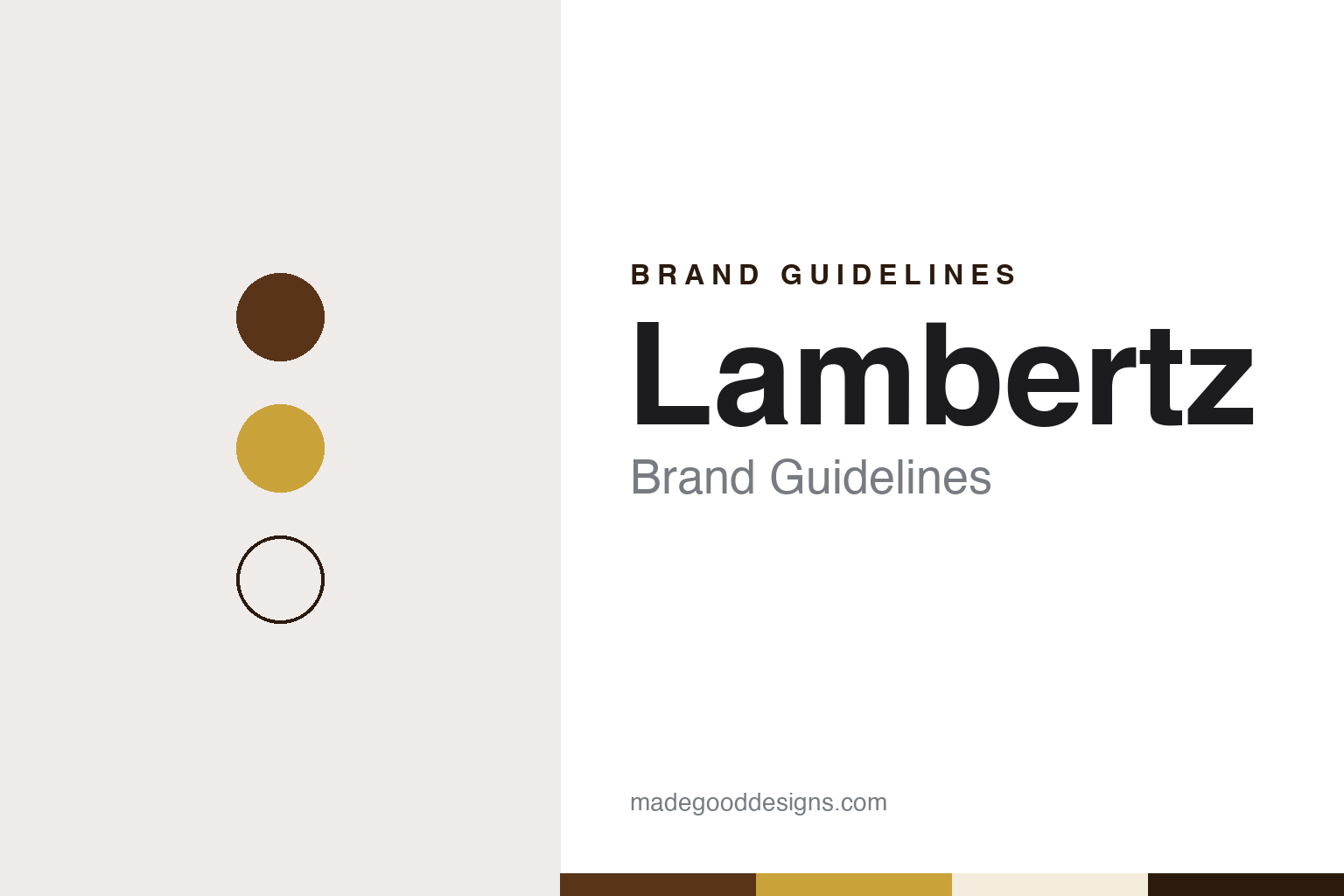
Lambertz Brand Guidelines
The Aachen Printen maker that dates itself to 1688.
Aa
Two constants: a Lambertz brown, gold and cream palette and a court-supplier serif register. Abstract homage — not a Lambertz product or mark; no tin, logo or packaging is reproduced.
Haus zur Sonne
A bakery licence, a sun sign and a confectioner from Erkelenz.
Lambertz dates itself to 1688. German Wikipedia, citing the company’s own timeline, says that in that year a baker named Zacharias Kreinsz received a licence to open a bakery in the house at Markt 7 in Aachen, then called the Haus zum Grünen Schild and later the Haus zur Sonne. The Lambertz name arrived later. Johann Werner Lambertz, a confectioner from Erkelenz, settled in Aachen in 1831, and his son Henry Lambertz, after training in his father’s business and further in Huy in Belgium, took over the Haus zur Sonne in 1860. The 1688 date therefore belongs to the bakery at Markt 7; the company today calls itself “the oldest sweet brand in Germany since 1688.”
At Markt 7 Henry Lambertz made confectionery of many kinds — pralines, dragées, jellies, preserved fruit, syrups, liqueurs and punch essences — and above all Aachener Printen, the hard, spiced gingerbread of the city. German Wikipedia says he began making chocolate from 1860 and created the chocolate Printe. By 1872 at the latest he held the title of court supplier from the Belgian, Dutch and Prussian royal houses, and the sun emblem of the house became the firm’s logo. A steam engine arrived in 1874, and a branch on Friedrich-Wilhelm-Platz opened in 1876.
Lambertz sold the business on 16 September 1878 to Christian Geller, a former brewer from a side line of the family; Geller’s sons Wilhelm and Josef joined the management in 1895. Henry Lambertz died in 1898, but his name stayed: German Wikipedia, citing the German Patent and Trade Mark Office, says the word mark “Henry Lambertz” was filed on 8 July 1899 and registered on 4 October 1899 for confectionery and baked goods. A new factory on Bergdriesch in Aachen followed in 1900.
Colour
From a Printen specialist to a group of seasonal bakers.
After heavy destruction in the Second World War, the business was rebuilt on Bergdriesch by Karl F. Kittelberger, an economist who had married Wilhelm Geller’s daughter and heir, Paula. In the early 1960s he moved it again, to Borchersstraße in Aachen-Laurensberg, still its head office. German Wikipedia says Lambertz was then still a pure Printen maker supplying only specialist shops, which left its long-term survival at risk, and that a major fire in 1977 caused a serious economic setback.
Hermann Bühlbecker, Kittelberger’s nephew, joined the management as an assistant in 1976 and took over overall leadership in 1978. He soon put Dominosteine on sale all year round, breaking the company’s dependence on Printen, and over time added Lebkuchen hearts, cinnamon stars and Spekulatius, largely through acquisitions. The company describes him as its sole owner.
Those acquisitions are dated. The company lists F.A. Crux as part of the group since 1975 and Heemann of Ladbergen since 1989. In 1994 Lambertz bought Max Weiss of Neu-Ulm, a Lebkuchen maker founded in 1925, together with Ferdinand Wolff of Nuremberg. Early in 1999 it acquired the bakery division of Theo Schöller’s Schöller holding, which brought in the Nuremberg Lebkuchen maker Haeberlein-Metzger and Kinkartz of Würselen, founded in 1872. In June 2014 it took a majority of the Dresden Stollen and Russisch Brot baker Dr. Quendt, raised to 100 per cent in 2018, and from 1 May 2015 it took over the business of the ifri Schuhmann group of Nuremberg, including Wendler nougat. The company now says it covers all three classic German protected origin names — Aachener Printen, Nürnberger Lebkuchen and Dresdner Stollen — and calls itself the world market leader in autumn and Christmas baked goods.
Typography
Biscuit houses and their marks.
The seven brands in this group all make biscuits, and they come from four countries: Kambly from Switzerland, Delacre from Belgium, Lambertz and Griesson from Germany, Lazzaroni and Matilde Vicenzi from Italy, and De Beukelaer, whose story runs through Belgium and Germany. Biscuit makers in general sit at many different points in the trade, from family bakeries that still carry a founder’s name to large groups that own several brands and plants, and a single name can move from one kind of owner to another over a century or more.
A biscuit brand’s identity is usually carried by a tin, a wrapper and a recipe it promises has not changed, while the company behind the name may have been sold, merged or renamed more than once, and the biscuits themselves may be baked a long way from the town on the packet. That makes the questions behind each name worth asking plainly: who started it, who owns it now, and where its biscuits are actually made.
Each guide separates what independent sources record from what the company says about itself — its founding story, its owners over time, its signature products and where they are baked — and marks plainly what rests only on the company’s own word.
Aa
A court-supplier serif — for a house that carried royal warrants. (Specimen set in Fraunces, a serif STAND-IN; NOT the Lambertz logo.)
Lambertz
Aachen, Poland and the tin.
Lambertz products are not all made in Aachen. German Wikipedia says the group opened a new production site in the Katowice area of Poland in 1998, which opened Eastern European markets; the company names its Polish subsidiary, Lambertz Polonia, and its plant at Ruda Śląska, from which it supplies countries including Poland, Czechia, Romania and Hungary. In January 2015 the Aachener Zeitung reported that one baking line at Kinkartz in Würselen was being moved to the Polish plant. The company said it had nine plants in its 2017/18 financial year. In the United States it founded Henry Lambertz Inc. in New Jersey in 2007. German Wikipedia adds that roughly half of output is seasonal, and that roughly half is sold under retailers’ own labels rather than the company’s brands.
Packaging carries much of the identity. In a May 2022 interview republished on its site, the company said that tins “play a big role” for it: because products with a protected origin may not be changed in recipe or appearance, it puts its creativity into decorative tinplate gift tins, which it says it has used from the start. It has also published an annual Lambertz FineArt calendar with photographers including Sven Creutzmann and James Nader, and reports being named a Superbrand by Superbrands Germany for 2017/18 and 2018/19. In 2021 it marked what it called 333 years of Lambertz.
For a design guide, Lambertz shows how an old house sign and a founding date can carry a brand through changes of family, premises and product. Compare Bahlsen, another German biscuit house, and Niederegger, the Lübeck marzipan maker. For this guide we use Printen brown, sun gold and cream with a serif, an unofficial interpretation; no product or logo is reproduced.
Explore & save
Keep Lambertz’s identity on hand — save it to a board in the Made Good inspiration library.
Lambertz identity set
Pin the Lambertz brown, gold and cream palette and the court-supplier serif register to your own board.