Niederegger Brand Guidelines
Lübeck marzipan since 1806, in white, red and gold.
Aa
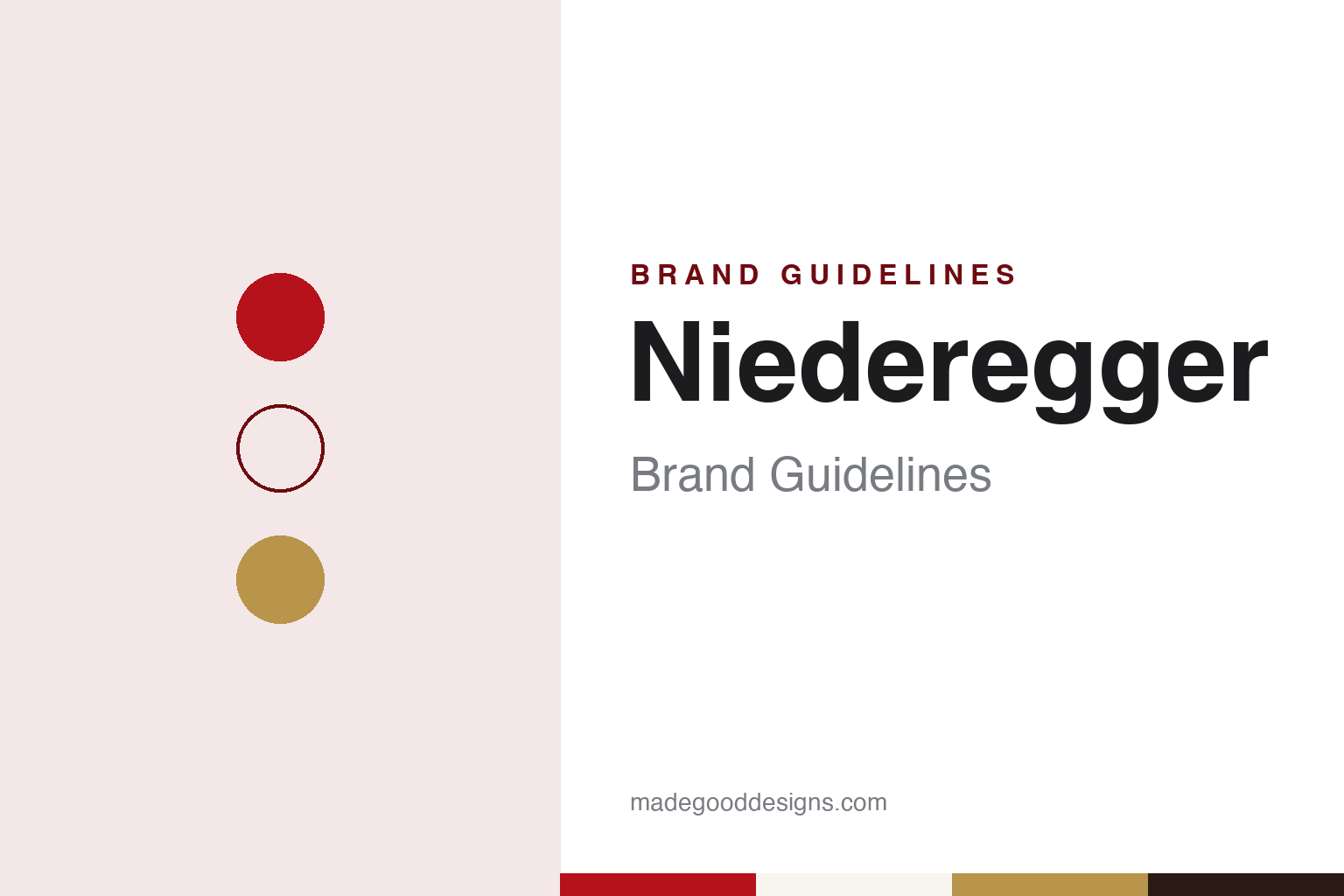
Two constants: a white over red with gold palette and a Roman capitals serif register. Abstract homage — not a Niederegger product or mark; no pack, logo or Holstentor emblem is reproduced.
Opposite the town hall
A journeyman from Ulm, a shop on the market and a blockade.
Niederegger dates itself to 1 March 1806. Its founder, Johann Georg Niederegger, was born in Ulm in 1777, trained as a confectioner in nearby Langenau and arrived in Lübeck in 1800, German Wikipedia says. He worked as a journeyman at the confectionery on the market square that the Heidelberg-born Johann Gerhard Maret had founded in 1786. After Maret’s death, Niederegger ran the business on his own account from 1806; German Wikipedia describes him as doing so on behalf of Maret’s under-age son, while the company says he took over the Maret confectionery that year.
The start was hard. Napoleon’s Continental System cut off almonds from Sicily and sugar, German Wikipedia says; production stopped altogether in 1811 and 1812, and from 1812 to 1814 supplies came in by smuggling through Heligoland. Once Maret’s son came of age, Niederegger moved in 1822 to his own house on the Breite Straße, opposite the steps of Lübeck’s town hall, where the main shop and café still stand.
The firm has passed down through families linked by marriage. After the founder, the business went to his son-in-law Karl Georg Barth; Wilhelm Köpff, also from Ulm, led it from 1864 and added a café and reading room; his son followed in 1895; and in 1927 Carl Arthur Strait, whom the company describes as a Danish son-in-law, took over. Sources differ on when machines arrived: German Wikipedia credits Barth with introducing machine production, while the company credits Köpff.
Recognition came in the nineteenth century. Niederegger’s marzipan won an award at the Vienna World Exhibition of 1873, and in 1908 Kaiser Wilhelm II named the firm a court supplier, according to both the company and German Wikipedia.
Colour
Alfred Mahlau’s white, red and gold.
Niederegger’s look was fixed in 1927, when Carl Arthur Strait took charge. The company says that Professor Alfred Mahlau then created a “corporate design” in white, red and gold with symbols of Lübeck, and that it has lasted ever since. German Wikipedia describes the mark more precisely: the Lübeck and Hanseatic colours, white over red, combined with gold, with the letters J G N set inside a stylised Holstentor, the city’s fifteenth-century brick gate.
Mahlau also gave the firm its lettering. German Wikipedia says Niederegger still uses a typeface he drew — an all-capitals alphabet based on the majuscules of Roman type — and that the face is sold today under the name “Mahlau,” though not exclusively for Niederegger. The packaging carries further Lübeck motifs.
Mahlau (1894–1967) was a Berlin-born painter and commercial artist who worked widely for Lübeck: German Wikipedia lists emergency banknotes for the city, work for the Schwartauer Werke jam maker and the Lübeck-Büchen railway, and a pageant for the city’s 700th anniversary of imperial freedom in 1926. In 1948 he designed the publisher Hoffmann und Campe’s emblem, still in use, and after 1945 he taught graphic design in Hamburg, where his students included Horst Janssen and Vicco von Bülow, the humorist Loriot.
The house itself is part of the brand. German Wikipedia says the company runs four cafés in Lübeck, including the café on the first floor of the Breite Straße building and an arcade café by the town-hall steps. Since 1999 the second floor has held a marzipan museum, the “Marzipan-Salon,” with historic wooden moulds and life-size marzipan figures. For its 200th anniversary in 2006 the company adopted the line “Marzipan aus Liebe. Seit 1806” — marzipan from love, since 1806.
Typography
Chocolate and documentation.
The seven brands in this group all make chocolate, and they come from two neighbouring countries: Cailler, Frey, Teuscher and Halba from Switzerland, and Ritter Sport, Niederegger and Stollwerck from Germany. Between them they show how differently a chocolate name can be owned and run, even in two neighbouring countries.
Some chocolate makers belong to larger businesses, from food groups to retailers that make their own chocolate for their own shelves, and their brand has to work inside someone else’s system. Others are family firms, where the founder’s name is still on the door and the identity is handed down through generations. And Germany has its own specialities alongside the chocolate bar, such as marzipan, the almond-and-sugar paste that some makers have built a whole tradition around. Read together, the guides show how such different businesses present themselves — on the wrapper, in the shop and online.
Each guide separates what independent sources record from what the company says about itself — who founded it, who owns it now, where its cocoa comes from and where its chocolate is made — and marks plainly what rests only on the company’s own word.
Aa
A Roman capitals serif — for a house lettered in Mahlau’s all-capitals alphabet. (Specimen set in Cinzel, a serif STAND-IN; NOT the Niederegger logo or the Mahlau typeface.)
Niederegger
Made in Lübeck, by the eighth generation.
Niederegger remains a family business, which German Wikipedia counts as being in its eighth generation. Holger Strait and his wife Angelika took over in 1986, the company says, and their daughters Anna-Theresa Mehrens-Strait and Elise-Antonie Strait became managing directors in 2016; the company’s legal notice names all four as managing directors of J. G. Niederegger GmbH & Co. KG in Lübeck.
The marzipan is made in the city. The company built a factory on the Ziethenstraße in 1930; the café was destroyed by bombing in 1942, when the company archive was lost, and rebuilt in 1948. In 1962 work began on a new marzipan works on the Zeißstraße, which has been extended since — German Wikipedia mentions a 3,000-square-metre production hall and, from 2023, a new picking warehouse. German Wikipedia also gives company figures: up to 30 tonnes of marzipan a day, around 300 products, exports to more than 40 countries and more than 700 employees, with over half of sales made at Christmas.
German Wikipedia describes the process: almonds are blanched and skinned, ground with sugar in a ratio of two-thirds to one-third between granite rollers, then roasted in small batches in kettles over an open gas flame before the paste is stored and flavoured. The company does not name the countries its almonds come from, saying only that they are of the “best origin.”
Its marzipan also carries a protected name. Lübecker Marzipan is a protected geographical indication in the European Union, covering marzipan from Lübeck and the neighbouring towns of Bad Schwartau and Stockelsdorf; German Wikipedia says the legal protection followed in 1996, and that Lübeck’s makers — among them Erasmi & Carstens, Lubeca and Mest as well as Niederegger — also follow a voluntary rule of at least 70 per cent raw marzipan paste.
For a design guide, Niederegger shows how a city’s colours and one 1920s commission can become a house style for a century. Compare Anthon Berg, the Copenhagen marzipan maker, and Ritter Sport, another German family firm. For this guide we use white, red and gold with a serif, an unofficial interpretation; no product or logo is reproduced.
Explore & save
Keep Niederegger’s identity on hand — save it to a board in the Made Good inspiration library.
Niederegger identity set
Pin the Niederegger white, red and gold palette and the Roman capitals serif register to your own board.