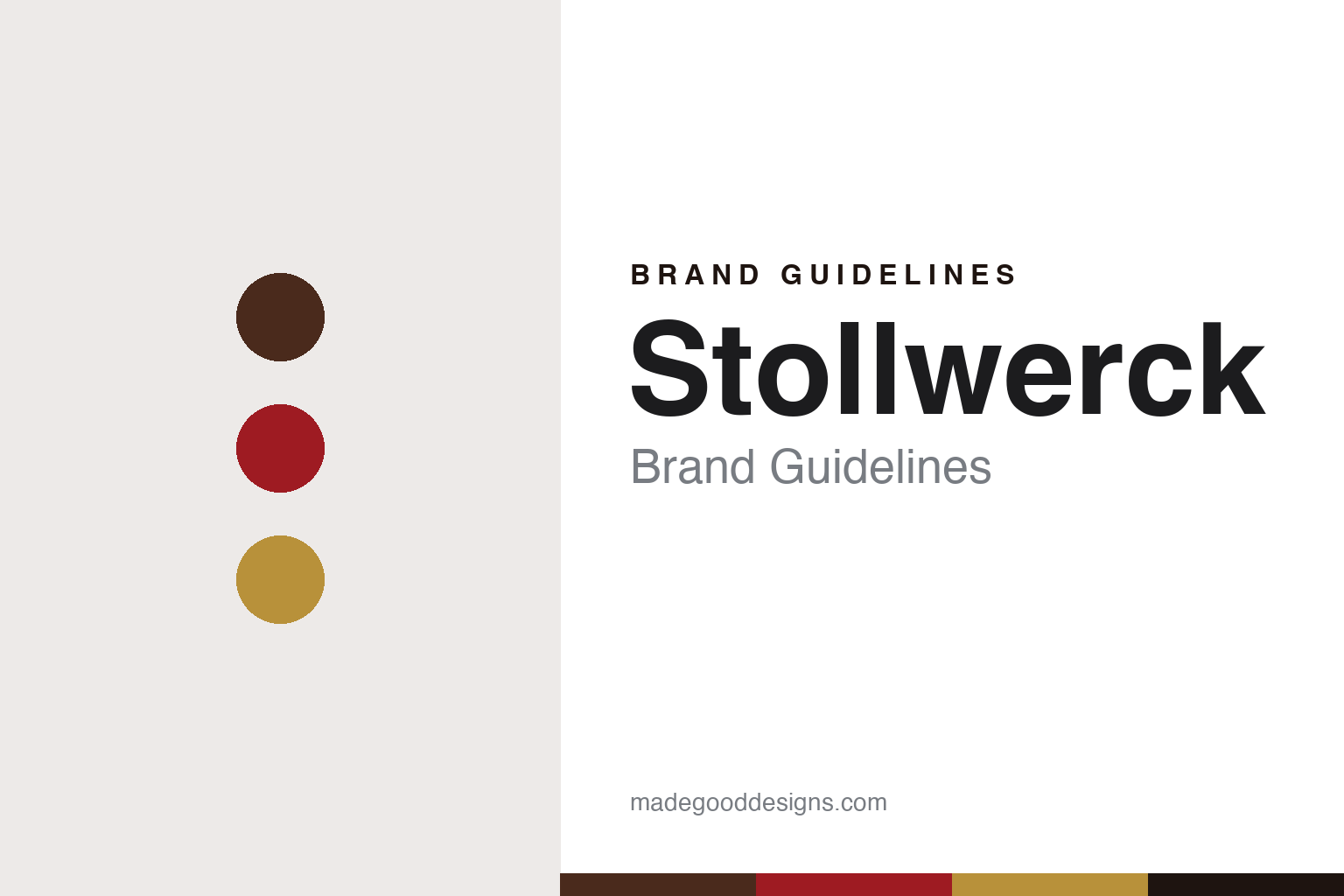
Stollwerck Brand Guidelines
Cologne’s chocolate maker since 1839, now part of a Belgian group.
Aa
Two constants: a Stollwerck cocoa, red and gilt palette and a Victorian serif register. Abstract homage — not a Stollwerck product or mark; no wrapper, logo or packaging is reproduced.
A Cologne confectioner
A small bakery, cough drops and five sons.
Stollwerck began in Cologne in 1839, when Franz Stollwerck (1815–1876), who had trained as a confectioner, opened what the Rhineland history portal of the regional authority LVR calls a small pastry bakery in the Blindgasse. By 1842 he had renamed it a confectionery and sweet factory and was selling the Stollwerck cough drops that made his name; English Wikipedia says local pharmacists asked in 1845 for him to be stopped from selling such medicinal goods, and were refused. He also ran coffee houses, including the Königshalle of 1856, which the portal calls the largest place of entertainment in Cologne.
Chocolate came with the next generation. In the early 1860s his three eldest sons turned to making chocolate industrially, and German Wikipedia dates the addition of chocolate, marzipan and Printen, the spiced Aachen biscuit, to 1860. The sons registered a separate firm, Gebrüder Stollwerck, in 1871, which merged with their father’s business after his death in 1876. The five brothers — Albert Nikolaus, Peter-Joseph, Heinrich, Ludwig and Carl — then built it into an international company, and in 1902 it became a public company, Gebr. Stollwerck AG.
By the turn of the century, German Wikipedia says, citing the 1904 Berlin directory, Stollwerck had branches from Breslau to Chicago and factories in Berlin, Bratislava, London and New York, and advertised itself as a supplier to royal courts with “27 court diplomas, 70 gold medals.” At the 1893 World’s Columbian Exposition in Chicago it showed a pavilion made of chocolate and cocoa butter, crowned by a statue of Germania, according to English Wikipedia.
Colour
Vending machines, film and picture albums.
Stollwerck’s best-documented innovation was selling chocolate by machine. Ludwig Stollwerck, the second-youngest brother, pushed the firm toward new technology, and in 1887 it set up its first vending machines; by 1893 it had 15,000, German and English Wikipedia say. In 1894 it founded Volkmann, Stollwerck & Co. in New York with the German merchant John Volkmann to build machines there, and more than 4,000 stood in New York stations. Its machines, English Wikipedia says, citing the business historian Alfred Chandler, came to sell cigarettes, matches, chewing gum and soap as well as chocolate. For the Budapest underground, opened in 1896, a Vienna-based Stollwerck subsidiary supplied sweet machines for the stations and a ticket machine. English Wikipedia says that by 1900 Stollwerck was the second-largest chocolate producer in the United States.
The firm was also an early player in moving pictures: German Wikipedia says it was among the leaders of the cinematograph business that began in 1895, a story told in the historian Martin Loiperdinger’s 1999 book Film & Schokolade. Its picture-card albums, collected from chocolate packs, were studied by Franziska Richter in Geschichte in Köln in 2018 for their First World War imagery.
The family era ended in crisis. After the slump of 1929, costly acquisitions and other bad investments, Deutsche Bank restructured the company in 1930–32 under its directors Georg Solmssen and Karl Kimmich, and nearly all the Stollwerck family were pushed out, German Wikipedia says. After wartime damage and the loss of foreign assets, the end of fixed chocolate prices in 1964 and competition from Mars and Ferrero left it with a loss of about 7.8 million marks in 1970.
Typography
Swiss and German chocolate.
The seven brands in this group all make chocolate, and they come from two neighbouring countries: Cailler, Frey, Teuscher and Halba from Switzerland, and Ritter Sport, Niederegger and Stollwerck from Germany. Between them they show how differently a chocolate name can be owned and run, even in two neighbouring countries.
Some chocolate makers belong to larger businesses, from food groups to retailers that make their own chocolate for their own shelves, and their brand has to work inside someone else’s system. Others are family firms, where the founder’s name is still on the door and the identity is handed down through generations. And Germany has its own specialities alongside the chocolate bar, such as marzipan, the almond-and-sugar paste that some makers have built a whole tradition around. Read together, the guides show how such different businesses present themselves — on the wrapper, in the shop and online.
Each guide separates what independent sources record from what the company says about itself — who founded it, who owns it now, where its cocoa comes from and where its chocolate is made — and marks plainly what rests only on the company’s own word.
Aa
A Victorian serif — for a firm whose name dates from 1839. (Specimen set in Libre Caslon Text, a serif STAND-IN; NOT the Stollwerck logo.)
Stollwerck
From Imhoff to Baronie.
The turnaround came from Hans Imhoff, a chocolate manufacturer who took control in 1972, for a symbolic sum, according to German Wikipedia. He moved production from the old works in Cologne’s Südstadt to Porz-Westhoven at the end of 1975, and over the next three decades bought established names including Sprengel, Waldbaur, Chocolaterie Jacques in Eupen and Sarotti, which, the taz reported in August 1997, Stollwerck was taking over from Nestlé. After German reunification it bought the Saalfeld works that had been the largest chocolate factory in East Germany.
Imhoff also built Cologne’s chocolate museum. After an exhibition for the firm’s 150th anniversary in 1989, the Imhoff-Stollwerck chocolate museum opened in the Rheinauhafen on 31 October 1993, at a cost of 53 million marks. The link did not last: in 2006 Barry Callebaut ended the partnership, Lindt & Sprüngli became the museum’s partner and the Stollwerck name was dropped; since 2017 it has been called the Schokoladenmuseum Köln, run by the Imhoff family’s company, German Wikipedia says.
In April 2002, the Neue Zürcher Zeitung reported, the Swiss chocolate group Barry Callebaut agreed to buy Stollwerck for 256 million Swiss francs; Imhoff, then 80, had found no successor. Stollwerck brought brands including Sprengel, Sarotti, Alpia and Gubor and made Alprose chocolate at Caslano in Ticino. Barry Callebaut took it off the stock market and closed the Cologne factory, keeping only the administration. In 2011 it sold Stollwerck to the Belgian chocolate maker Baronie, founded in 1920; the Aachener Zeitung reported the sale complete at the end of September. In 2016, the Kölner Stadt-Anzeiger reported, the company left Cologne after 177 years for Norderstedt, near Hamburg.
Today Stollwerck GmbH is Baronie’s German company. Its website lists four German sites — Berlin, Norderstedt, Saalfeld and Veitshöchheim — in a group of eleven locations in five European countries, and the brands it names are Alpia, Eszet, Sarotti and Schwarze Herren alongside the group’s Swiss and Belgian lines. The company says it manages “the entire production chain, from bean to bar,” and that in 2021 Baronie became partners with the French group Cémoi. German Wikipedia, citing its published accounts, gives 1,147 employees and revenue of €464.5 million for 2024.
For a design guide, Stollwerck shows how a founder’s name can outlast the family and become the name of a company rather than a bar. Compare Ritter Sport and Niederegger, two German family firms, and Wawel, another long-lived Central European maker. For this guide we use cocoa brown, red and gilt with a serif, an unofficial interpretation; no product or logo is reproduced.
Explore & save
Keep Stollwerck’s identity on hand — save it to a board in the Made Good inspiration library.
Stollwerck identity set
Pin the Stollwerck cocoa, red and gilt palette and the Victorian serif register to your own board.