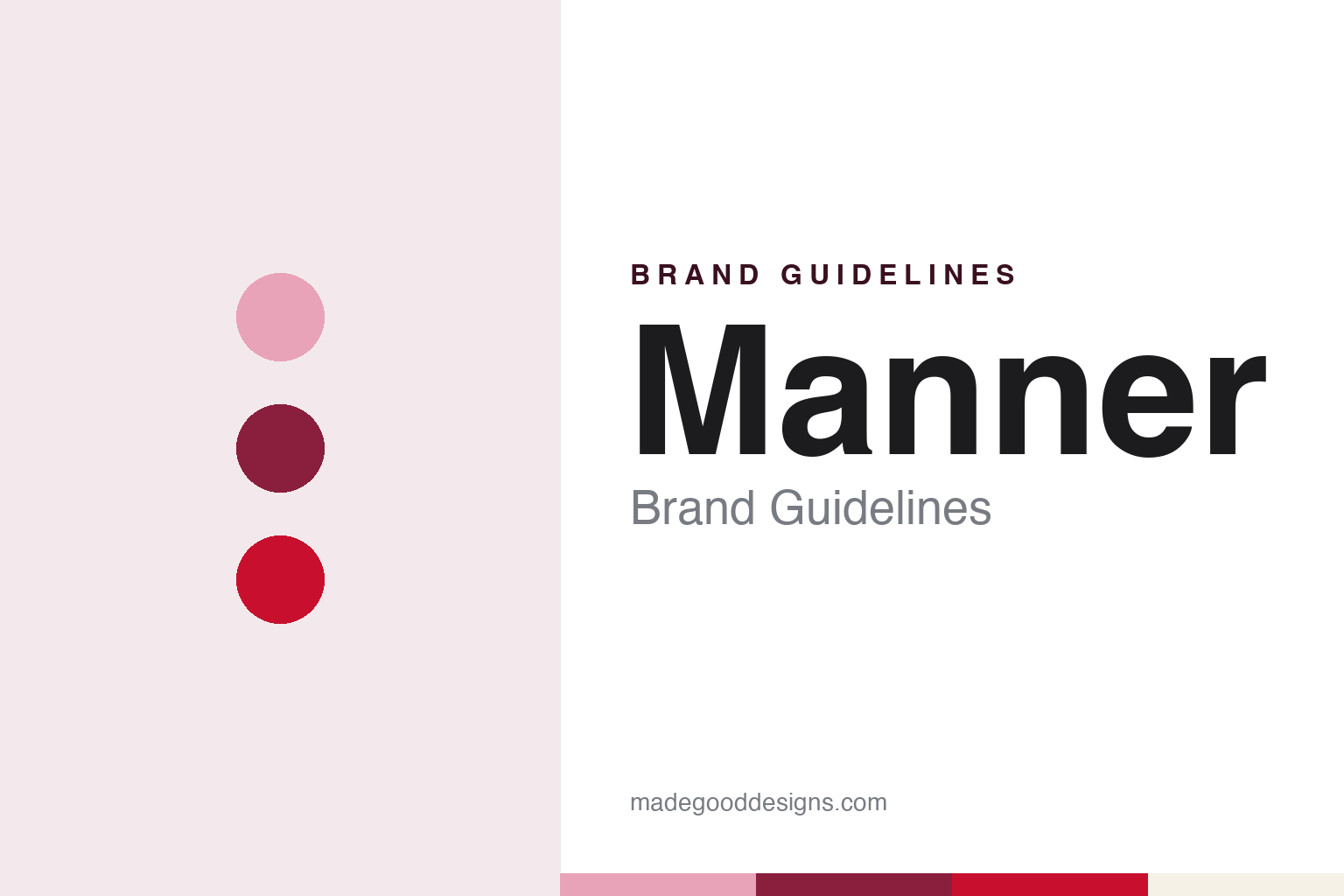
Manner Brand Guidelines
Vienna’s pink wafer maker, with a cathedral for a mark.
Aa
Two constants: a wafer pink, raspberry and tear-strip red palette and a Viennese serif register. Abstract homage — not a Manner product or mark; no pack, cathedral emblem or logo is reproduced.
Stephansplatz, 1890
A shop beside the cathedral, then a factory in Hernals.
Manner began with a shop. The company says Josef Manner opened a small store selling chocolate and fig coffee beside St. Stephen’s Cathedral in Vienna in 1889, and that, unhappy with the quality his suppliers delivered, he decided to make chocolate himself. On 1 March 1890, aged 25, he bought the trading licence, premises and equipment of a small chocolate maker in Vienna’s 5th district and became owner of the “Chocoladenfabrik Josef Manner.” That is why the company gives 1890 as its founding year while its consumer website speaks of a tradition “since 1889.”
The business grew quickly. The company says it moved within the year to Kulmgasse in Hernals, Vienna’s 17th district, and had 100 employees by 1897. An accountant, Alfred Teller, joined as a partner in 1893 and sold his share in 1900 to Johann Riedl, beginning a partnership between the Manner and Riedl families that, the company says, continues today. The Hernals factory was enlarged between 1904 and 1913 — production often ran beside the building site, the company says — and on 23 October 1913 the firm became a stock corporation, Josef Manner & Comp AG, with 3,000 employees.
The interwar years were harder. English Wikipedia, citing a 2016 history of Austria’s banks, says the Anglo-Austrian Bank held a majority of the shares from March 1922, and that the founder withdrew from day-to-day management in 1935. Josef Manner died in 1947, the company says, before the post-war recovery that would make his wafers a national classic.
Colour
No. 239, a cathedral and a colour.
The product that defines the brand appeared in 1898 as “Neapolitaner Schnitte No. 239,” the company says — the Original Neapolitaner wafer, layered with hazelnut cream. The name refers to hazelnuts from the region around Naples, and the company says the pack size has never changed. Today the wafers are made in Vienna’s 17th district, on the site where the company moved in 1890.
The mark is older still. The company says it registered St. Stephen’s Cathedral as its trademark in 1890, a reminder of the first shop beside it. The Archdiocese of Vienna wrote in 2014 that the cathedral had always been the Manner trademark, and that in gratitude Manner had once paid the full wages of a stonemason; the support continues, it said, in the form of the “Manner-Mann,” a stonemason of the cathedral works who wears a work suit in the company’s pink. In 1999 Carl Manner, the founder’s grandson, received the archdiocese’s highest honour, the Order of St. Stephen in gold, the archdiocese said.
The packaging became part of the identity in the 1960s, when Manner introduced flavour-sealing aluminium foil packs with a red tear strip — “an Austrian design classic to this day,” the company says. It credits the new pack with a sales recovery: in 1964, it says, turnover passed the record set in 1914 for the first time. The colour that ties the range together is what the company calls Manner pink; “only pink tastes like this,” its website says.
The wafers have also travelled. The Wiener Zeitung reported in 2011 that Manner packs appeared in the background of the café in the American sitcom Friends, and Der Standard reported a paid placement in the 2003 film Terminator 3, in which Arnold Schwarzenegger’s character buys a pack.
Typography
Design and documentation.
The seven brands in this group all make chocolate, and they come from three countries: Mary, Dumon and Chocolat Jacques from Belgium, Manner, Mirabell and Hofbauer from Austria, and Sarotti from Germany. Chocolate brands reach shoppers in different ways, from a chocolatier’s own shop counter to a bar or a box on a supermarket shelf.
An old chocolate brand can carry two histories at once. One is the story of a founder, a workshop and a city, which a brand may keep telling on its packs and its website long after the founding family has gone. The other is the story of ownership: who bought the business, who bought it after that, and which group’s factory the chocolate comes from now. The two need not line up: a name tied to one town can be made somewhere else, or by a company based in another country.
Each guide separates what independent sources record from what the company says about itself — who founded it, who owns it now, where its cocoa comes from and where its chocolate is made — and marks plainly what rests only on the company’s own word.
Aa
A Viennese serif — for a brand whose mark is a Gothic cathedral. (Specimen set in Fraunces, a serif STAND-IN; NOT the Manner logo.)
Manner
Listed, family-controlled, made in Austria.
Manner grew by merger as well as by wafers. In 1970, the company says, it merged with Napoli, Ragendorfer & Co., then Austria’s second-largest confectioner, adding the Casali and Napoli brands — Casali’s chocolate-covered bananas and Napoli’s Dragee Keksi among them. In 2000 it added Victor Schmidt & Söhne, with the Ildefonso and Victor Schmidt Austria Mozartkugeln brands. Its corporate website now lists six brands: Manner, Casali, Victor Schmidt, Ildefonso, Dragee Keksi and Napoli.
The company is still listed and family-controlled. Its 2025 annual financial report says its bearer shares trade on the Vienna Stock Exchange, in the Standard Market Auction segment, and that a two-tier syndicate of the Manner and Riedl families and the Andres group holds 88.37% of the shares, with small shareholders holding 5.33%. In April 2026 the company reported 2025 revenue of about €304 million, up 5.5%, with almost 60% earned abroad; profit before tax roughly halved, which it put down mainly to higher raw-material costs, cocoa in particular, and a write-down on a hazelnut farm it is developing in Azerbaijan.
On where the products are made, the company is specific: production takes place “exclusively” in Austria, at the main factory in Vienna’s 17th district and at a second plant in Wolkersdorf, Lower Austria, its annual report says. ORF Vienna reported in 2020 that a long rebuilding of the Hernals factory was complete, that a plant at Perg in Upper Austria had closed and its machines had moved to Vienna, and that about 700,000 Manner wafers were being made a day. The company says it roasts its cocoa beans in Vienna, that since 2020 its branded products have used 100% certified sustainable cocoa, and that since 2021 all Manner wafers have carried the FAIRTRADE cocoa seal.
For a design guide, Manner shows how a single colour and a single landmark can carry a brand for more than a century. Compare Zotter, an Austrian chocolate maker with a very different approach to packaging, and Mirabell, another Austrian confectionery name. For this guide we use wafer pink, a raspberry ink and a tear-strip red with a serif, an unofficial interpretation; no product or logo is reproduced.
Explore & save
Keep Manner’s identity on hand — save it to a board in the Made Good inspiration library.
Manner identity set
Pin the Manner wafer pink, raspberry and tear-strip red palette and the Viennese serif register to your own board.