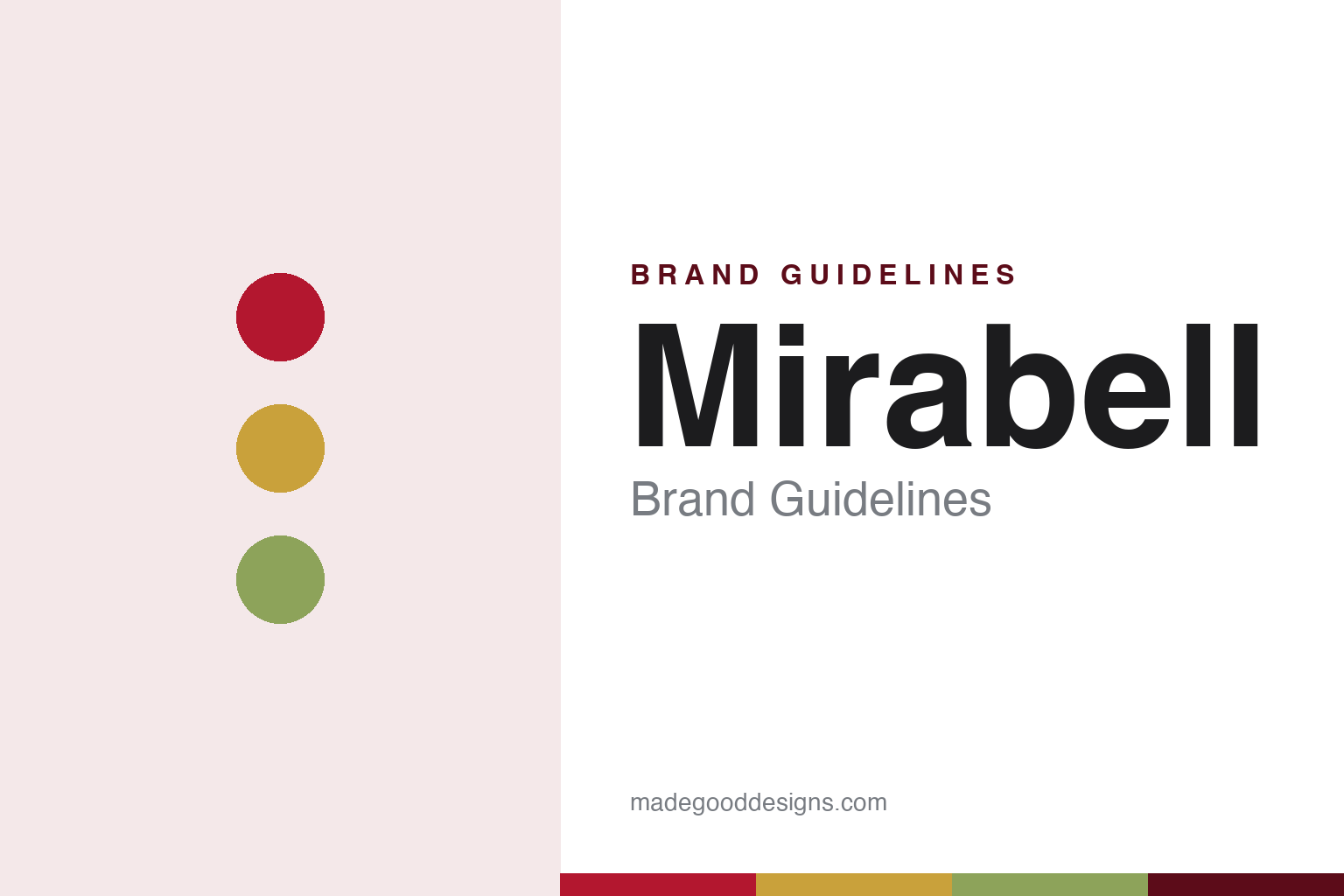
Mirabell Brand Guidelines
The Salzburg Mozartkugel brand that outlived its Salzburg factory.
Aa
Two constants: a Mirabell red, gold and pistachio palette and a Salon serif register. Abstract homage — not a Mirabell product or mark; no wrapper, portrait or logo is reproduced.
Rajsigl to Grödig
A Salzburg sweet factory and a palace name.
Mirabell is a brand of Mozartkugeln — round chocolates of pistachio marzipan and nougat named after Wolfgang Amadeus Mozart — and its roots are older than its name. The brand’s own history page, as archived in April 2017, traces it to the Rajsigl sweet factory in Salzburg, founded in 1897, which it says began making Mozartkugeln by hand in the 1920s. An earlier press page from the brand’s website says the Mirabell business grew after the Second World War out of a Rajsigl branch works, took its name from Schloss Mirabell, the palace in Salzburg, and moved in 1948 to Grödig, just south of the city, because the Rajsigl factory had become too small. The Austrian broadcaster ORF reported in 2021 that Mirabell Mozartkugeln had been made at Grödig since 1948.
The chocolate itself is not Mirabell’s invention. English and German Wikipedia credit the Salzburg confectioner Paul Fürst, who created it in 1890 as the “Mozart-Bonbon”; his descendants still make it by hand in Salzburg, and Mirabell’s own history pages say as much. What Mirabell did was industrialise it. Its 2017 history says the hand method was “industrially developed and newly patented,” and German Wikipedia, citing the company, says Mirabell was the first to make completely round Mozartkugeln by machine.
Ownership moved to large groups. The 2017 history says the company was taken over by Suchard and that the Mirabell mark was registered in 1976. A press page on the brand’s website in the early 2000s described Mirabell as a subsidiary of Kraft Foods Österreich, and the brand now belongs to Mondelēz International, the name Kraft Foods’ snacks business took in 2012. The current Mirabell web page is published by a Mondelēz company, and German Wikipedia lists the Austrian business as Mirabell Salzburger Confiserie- und Bisquit-GmbH.
Colour
Echte, not Original.
The words on the pack are the result of a long argument. When imitations of Fürst’s chocolate spread, the Fürst side went to court over the name, and according to English Wikipedia the dispute ended in an agreement that obliged competitors to use other names: Mirabell chose “Echte Salzburger Mozartkugeln” — “genuine Salzburg Mozartkugeln” — while only Fürst may sell “Original Salzburger Mozartkugeln.” The German business daily Handelsblatt reported in January 2006 that a case brought by Fürst against a Nestlé subsidiary, which had wanted to sell “Original Austria Mozartkugeln,” was decided in Fürst’s favour in the third instance in 1996.
Mirabell had its own fight across the border. At the end of the 1970s it clashed with the Bavarian maker Reber; in 1981 Austrian and German officials reached a provisional agreement that only Austrian producers could use the name, which the European Commission later declared invalid, English Wikipedia says, citing a 2006 report. German Wikipedia notes that Der Spiegel wrote of a “Mozartkugel war” in the summer of 1982. Die Zeit reported in December 2005 that only Mirabell’s Mozartkugeln may be perfectly round; other industrially made ones have one flattened side.
The packaging grew into a system. A version of the brand website from 2000 describes the “unmistakable red-and-gold octagonal pack,” and the 2017 history dates the octagonal gift box and the unification of the packaging colours to the early 1980s. The current website still sells the balls in an octagonal carton. The foil carries a portrait of Mozart, which, German Wikipedia notes, has been made noticeably younger over the years. Alongside the ball, Mirabell sells the flatter Mozarttaler, first called “Tortelettì,” according to the 2017 history, which also lists sponsorship of the International Mozarteum Foundation in Salzburg and the Mozarthaus Vienna, and a tram in Vienna and a bus in Salzburg painted in Mirabell colours.
Typography
Chocolate and confectionery.
The seven brands in this group all make chocolate, and they come from three countries: Mary, Dumon and Chocolat Jacques from Belgium, Manner, Mirabell and Hofbauer from Austria, and Sarotti from Germany. Chocolate brands reach shoppers in different ways, from a chocolatier’s own shop counter to a bar or a box on a supermarket shelf.
An old chocolate brand can carry two histories at once. One is the story of a founder, a workshop and a city, which a brand may keep telling on its packs and its website long after the founding family has gone. The other is the story of ownership: who bought the business, who bought it after that, and which group’s factory the chocolate comes from now. The two need not line up: a name tied to one town can be made somewhere else, or by a company based in another country.
Each guide separates what independent sources record from what the company says about itself — who founded it, who owns it now, where its cocoa comes from and where its chocolate is made — and marks plainly what rests only on the company’s own word.
Aa
A salon serif for a Salzburg souvenir. (Specimen set in Cormorant Garamond, a serif STAND-IN; NOT the Mirabell logo.)
Mirabell
No longer made in Salzburg.
For decades Mirabell sold itself on place. Its 2017 history said it was the only industrially made Mozartkugel actually produced in Salzburg. That is no longer the case. In 2014, ORF later reported, the Grödig works was taken over by an investor group; trading as Salzburg Schokolade, it went on making Mirabell for Mondelēz. It entered insolvency proceedings in November 2021 after losses in the pandemic, ORF reported, and the Salzburger Nachrichten reported that December that Mondelēz wanted to keep production there.
In July 2024 the Kleine Zeitung reported that Mondelēz was withdrawing production from Salzburg and that the Grödig works would close after almost seventy years. On 6 December 2024 Der Standard reported that the last “Echte Salzburger Mozartkugel” of Mirabell had been made at Grödig and that production was moving abroad; Salzburg Schokolade’s managing director told the radio programme Ö1 that Mondelēz had not told him where. ORF confirmed in May 2025 that production had been moved abroad. In the sources we checked, neither Mondelēz nor the current Mirabell web page names the new factory, so we do not name it.
Today the brand page calls Mirabell one of Austria’s most traditional brands and describes the Mozartkugel as a core of marzipan and pistachio wrapped in light and dark nougat and dark chocolate, under the words “echte Mirabell Mozartkugeln.”
For a design guide, Mirabell shows how a pack — a red-and-gold octagon and a composer’s portrait — can carry a city’s name long after the factory has left the city. Compare Côte d’Or, another old chocolate name now owned by Mondelēz, and Manner, the Viennese company that also makes Mozartkugeln. For this guide we use red, gold and pistachio with a serif, an unofficial interpretation; no product or logo is reproduced.
Explore & save
Keep Mirabell’s identity on hand — save it to a board in the Made Good inspiration library.
Mirabell identity set
Pin the Mirabell red, gold and pistachio palette and the Salon serif register to your own board.