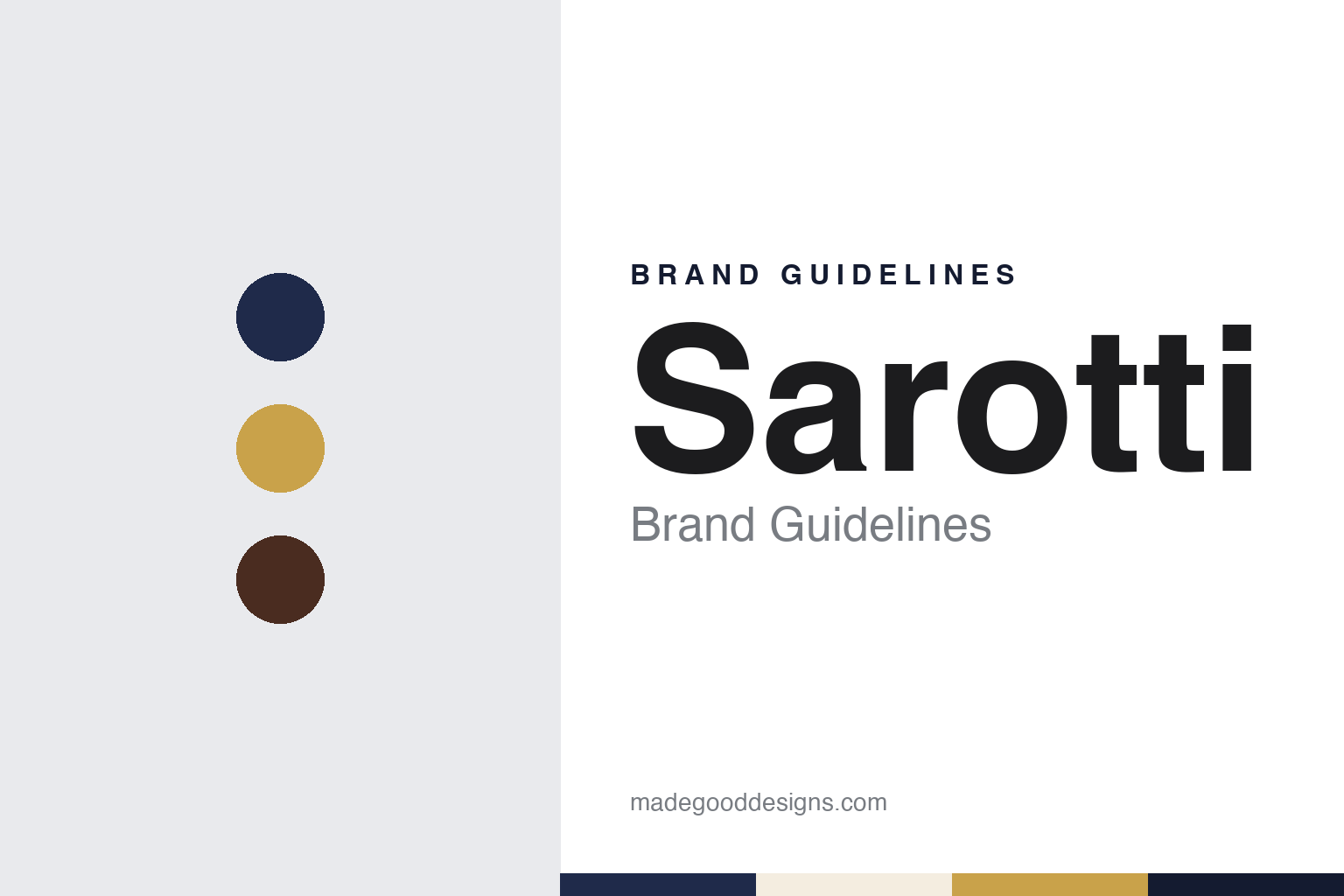
Sarotti Brand Guidelines
The Berlin chocolate brand that began in a sweet shop in 1852.
Aa
Two constants: a Sarotti night blue, gold and cocoa palette and a gilded serif register. Abstract homage — not a Sarotti product or mark; no figure, logo or wrapper is reproduced.
Felix & Sarotti
A Friedrichstraße sweet shop and a confectioner trained in Paris.
Sarotti dates itself to 16 September 1852, when, the company and German Wikipedia say, Heinrich Ludwig Neumann and his son Louis opened the “Confiseur-Waren-Handlung Felix & Sarotti”, a confectionery shop on Berlin’s Friedrichstraße, dressed in what the company calls luxurious oriental decoration. Where the name Sarotti came from is unknown, German Wikipedia says.
The man who turned the shop into a manufacturer was Hugo Hoffmann (1844–1911), a confectioner from Stuttgart who had trained in Paris. According to the Neue Deutsche Biographie, as summarised by German Wikipedia, he set up a confectioner’s kitchen in Berlin’s Mohrenstraße in 1868, making fondants and fruit pastes and, from 1871, chocolate and pralines. Sources differ on when he took over Felix & Sarotti: the company and German Wikipedia’s Sarotti article say 1872, while its biography of Hoffmann gives 1878. Afterwards he sold his own products under the Sarotti name, which German Wikipedia says was registered as a trademark in the 1890s — 1893 in one article, 1894 in another.
Production grew quickly. From 1883 Hoffmann and his partner Paul Tiede (1842–1912) made chocolate, confectionery and later marzipan at Belle-Alliance-Straße 81, today’s Mehringdamm in Kreuzberg, where the buildings are still known as the Sarotti-Höfe. In 1903 the businesses were merged into the Sarotti Chocoladen- und Cacao-AG, with about 1,000 employees, according to the Berlin-Brandenburg business archive. In 1913 production moved to a new factory on Teilestraße in Tempelhof, beside the Teltow Canal, with about 2,000 workers. A three-day fire in January 1922 nearly destroyed it; the company says full production resumed in December 1923. The factory, boiler house and coal store are now a listed ensemble, German Wikipedia says.
Colour
From the mascot to the magician.
Sarotti’s packaging history is bound up with its trademark figure, and the company tells that story on its own history page. It says its praline boxes were first decorated with a bear, a tree trunk and bees. For its 50th anniversary, counted from Hoffmann’s 1868 start, it filed a new mark on 27 August 1918: three servant figures carrying a tray. English Wikipedia credits the figure to the graphic artist Julius Gipkens; German Wikipedia says Gipkens was asked to redraw it two years later, with the registration following in 1922, when the three figures became one.
The figure was a caricature of a Black servant in the advertising style of the colonial era, and it was criticised as racist, more strongly from the 1990s, according to the historian Silke Hackenesch, writing in Food and History in 2014. The company says it moved to a medallion on the pack in the 1960s and returned to prominence in the early 1990s, under Nestlé, and in nostalgia packs after 1998. A history of the figure by Rita Gudermann and Bernhard Wulff was published by Ch. Links in Berlin in 2004.
That same year the figure was dropped. In 2004, German Wikipedia says, citing the Berliner Zeitung, all products were redesigned and the mascot gave way to the “Sarotti-Magier der Sinne”, the magician of the senses: a figure with golden skin, seated on a golden crescent moon, throwing stars into the air. English Wikipedia, citing Hackenesch, says the new image still recalls the old one. The company says the magician appeared in animated form from 2006, introducing children’s television programmes.
Recent packs show a different direction. The company says the paper wrapper of its Fair Ecuador bars is made from certified paper containing crushed cocoa shells, which give each wrapper its small dark flecks.
Typography
Old names in three chocolate countries.
The seven brands in this group all make chocolate, and they come from three countries: Mary, Dumon and Chocolat Jacques from Belgium, Manner, Mirabell and Hofbauer from Austria, and Sarotti from Germany. Chocolate brands reach shoppers in different ways, from a chocolatier’s own shop counter to a bar or a box on a supermarket shelf.
An old chocolate brand can carry two histories at once. One is the story of a founder, a workshop and a city, which a brand may keep telling on its packs and its website long after the founding family has gone. The other is the story of ownership: who bought the business, who bought it after that, and which group’s factory the chocolate comes from now. The two need not line up: a name tied to one town can be made somewhere else, or by a company based in another country.
Each guide separates what independent sources record from what the company says about itself — who founded it, who owns it now, where its cocoa comes from and where its chocolate is made — and marks plainly what rests only on the company’s own word.
Aa
A gilded serif for a brand that sells itself on tradition and a little magic. (Specimen set in Playfair Display, a serif STAND-IN; NOT the Sarotti logo.)
Sarotti
From Nestlé to Stollwerck and Baronie.
In 1929 Nestlé took a majority of Sarotti’s shares, according to German Wikipedia and the company; the company adds that Sarotti took over Nestlé’s factory at Hattersheim am Main, near Frankfurt, and licences to make Swiss chocolate brands. After the war, German Wikipedia says, 85 percent of the Tempelhof machinery was dismantled, and in 1949 the head office moved to Hattersheim, where a new plant opened in 1964. In May 1969 Der Spiegel described a company losing sales with too little innovation in its range. English Wikipedia says the Hattersheim factory closed in 1994.
In August 1997 the taz reported that Stollwerck of Cologne was taking Sarotti over from Nestlé; the company dates the takeover to 1998. Stollwerck moved Sarotti production to its own factory in Marienfelde, on the southern edge of Berlin, German Wikipedia says. Barry Callebaut bought Stollwerck in 2002, the Neue Zürcher Zeitung reported, and sold it, with Sarotti, to the Belgian chocolate maker Baronie in 2011: the Nürnberger Zeitung reported the deal in July. Stollwerck GmbH, now based in Norderstedt near Hamburg, names Sarotti among its brands and holds the copyright on the Sarotti website.
Today’s range includes Tiamo truffles, Magische Momente pralines and No.1 bars named for cocoa origins such as Ecuador and Santo Domingo, as well as baking couverture. For its Fair Ecuador bars the company says it has run a training and support programme since April 2020 with the Sanchez family’s AgroSanchez initially for 183 cocoa farmers in the Los Ríos and Bolívar provinces, using Rainforest Alliance certified Arriba Nacional beans that are brought to “our plant in Berlin” to be made into cocoa mass and bars. We give those as the company’s claims.
For a design guide, Sarotti shows how a brand can keep its name and its place in a city’s history while replacing the figure that once stood for it. Compare Stollwerck, the company that owns it, and Ritter Sport, another German bar brand. For this guide we use night blue, gold and cocoa with a serif, an unofficial interpretation; no product or logo is reproduced.
Explore & save
Keep Sarotti’s identity on hand — save it to a board in the Made Good inspiration library.
Sarotti identity set
Pin the Sarotti night blue, gold and cocoa palette and the gilded serif register to your own board.