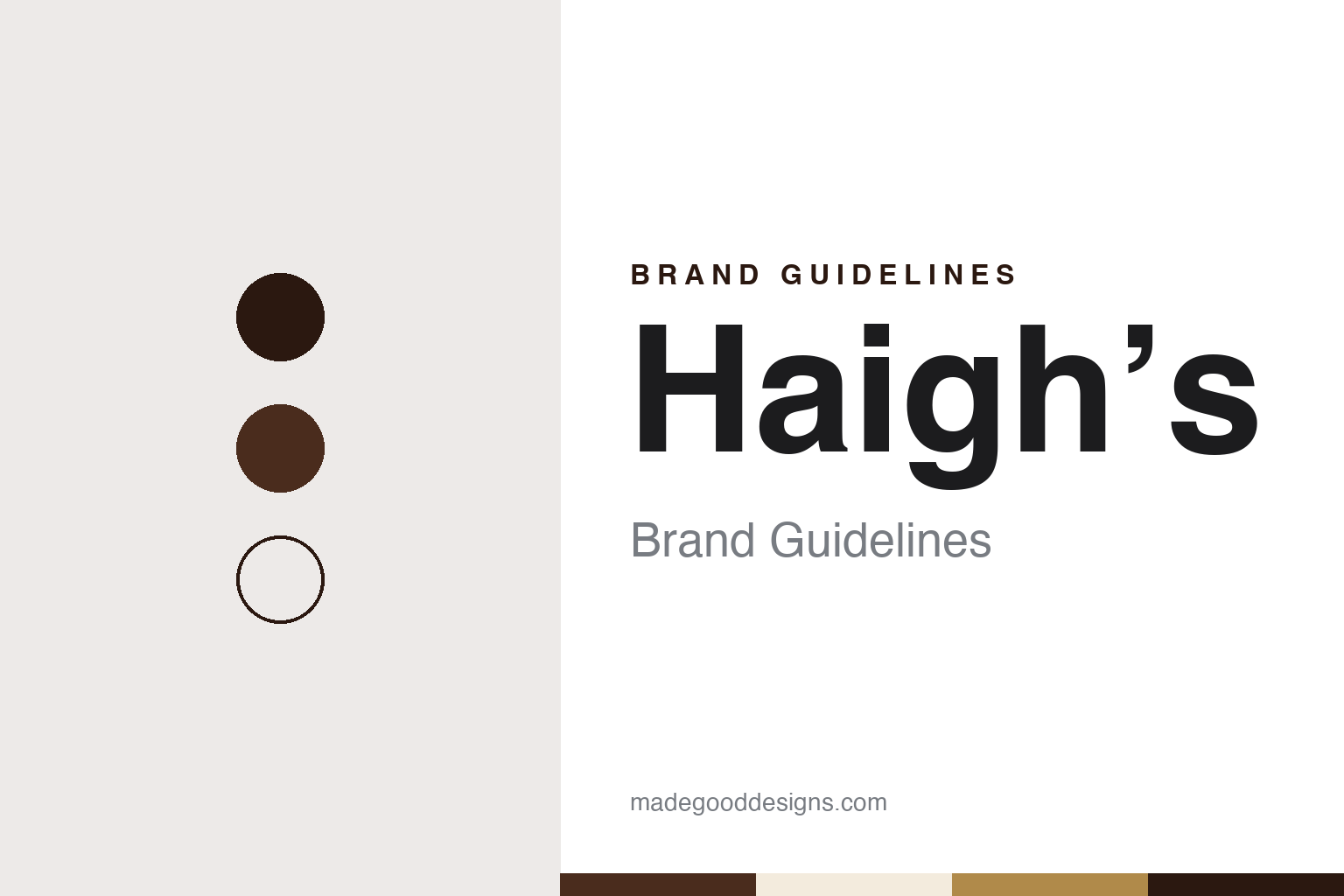
Haigh’s Brand Guidelines
The Adelaide family chocolate maker founded in 1915.
Aa
Two constants: a Haigh’s cocoa, cream and gold palette and a heritage serif register. Abstract homage — not a Haigh’s product or mark; no box, logo or wrapper is reproduced.
King William Street
A shop in Adelaide, then a factory behind the family home.
Haigh’s began in Adelaide on 1 May 1915, when Alfred E. Haigh opened a chocolate shop in the Beehive Building at 34 King William Street, the company says. The Australian Dictionary of Biography, in its 1996 entry on his son Claude, adds a detail the company’s own timeline leaves out: in 1915 Alfred bought an existing Adelaide business from Carl Stratmann and named it Haigh’s Chocolates.
The shop moved a few doors to Beehive Corner, at King William Street and Rundle Street (now Rundle Mall) — in 1922 according to English Wikipedia, in 1923 according to the company — and it is still the firm’s Adelaide flagship. In 1917, the company says, Alfred began making chocolate-coated fruit centres; he then bought the family home and land at Parkside, just south of the city, built a small two-room factory and in 1919 moved all manufacturing there. Parkside remains home to the company’s factory and its Visitor Centre.
Alfred Haigh died suddenly in 1933, when the business had six shops, the company says. His son Claude Haigh, a partner since 1921, became managing director and moved the registered offices to the Parkside factory, the Australian Dictionary of Biography records. Claude steered the firm through the Depression and through wartime sugar rationing, when, the company says, Haigh’s kept trading by making boiled sweets and wrapped toffees for the armed forces. In 1950 he bought a freehold interest in the Beehive building, the firm’s most prominent shop.
Colour
John Haigh, Switzerland and the cinemas.
The company credits Alfred’s grandson John Haigh with the taste of its chocolate today. He joined in 1946, the company says, trained in Switzerland with Lindt & Sprüngli and visited the United States to study production, shop design and marketing. The Australian Dictionary of Biography dates his return from the Swiss placement to 1951 and links the firm’s rapid growth that decade to imported German processing plant, cinema concessions and new shops. John Haigh was managing director from 1959 to 1990.
In the 1950s and 1960s Haigh’s chocolates were sold in cinemas, from counters and by uniformed “tray boys” and “tray girls” who stood in front of the screen at the interval, the company says. When television drew audiences away, Haigh’s looked interstate: in 1965 it opened its first shop outside South Australia, on Collins Street in Melbourne. Sydney and Canberra followed, and since October 2014 it has also sold online, according to English Wikipedia.
The fourth generation took over from there. Alister Haigh joined in 1973 and became chief executive in 1995, InDaily reported in July 2025; by then, he said, the company had more than 300 chocolate varieties, about 900 employees and 21 shops, and made more than 1,000 tonnes of chocolate a year.
Haigh’s calls itself a bean-to-bar maker, and its free tours at Parkside walk visitors through that process. Through the Vanuatu cooperative ACTIV and the local maker Aelan it has made a single-origin Vanuatu bar, InDaily reported in 2022.
Its best-known seasonal product is a substitution. Since Easter 1993 Haigh’s has sold a chocolate Easter Bilby in place of the rabbit, which is an introduced pest in Australia, with part of the proceeds going to the Foundation for Rabbit Free Australia, according to English Wikipedia and ABC News (2023).
Typography
Design and documentation.
The seven brands in this group all sell chocolate, and they come from three countries: Haigh’s, Darrell Lea and Koko Black from Australia, Whittaker’s from New Zealand, and Laura Secord, Purdys and Rogers’ Chocolates from Canada. They are grouped here because they share a market position more than a style: each is a home-grown name in a country whose chocolate shelves are also stocked by international groups.
They reach shoppers in different ways. Some are known mainly through their own shops, where the window, the counter and the box do much of the work of a brand; others are known mainly through supermarket shelves, where a wrapper has a few seconds to be recognised. Many sit between the two, and the line between a chocolatier, a confectioner and a chocolate maker is not always drawn the same way from one company to the next.
Each guide separates what independent sources record from what the company says about itself — who founded it, who owns it now, where its cocoa comes from and where its chocolate is made — and marks plainly what rests only on the company’s own word.
Aa
A heritage serif for an Adelaide family firm. (Specimen set in Cormorant Garamond, a serif STAND-IN; NOT the Haigh’s logo.)
Haigh’s
Still family-owned, now with an outside chief executive.
Haigh’s remains family-owned. In July 2025 Alister Haigh announced his retirement, and on 4 August 2025 he handed over to Peter Millard, the chief operating officer, who had joined the company 19 years earlier as a supply-chain manager — the first chief executive from outside the family, InDaily reported. Alister Haigh stays on the board with the fourth-generation family members Simon Haigh and Sara Fitzgerald. The company describes itself as Australia’s oldest family-owned chocolate maker.
The biggest change is in where the chocolate is made. In December 2023 Haigh’s announced a new plant at Salisbury South, in Adelaide’s north, and on 16 September 2025 it opened the 18,000-square-metre production, warehouse and fulfilment facility. InDaily reported a cost of A$120 million — A$130 million in its July 2025 report — and said it lifts capacity from 1,100 to 2,000 tonnes of chocolate a year, with 1.7 kilometres of chocolate pipes and room for up to 400 staff. The Parkside site still hosts the Visitor Centre and the tours, which the company describes as showing its “original Parkside Manufacturing facility.”
The shop network had grown to 22 retail and online stores by September 2025, InDaily reported, across Adelaide, Melbourne, Sydney and Canberra, with a seventh Sydney shop opened on Broadway that month. Haigh’s was inducted into the Food South Australia Hall of Fame in 2012.
For a design guide, Haigh’s shows how a regional maker can carry one family name and one flagship corner for more than a century while moving its production to a new plant. Compare Koko Black, a Melbourne chocolate-shop chain, and Bahen & Co, a Western Australian bean-to-bar maker. For this guide we use cocoa brown, cream and a muted gold with a serif, an unofficial interpretation; no product or logo is reproduced.
Explore & save
Keep Haigh’s’s identity on hand — save it to a board in the Made Good inspiration library.
Haigh’s identity set
Pin the Haigh’s cocoa, cream and gold palette and the heritage serif register to your own board.