Darrell Lea Brand Guidelines
The Sydney confectioner behind Rocklea Road and soft liquorice.
Aa
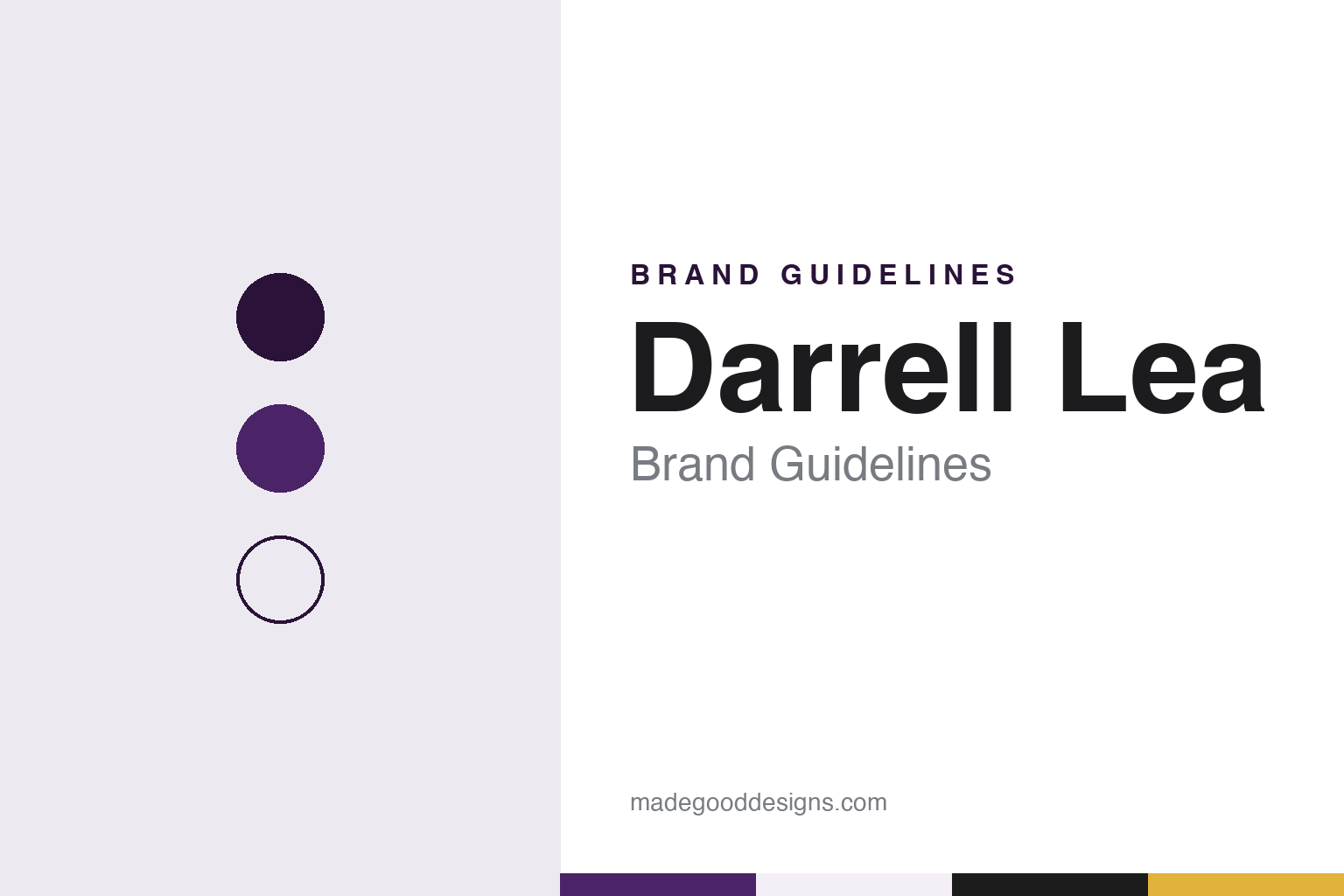
Two constants: a Darrell Lea purple, liquorice and caramel palette and a rounded sans register. Abstract homage — not a Darrell Lea product or mark; no pack, logo or wrapper is reproduced.
Haymarket
A fruit shop, a sweet shop and a name taken from the youngest son.
Darrell Lea is usually dated to 1927 — the founding year given by English Wikipedia and by The Sydney Morning Herald in 2018 — but the business grew in stages, and the sources date them differently. Its founder was Harry Lea, born Monascher Levy in London, whose family emigrated to Australia when he was a boy, according to the Australian Dictionary of Biography. By about 1917 he and his wife Esther were running a fruit shop on the Corso at Manly, where Harry revived his old trade of making toffees for the slow winter months.
In 1924 the couple gave up fruit for confectionery, opening a milk bar and sweet shop in the Haymarket, next to a theatre, and making their products at the back; the company names the shop the “King of Sweets.” The company dates the first city store, on Pitt Street, to 1929; the Australian Dictionary of Biography dates the Pitt Street shop to June 1930 and says that it was then that Levy changed the family name to Lea and called the firm “Darrell Lea” after his youngest son. The company tells a different version: in 1934 Maurice and Monty Lea set out to register the name “Levy Brothers,” and a clerk suggested naming the business after their young brother Darrell instead. The Darrell Lea Chocolate Co. Ltd was registered in 1935, the dictionary says.
The shops were the brand. The dictionary describes heaped pyramids of chocolate in the windows, prices about half those of competitors, and salesgirls in smocks finished with an oversized bow.
Colour
Rocklea Road, a factory under the Bridge and a liquorice accident.
The company dates its best-known chocolate line, Rocklea Road — toasted marshmallow and roasted peanuts mixed by hand with milk chocolate — to 1935, and says it still makes it to that recipe. Coconut Ice and Caramel Snows date from the same years, it says. In 1936 the firm won the tender for premises at No. 1 York Street, under the first arch of the new Sydney Harbour Bridge, and made its sweets there until a new factory opened at Kogarah in 1962, the Australian Dictionary of Biography records.
The family spread the business across the country. Monty and Harris Lea opened a Melbourne operation in 1940, with a shop on Swanston Street, and shops followed in Brisbane and Adelaide in 1966, English Wikipedia says. The company dates its soft black liquorice to 1957, when, it says, a batch went wrong and the result proved popular; its Batch 37 liquorice is the current version. Harry Lea died in 1957, and the company remained a family concern into the third generation.
Darrell Lea was listed on the stock exchange in 1968 and taken private again in 1982, according to English Wikipedia. Its packaging colour became a legal matter: Cadbury, which uses purple for its Dairy Milk range, sued over Darrell Lea’s use of purple, and in April 2008 a judge ruled that Darrell Lea had not been trying to mislead customers, ending a five-year case, The Daily Telegraph reported.
The company says it launched its black liquorice in the United States in 2006 and now describes itself as the largest black liquorice brand there; we give that as its claim.
Typography
Design and documentation.
The seven brands in this group all sell chocolate, and they come from three countries: Haigh’s, Darrell Lea and Koko Black from Australia, Whittaker’s from New Zealand, and Laura Secord, Purdys and Rogers’ Chocolates from Canada. They are grouped here because they share a market position more than a style: each is a home-grown name in a country whose chocolate shelves are also stocked by international groups.
They reach shoppers in different ways. Some are known mainly through their own shops, where the window, the counter and the box do much of the work of a brand; others are known mainly through supermarket shelves, where a wrapper has a few seconds to be recognised. Many sit between the two, and the line between a chocolatier, a confectioner and a chocolate maker is not always drawn the same way from one company to the next.
Each guide separates what independent sources record from what the company says about itself — who founded it, who owns it now, where its cocoa comes from and where its chocolate is made — and marks plainly what rests only on the company’s own word.
Aa
A rounded sans for a shop-window sweet maker. (Specimen set in Rubik, a sans STAND-IN; NOT the Darrell Lea logo.)
Darrell Lea
Administration, the Quinns and private equity.
After 85 years of Lea family control, Darrell Lea was placed into voluntary administration on 10 July 2012. It was reported to be losing A$200,000 a week, and about half its company-run shops closed at once, according to English Wikipedia, citing the Herald Sun and The Daily Telegraph. On 3 September 2012 it was bought by the Queensland-based Quinn family, Tony and Christina Quinn, then owners of VIP Petfoods. Most of the remaining staff and the last company-owned shops went that month; the Quinns cut more than 500 products, put about A$30 million into the business, built a second factory at Ingleburn in south-west Sydney and moved the brand into supermarkets including Coles, Woolworths and IGA, English Wikipedia says, citing the Australian Financial Review and The Daily Telegraph.
In January 2018 Quadrant Private Equity bought Darrell Lea from the Quinns for about A$200 million, the Australian Financial Review and The Sydney Morning Herald reported; the Financial Review said the Quinns kept a significant stake. Quadrant’s executive chairman, Chris Hadley, called it an “iconic brand.” That is the most recent change of ownership we could confirm. The headquarters is at Ingleburn.
The company says its liquorice, Rocklea Road and chocolate bullets are made at Ingleburn, while its chocolate blocks, launched nationally in 2019, are made at a factory at Rowville in Victoria from ingredients partly sourced overseas. It says its cocoa has been sourced through the Cocoa Horizons sustainability programme since 2018. The Australian reported in November 2023 that the company makes more than a billion chocolate bullets a year.
For a design guide, Darrell Lea shows how a brand born in its own shop windows can survive the loss of those shops and live on supermarket shelves. Compare Haigh’s, another Australian maker of the same era, and Thorntons, a British shop-chain confectioner. For this guide we use a purple, liquorice black and caramel with a sans, an unofficial interpretation; no product or logo is reproduced.
Explore & save
Keep Darrell Lea’s identity on hand — save it to a board in the Made Good inspiration library.
Darrell Lea identity set
Pin the Darrell Lea purple, liquorice and caramel palette and the rounded sans register to your own board.