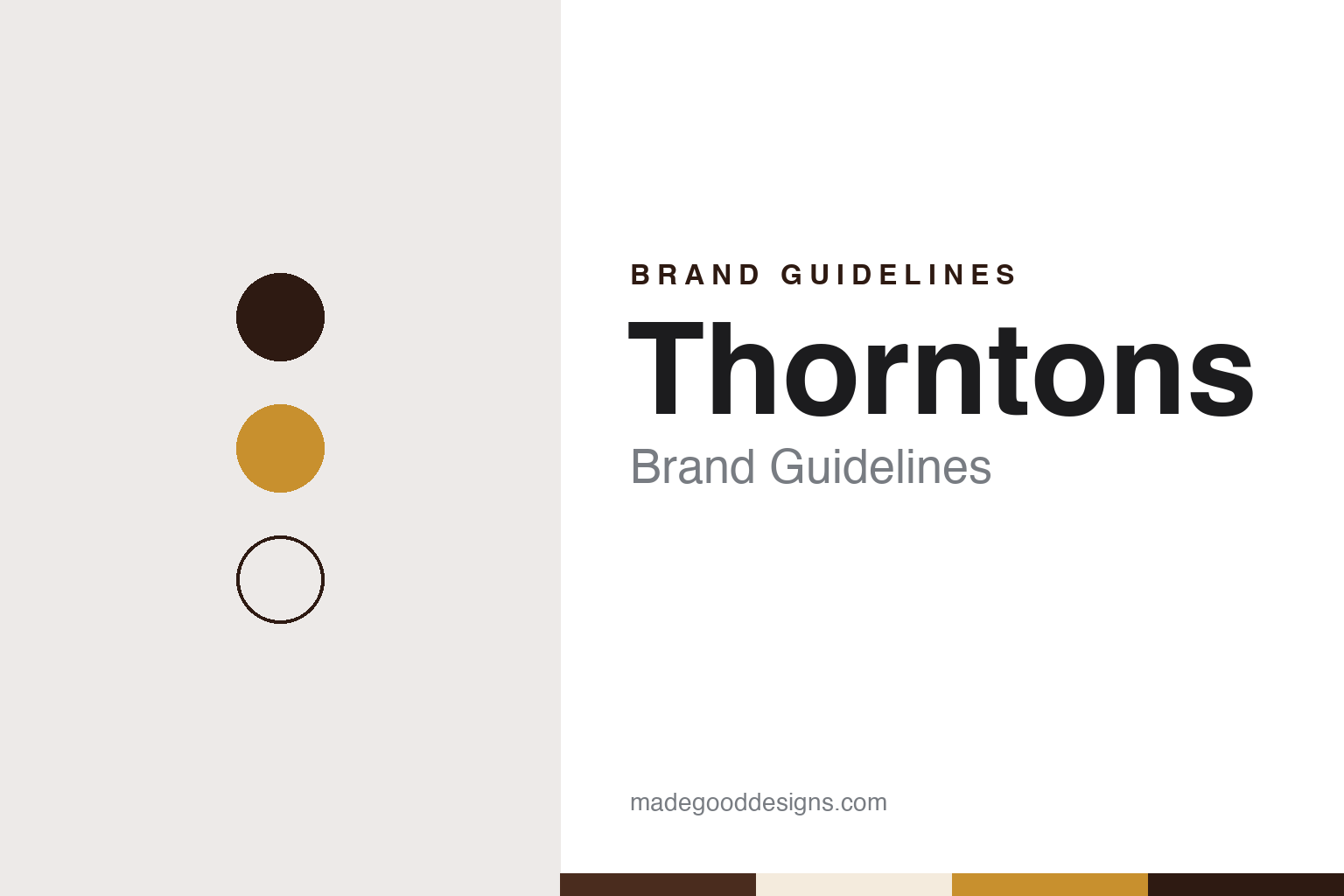
Thorntons Brand Guidelines
The Sheffield sweet shop that became a Ferrero brand.
Aa
Two constants: a cocoa brown, toffee gold and cream palette and a classic serif register. Abstract homage — not a Thorntons product or mark; no box, logo or wrapper is reproduced.
A Sheffield sweet shop
A travelling confectioner, a son and a shop.
Thorntons began in Sheffield in 1911. The company says Joseph Thornton, a travelling confectioner, opened a sweet shop in the city and asked his son Norman to run it; Norman later brought in his brother Stanley. The Guardian, reporting the company’s sale in 2015, also named Joseph Thornton as the founder, and quoted the slogan the business still used: “chocolate heaven since 1911.”
The first shop sold bought-in sweets — the company names Violet Cachous and Sweet Lips — and the brothers did not start making their own hand-made truffles and fondants until the 1920s, it says. In 1922 they began hand-icing Easter eggs, packed in a plain white box, which the company presents as the start of its personalised chocolates, a line it still sells. Its Special Toffee followed in 1925; the company says the recipe took 50 attempts to get right and is still used, “albeit with a few delicate tweaks.”
Toffee mattered to the brand’s reputation. Speaking to The Observer in 2011, the retail analyst Clive Black recalled that Thorntons had been “a reasonably high-end brand in the north of Britain” with “a real point of difference in their toffee.” The same article described the family side of the story: Peter Thornton, the founder’s grandson, had served as chairman until he was pushed out in a family rift in 1987.
Colour
A factory built for more than the shops.
The business grew from shops into manufacturing. The company says a purpose-built factory came first, and that production later moved to Derbyshire, where its fudge and the original Continental range were introduced. In 1983 construction started on Thornton Park at Alfreton, in Derbyshire, which the company says was opened by the Queen in 1985 and where its chocolates are still made. Thorntons floated on the stock market in 1987, The Guardian reported.
That factory shaped the next quarter-century. The Observer wrote in May 2011 that the Alfreton plant had been opened “in more ambitious times, with capacity well beyond the amount of chocolate sold in the company’s shops,” so the firm had chosen to push more of it through supermarkets. At the time Thorntons had about 370 high-street shops and 229 franchise counters and employed 4,500 people; it had issued four profit warnings in little over a year, and the paper called it Britain’s biggest free-standing chocolate maker after Kraft bought Cadbury. Peter Thornton, then campaigning for a turnaround plan, criticised “robot-packed” boxes and called the slogan of the day, “The Art of the Chocolatier,” vacuous.
Its marketing could be theatrical. In April 2007, BBC News reported, Thorntons built an Easter billboard in London’s Covent Garden from 390kg of chocolate — ten bunnies, 72 giant eggs and 128 panels — which passers-by ate in about three hours.
A new chief executive, Jonathan Hart, arrived from Caffè Nero in January 2011, and that June the company announced plans to close up to 180 of its 364 shops after a strategic review, BBC News later recalled. By 2015, The Guardian wrote, Thorntons’ chocolate, “once seen as luxurious and upmarket,” had lost some of its lustre as tastes shifted towards darker, less sugary flavours.
Typography
Britain’s chocolate makers.
The seven brands in this group are all British chocolate names: Thorntons, Green & Black’s, Montezuma’s, Divine Chocolate, Charbonnel et Walker, Prestat and Rococo Chocolates. Between them they cover most of the ways chocolate is sold in Britain, from the high street and the supermarket shelf to the small shop with a box tied in ribbon.
Some are high-street makers, known for shops in town centres and for the boxes people buy as presents at Easter and Christmas. Some built their names on ethics, putting organic farming, fair trade or the cocoa growers themselves at the centre of the story told on the wrapper. Others are London houses whose identity rests on age, address and patronage: shops in Mayfair and the West End, hand-finished truffles, and, in some cases, the royal warrant that allows a firm to display the royal arms on its packaging.
British chocolate brands have also changed hands often, and several of the best-known names now belong to larger groups at home or abroad. Each guide separates what independent sources record from what the company says about itself — who founded it, who owns it now, where its cocoa comes from and where its chocolate is made — and marks plainly what rests only on the company’s own word.
Aa
A classic serif — our register for a century-old shop brand. (Specimen set in Playfair Display, a serif STAND-IN; NOT the Thorntons logo.)
Thorntons
From high street to supermarket shelf.
On 22 June 2015 the Italian group Ferrero, maker of Nutella and Ferrero Rocher, agreed to buy Thorntons for £112m, The Guardian reported. Ferrero did not then manufacture in the UK, and said it would keep the Thorntons brand and the Alfreton factory, which employed about 1,500 of Thorntons’ 3,500 staff; the future of its 242 shops in Britain and Ireland, and of the head office, also in Alfreton, was put under review. Giovanni Ferrero said the deal united “two companies that share the same passion for growing brands and a proud heritage.” The company says joining Ferrero led to the “reimagining and remastering” of some of its best-known chocolates.
The shops did not survive. On 15 March 2021 Thorntons said that none of its 61 remaining shops would reopen after the coronavirus lockdowns, putting more than 600 jobs at risk, BBC News reported; the estate had shrunk from 252 shops over five years. The company said it had spent £45m transforming the business, including new cafés, before the pandemic; it would now sell online, where sales had risen by more than 70% on the previous year, and through supermarkets, and would expand the range made at Alfreton and its international sales. Ferrero said it remained “committed to this iconic British brand.”
Today the website names Thorntons Limited, “part of the Ferrero Group,” and sells boxed ranges under the Classic and Continental names alongside Special Toffee, Vanilla Fudge and personalised chocolates. It describes the Continental collection as inspired by recipes met on its chocolate makers’ travels, with flavours meant to evoke Sicily, Seville, Milan and Vienna. Its sustainability page sets out Ferrero’s group commitments on cocoa, hazelnuts and palm oil; the pages we checked do not name the countries its cocoa comes from.
For a design guide, Thorntons shows how a shop brand’s identity has to travel when the shops close and the box becomes the whole storefront. Compare Green & Black’s, another British chocolate name now owned by a multinational, and Pump Street, a small British maker. For this guide we use cocoa brown, toffee gold and cream with a serif, an unofficial interpretation; no product or logo is reproduced.
Explore & save
Keep Thorntons’s identity on hand — save it to a board in the Made Good inspiration library.
Thorntons identity set
Pin the Thorntons cocoa brown, toffee gold and cream palette and the classic serif register to your own board.