Green & Black’s Brand Guidelines
Organic chocolate, Maya Gold and the Fairtrade mark.
Aa
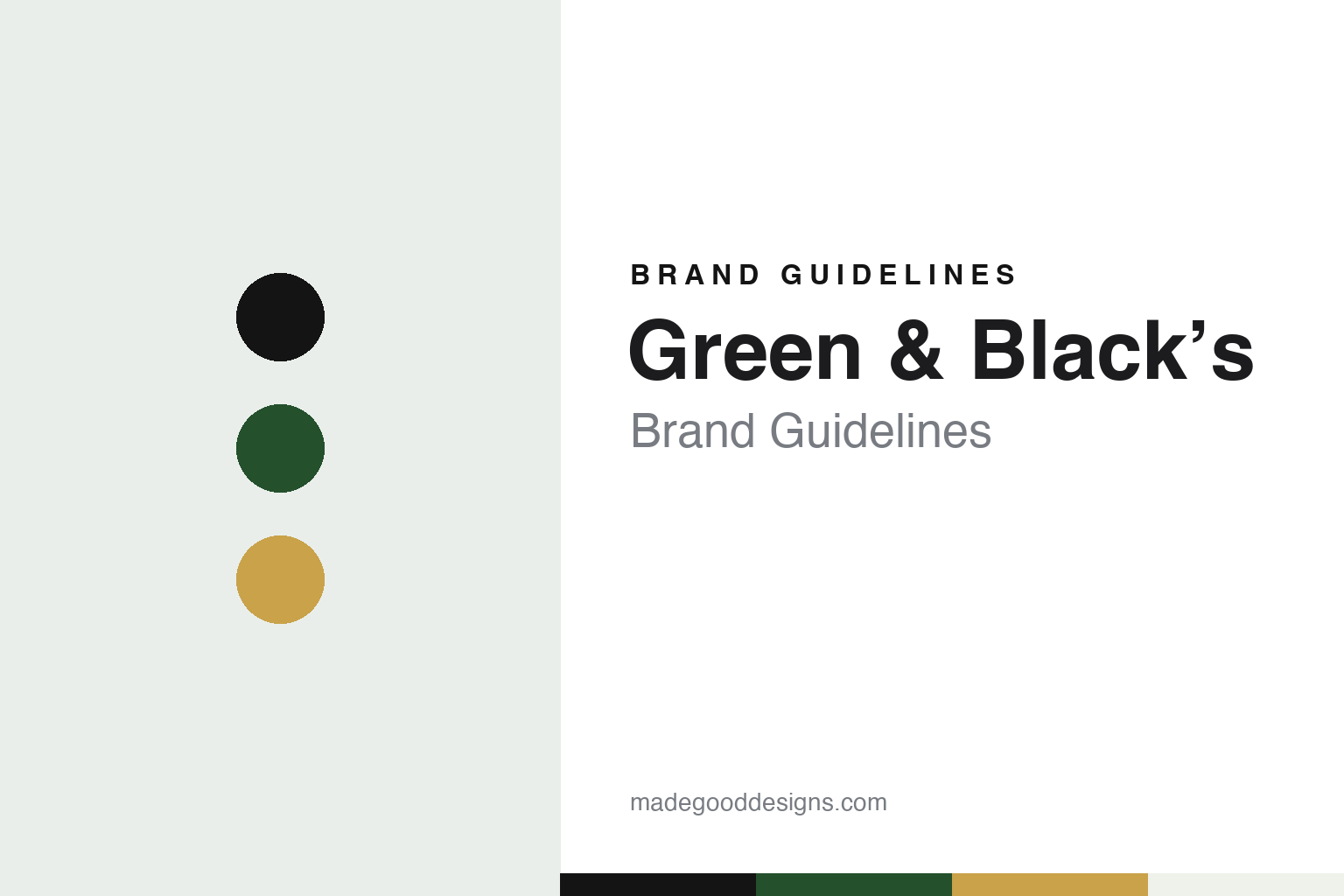
Two constants: a black, green and gold palette and a geometric sans register. Abstract homage — not a Green & Black’s product or mark; no wrapper, logo or bar is reproduced.
Portobello Road
An organic-food pioneer and a journalist.
Green & Black’s was founded in London in 1991 by Craig Sams and his wife Josephine Fairley; BBC News placed its start on Portobello Road. Sams already had a long record in organic food: he had founded the Whole Earth brand, and English Wikipedia says he was honorary treasurer of the Soil Association, the British organic farming charity, from 1990 to 2001 and its chairman from 2001 to 2007. Fairley was, in the company’s words, an environment columnist for The Times.
The company tells its origin as a tasting. Its website in 2008 said Sams was sent a sample of 70% dark chocolate made from organic cocoa beans; Fairley found the half-eaten bar on his desk, and the couple set out to sell it. Their first product, it says, was a bittersweet dark bar with 70% cocoa solids — enough “to make chocolate fans sit up and take notice.” The Observer gave a supply-side detail in 2006: Whole Earth had launched a bar made with organic beans from Togo in 1991, and when a military coup there cut off supply two years later, Sams went looking for organic cocoa elsewhere, and found it in Belize.
The name was a deliberate period piece. There was never a Mr Green or a Mrs Black, the company said in 2008; Sams and Fairley had in mind the paired names of the confectionery of their childhoods, such as Callard & Bowser and Barker & Dobson. In the company’s telling, green stood for strict organic principles and black for the intensity of the chocolate “and iconic style of the brand.”
Colour
Maya Gold and the first Fairtrade mark.
The bar that made the brand’s name came from southern Belize. In 1993 Sams approached the Toledo Cacao Growers’ Association, a co-operative of Maya smallholders whose cocoa market had collapsed, The Observer reported; he offered a five-year rolling contract, a fixed price above the market, a cash advance and help with Soil Association certification. The result was Maya Gold, a dark chocolate with orange and spice which the company says was inspired by a traditional Mayan cocoa drink, and which it now describes as blended with orange, cinnamon, nutmeg and vanilla.
In 1994 Maya Gold became the first chocolate in the UK — and, according to The Observer, the first British product of any kind — to carry the Fairtrade mark. English Wikipedia adds that the company won a Worldaware Business Award the same year and keeps a small office in Punta Gorda, Belize. By 2006 the association had about 940 members, and The Observer reported that Green & Black’s was buying all the organic cocoa it produced, while also shipping some from the Dominican Republic to meet demand; at that point Maya Gold was the only Fairtrade bar among 15, and the rest were organic, using cocoa from the Dominican Republic, Mexico, Madagascar and Belize.
Growth came with outside money. In 1999 a group of investors led by William Kendall, the former head of the New Covent Garden Soup Company, bought an 80% stake, BBC News reported in 2005. Sales then grew at an annual rate of 69%, to £22.4m in the year before the sale, and the brand had 5.1% of the UK market for block chocolate, the BBC said, calling it the fastest-growing confectionery brand. By then it also sold organic ice cream, biscuits and baking chocolate through retailers such as Boots and Tesco.
Typography
Britain’s chocolate makers.
The seven brands in this group are all British chocolate names: Thorntons, Green & Black’s, Montezuma’s, Divine Chocolate, Charbonnel et Walker, Prestat and Rococo Chocolates. Between them they cover most of the ways chocolate is sold in Britain, from the high street and the supermarket shelf to the small shop with a box tied in ribbon.
Some are high-street makers, known for shops in town centres and for the boxes people buy as presents at Easter and Christmas. Some built their names on ethics, putting organic farming, fair trade or the cocoa growers themselves at the centre of the story told on the wrapper. Others are London houses whose identity rests on age, address and patronage: shops in Mayfair and the West End, hand-finished truffles, and, in some cases, the royal warrant that allows a firm to display the royal arms on its packaging.
British chocolate brands have also changed hands often, and several of the best-known names now belong to larger groups at home or abroad. Each guide separates what independent sources record from what the company says about itself — who founded it, who owns it now, where its cocoa comes from and where its chocolate is made — and marks plainly what rests only on the company’s own word.
Aa
A clean geometric sans — our register for an organic brand. (Specimen set in Jost, a sans STAND-IN; NOT the Green & Black’s logo.)
Green & Black’s
From Cadbury to Mondelēz.
In May 2005 Cadbury Schweppes bought Green & Black’s for an undisclosed sum, estimated at about £20m, BBC News reported. Cadbury pledged to run it as a standalone company; Craig Sams stayed on as president and William Kendall as chief executive, and Cadbury’s chief executive Todd Stitzer said the two businesses shared “a passion for quality products and ethical values.” When Kraft Foods took over Cadbury in 2010, Green & Black’s went with it; Kraft’s snacks business is now Mondelēz International, which owns the brand through Cadbury, BBC News noted in 2017.
Under its new owners the ethical labels changed more than once. English Wikipedia says Green & Black’s in Australia moved its whole range to Fairtrade by 2011. In August 2017 the brand launched its first UK product without either a Fairtrade or an organic label, the Velvet Edition, which carried Mondelēz’s own Cocoa Life sustainability scheme instead, BBC News reported; Mondelēz’s Glenn Caton said the beans were “not available in organic at the scale required.” The rest of the range stayed organic and Fairtrade, the BBC said. The company now says it celebrated 30 years as a Fairtrade-certified chocolate brand in 2024.
Where the bars are made is less clearly documented. English Wikipedia says the brand’s principal manufacturing sites are in Canada, Poland and Italy, without citing a source, and the brand pages we checked do not say. The UK web address now leads to Cadbury Gifts Direct, which says it is run under licence from Mondelēz by Hemingways Marketing Services of Ripon, and sells Green & Black’s bars, hampers and gift boxes there; the current range includes Dark 85%, Dark 70%, Mint and Butterscotch, and the story of Maya Gold remains the brand’s headline.
For a design guide, Green & Black’s shows how a name built on two words — one for the ethics, one for the chocolate — can carry a brand through changes of owner. Compare Divine Chocolate, another British Fairtrade pioneer, and Alter Eco, an organic and fair-trade chocolate brand. For this guide we use black, a deep green and gold with a sans, an unofficial interpretation; no product or logo is reproduced.
Explore & save
Keep Green & Black’s’s identity on hand — save it to a board in the Made Good inspiration library.
Green & Black’s identity set
Pin the Green & Black’s black, green and gold palette and the geometric sans register to your own board.