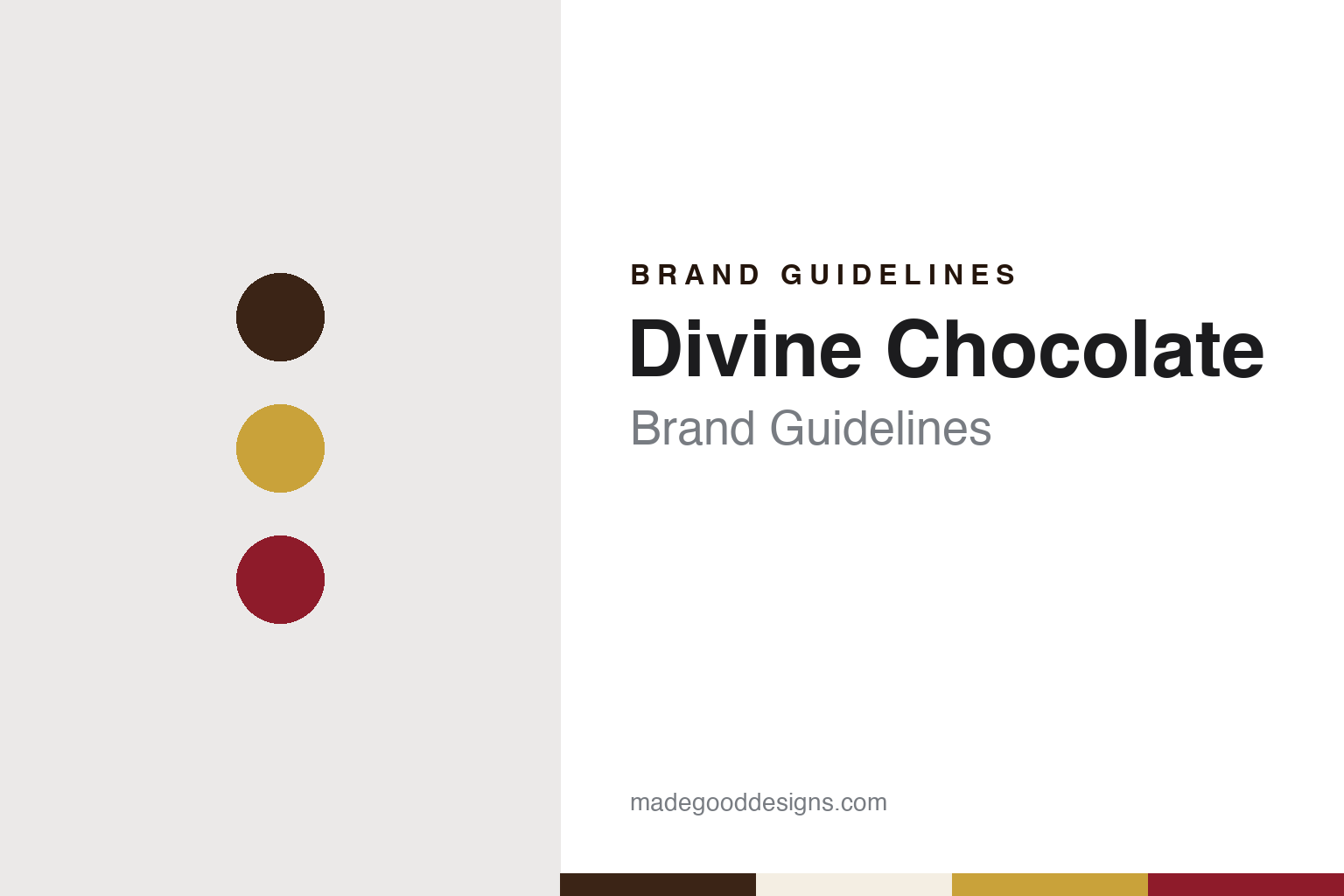
Divine Chocolate Brand Guidelines
A chocolate brand set up by cocoa farmers, with Adinkra symbols on the bar.
Aa
Two constants: a cocoa, gold and red palette and a bookish serif register. Abstract homage — not a Divine product or mark; no wrapper, Adinkra symbol or logo is reproduced.
The Day Chocolate Company
A vote by cocoa farmers in Ghana.
Divine Chocolate began with a vote in Ghana. In 1998, the company says, members of Kuapa Kokoo, a cocoa farmers’ cooperative, voted at their annual general meeting to set up a chocolate company of their own in the UK. The cooperative had been formed earlier in the decade with the help of Twin Trading, a London fair-trade organisation; its name means “good cocoa farmer” in Twi, and its motto, “pa pa paa,” means “the best of the best,” the company says.
The UK business was first called The Day Chocolate Company, named in memory of Richard Day of Twin Trading, the company says; Companies House records it as incorporated in September 1997 under that name. Its first bar was Divine Fairtrade Milk Chocolate. According to the company’s website in 2007, its 99 ordinary shares were held from the outset 52% by Twin Trading, 33% by Kuapa Kokoo and 14% by The Body Shop; Christian Aid held preference shares, and Comic Relief backed the venture. English Wikipedia describes the same founding partners, and the company also credits support from the UK’s Department for International Development.
The farmers’ stake then grew. After The Body Shop was bought by L’Oréal, it gave its shares to Kuapa Kokoo, and the Dutch development lender Oikocredit bought 12%, taking the cooperative to 45%; the company’s 2007 website dates that decision to July 2006, while Wikipedia gives 2007. The Day Chocolate Company was renamed Divine Chocolate Ltd in January 2007, to match its brand. Divine says it made its first profit in 2006 and paid its first dividend to Kuapa Kokoo at the cooperative’s 2007 meeting. It launched in the United States in 2009, and in 2015 merged its UK and US businesses, leaving Kuapa Kokoo with 44%, Wikipedia says.
Colour
Partnerships, prizes and a printed wrapper.
Divine’s model was the point of the brand. In 1999 the Design Council gave the company “Millennium Product” status for its organisational model, the company’s website said in 2007. English Wikipedia lists later recognition: runner-up in the Worldaware Awards in 2002, Best Ethical Business in the Observer Ethical Awards in 2008, Social Enterprise of the Year in 2014 and a Guardian Sustainable Business Award in 2015.
The range spread through partnerships. With Comic Relief, Divine launched Dubble, a Fairtrade bar for children, in 2000, developed “with input from thousands of children,” its website said in 2009. By 2007 it was also supplying the chocolate for the Co-op’s own-label range, after the chain switched its own-label chocolate to Fairtrade in 2003, and for Starbucks’ own-label bars in the UK, the company said then. Today the line-up runs from 70% dark bars with ginger and orange or raspberries to milk and white chocolate and hot chocolate, and, since 2024, a Dessert Bar range inspired by puddings such as tiramisu and lemon cheesecake, which the company says won two Great Taste Awards.
The wrapper carries a West African signature. Divine’s bars have been printed with Adinkra symbols, the visual symbols of Ghana’s Akan tradition, since at least 2007; its website in 2010 invited visitors to “roll over the bar” to learn what “the symbols on the Divine bar represent.” Divine says it stopped using palm oil after launching a caramel-filled bar without it in 2015, was certified as a B Corporation in 2018, and uses FSC-certified paper and board. In September 2025 it ran its first television advertisement, shot in the UK and Ghana with Kuapa Kokoo farmers, after winning media space in a Channel 4 competition for B Corps.
Typography
British chocolate and its owners.
The seven brands in this group are all British chocolate names: Thorntons, Green & Black’s, Montezuma’s, Divine Chocolate, Charbonnel et Walker, Prestat and Rococo Chocolates. Between them they cover most of the ways chocolate is sold in Britain, from the high street and the supermarket shelf to the small shop with a box tied in ribbon.
Some are high-street makers, known for shops in town centres and for the boxes people buy as presents at Easter and Christmas. Some built their names on ethics, putting organic farming, fair trade or the cocoa growers themselves at the centre of the story told on the wrapper. Others are London houses whose identity rests on age, address and patronage: shops in Mayfair and the West End, hand-finished truffles, and, in some cases, the royal warrant that allows a firm to display the royal arms on its packaging.
British chocolate brands have also changed hands often, and several of the best-known names now belong to larger groups at home or abroad. Each guide separates what independent sources record from what the company says about itself — who founded it, who owns it now, where its cocoa comes from and where its chocolate is made — and marks plainly what rests only on the company’s own word.
Aa
A bookish serif — the register of a brand that tells its story on the wrapper. (Specimen set in Cormorant Garamond, a serif STAND-IN; NOT the Divine logo.)
Divine Chocolate
Made in Germany, and now owned there too.
Divine does not make its own chocolate: its accounts for 2022 describe its business as “the marketing and distribution of fair trade chocolate products.” The cocoa comes chiefly from Kuapa Kokoo in Ghana; the same accounts name cocoa farmers in São Tomé who supply its organic range, and farmers in Sierra Leone’s Gola Rainforest. The chocolate is made in Germany: Ludwig Weinrich, a family chocolate maker in Herford founded in 1895, says it has produced Fairtrade chocolate since 1996 for GEPA and “Divine UK,” with Kuapa Kokoo supplying the raw materials for Divine’s bars. Divine’s own FAQ explains why the chocolate is not made in Ghana, citing imported milk and other ingredients and the cost of refrigerated shipping.
Weinrich is now its owner as well as its maker. Companies House records that on 29 May 2020 a Herford company, Papa Paa GmbH — its name echoing the cooperative’s motto — became Divine’s majority shareholder, with 75% or more of the shares, and that Kuapa Kokoo and Twin Trading each ceased to hold more than a quarter on the same date. Divine’s accounts for the year to June 2025 name Ludwig Weinrich GmbH & Co. KG as its ultimate controlling parent, and the Divine website says the company “is part of the Weinrich Group.” The accounts also record that its American subsidiary, Divine Chocolate Inc, was wound up in August 2025. Divine still describes itself as “a company co-owned by cocoa farmers”; we could not find a dated, sourced figure for the cooperative’s current stake.
For a design guide, Divine shows how ownership itself can become the brand story — and how that story has to be read against the register when ownership changes. Compare Tony’s Chocolonely, another mission-led brand that makes its case on the wrapper, and Alter Eco, a fair-trade chocolate brand. For this guide we use cocoa brown, gold and a deep red with a serif, an unofficial interpretation; no product or logo is reproduced.
Explore & save
Keep Divine Chocolate’s identity on hand — save it to a board in the Made Good inspiration library.
Divine Chocolate identity set
Pin the Divine cocoa, gold and red palette and the bookish serif register to your own board.