Neuhaus Brand Guidelines
The Brussels house credited with the praline and the ballotin.
Aa
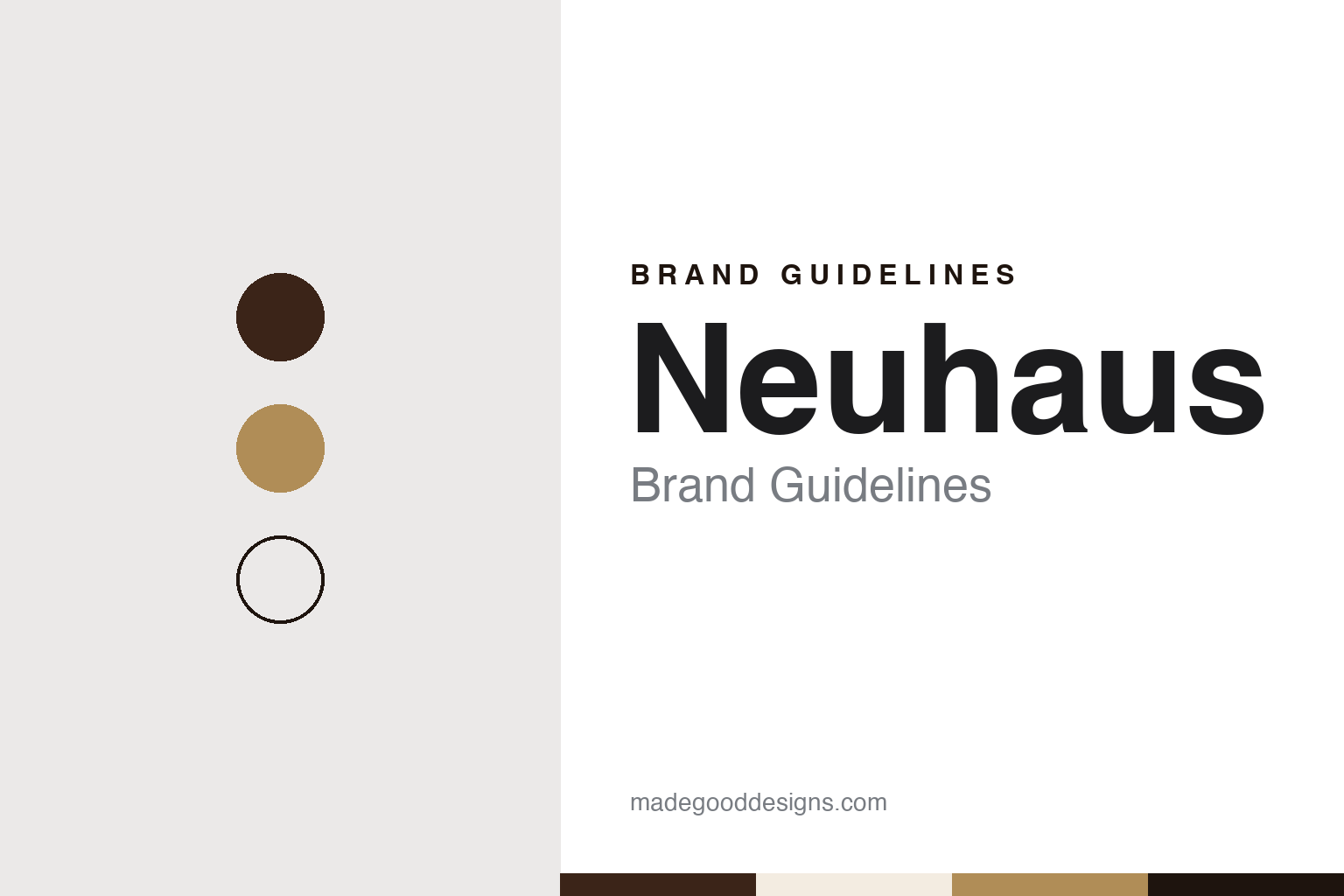
Two constants: a Neuhaus brown, cream and gold palette and an arcade serif register. Abstract homage — not a Neuhaus product or mark; no box, logo or chocolate is reproduced.
A pharmacy in the Galerie
Medicine, then chocolate, under a glass roof.
Neuhaus began in 1857, when Jean Neuhaus, a Swiss immigrant, opened a pharmacy in the Galerie de la Reine, part of the glass-roofed Galeries Royales Saint-Hubert near the Grand-Place in Brussels. The company’s own history says he coated his medicines in chocolate to make them easier to take; English Wikipedia adds that liquorice, guimauves (a kind of marshmallow) and dark chocolate tablets soon shared the counter. With his son Frédéric, the confectionery gradually pushed the pharmacy aside.
The step the house is best known for came in 1912, the year Frédéric died. His son, Jean Neuhaus II, replaced the medicine inside the chocolate with a soft filling and called the result a praline; Neuhaus describes it as the first filled chocolate, and The New York Times wrote in 2011 that the Brussels chocolatier Jean Neuhaus “invented the praline 100 years ago.” In Belgium the word still means a chocolate shell with a soft centre, not the French sugared nut.
The second invention was packaging. Pralines were crushed in the paper cones then used to carry them, and in 1915 Louise Agostini, Jean II’s wife, designed a rigid gift box, the ballotin. English Wikipedia, citing Jacques Mercier’s The Temptation of Chocolate (2007), says its registration document is dated 16 August 1915. French Wikipedia dates the company form, Jean Neuhaus S.A., to 1938.
Colour
Irrésistibles, royal pralines and a holding company.
Later generations kept adding named chocolates. French Wikipedia credits Adelson de Gavre, Jean II’s son-in-law, with many new varieties from 1923, and the company dates its “Bonbon 13” and “Astrid” pralines to 1937. At the Brussels World Expo of 1958 it showed the Caprice and Tentation, the first of its Irrésistibles, nougatine shells filled with cream or ganache, which the company says were inspired by Brigitte Bardot. Royal weddings in 1959 and 1960 brought pralines named Baudouin, Fabiola, Albert and Paola, and in 1970 it introduced the Cornet Doré, a nod to the paper cones the ballotin replaced. Neuhaus became a Royal Warrant holder to the Belgian court in 2000.
Abroad, its first US boutique opened in Grand Central Terminal in New York in 1999, followed by a Madison Avenue flagship in 2011, according to the company’s US site. Bloomberg Pursuits named its classic truffle the best in the world in February 2017.
Ownership is documented by the owner itself. Compagnie du Bois Sauvage, a Brussels investment holding founded in 1991 by Guy Paquot and still controlled by the Paquot family, reported holding 28.03% of Neuhaus in 1999, 36.61% in 2000 and 45.87% by March 2002. By 2013 its chocolate group, made up of Neuhaus, the French chain Jeff de Bruges, founded in 1986 and now running some 480 shops in France, and Corné Port-Royal (bought in 2013), was 100% owned, its website showed in 2016. Its 2025 annual report lists Neuhaus at 100%; in March 2026 Bois Sauvage announced it was buying the remaining 34% of Jeff de Bruges, and it now calls chocolate the strategic core of the group.
Typography
Design and documentation.
The seven brands in this group are all Belgian: Neuhaus, Leonidas, Godiva, Côte d’Or, Guylian, Galler and Wittamer. Together they show how wide the phrase “Belgian chocolate” has become, from a filled praline chosen piece by piece over a shop counter to a bar or a box sold in supermarkets and airport shops around the world.
The praline — in Belgium, a shell of chocolate around a filling such as ganache, nut paste or cream — is the country’s signature, and the ballotin, the small card box it is packed into, is part of the same ritual. At one end of the trade are names that grew into large groups, with factories, franchise shops and global distribution, and whose identity has to work on a shelf as well as in a window. At the other are pâtissier-chocolatiers on squares such as the Grand Sablon in Brussels, where the name rests on one address, a workshop nearby and a long local history.
Each guide separates what independent sources record from what the company says about itself — who founded it, who owns it now and where its chocolate is made — and marks plainly what rests only on the company’s own word.
Aa
A classical serif — the register of a nineteenth-century arcade. (Specimen set in Cormorant Garamond, a serif STAND-IN; NOT the Neuhaus logo.)
Neuhaus
Still made at Vlezenbeek.
Where the chocolates are made is stated plainly. Bois Sauvage says Neuhaus produces more than 500 million pralines a year in its workshop at Vlezenbeek, just west of Brussels, and the company says all its pralines and truffles “have always been crafted with care in Belgium.” In 2025 a new moulding line was commissioned, due to be fully running in 2026, and projects began to automate baking and folding lines; the owner also says Neuhaus makes chocolates for selected private-label partners to use the added capacity.
On cocoa, Neuhaus says all its cacao is sustainably sourced and that it has invested in a farm in the Guayaquil region of Ecuador. The owner’s report is more precise: the group holds 28% of the Ecuadorian company Ecuadorcolat, counting Jeff de Bruges’s share, which farms close to 1,500 hectares, mainly cacao, and supplies its shareholders only; it added 185 hectares in 2025. The report also says other cocoa sources are used, so the farm is one supply among several rather than the whole.
The business is smaller than its reputation. Bois Sauvage counts more than 800 points of sale worldwide, a lower figure than the 1,500 quoted in older summaries. It described 2025 as a “perfect storm” of volatile cocoa prices and new US import tariffs, yet reported double-digit sales growth, four new US shops and entry into Jordan. Its chief executive, Isabel Baert, is interviewed in that report about the sustainability reporting Neuhaus began publishing in 2024. The historic flagship remains in the Galerie de la Reine, where the house began.
For a design guide, Neuhaus shows how a house can own two inventions at once, a product and the box it comes in, and how the box became the category’s shape. Compare Leonidas, the other Brussels praline house, and Pierre Marcolini, a younger Brussels name. For this guide we use praline brown, cream and ballotin gold with a serif, an unofficial interpretation; no product or logo is reproduced.
Explore & save
Keep Neuhaus’s identity on hand — save it to a board in the Made Good inspiration library.
Neuhaus identity set
Pin the Neuhaus brown, cream and gold palette and the arcade serif register to your own board.