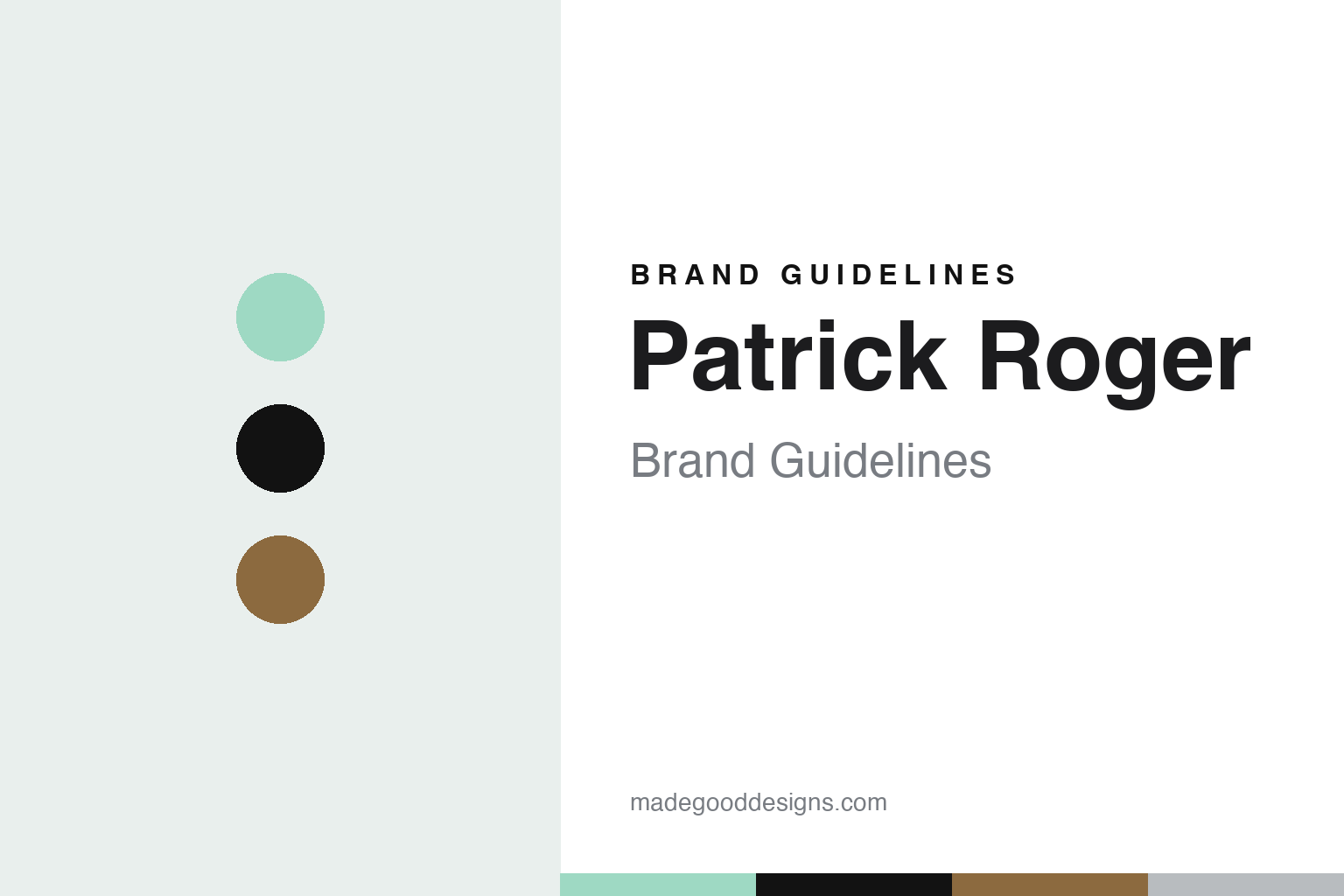
Patrick Roger Brand Guidelines
The chocolatier who works in chocolate, bronze and mint green.
Aa
Two constants: a mint, black and bronze palette and a workshop sans register. Abstract homage — not a Patrick Roger product or mark; no chocolate, sculpture or logo is reproduced.
From Le Poislay to Sceaux
A baker’s son, a competition and a shop in the suburbs.
Patrick Roger is a chocolatier with his own name over the door. He grew up in Le Poislay, a village in the Loir-et-Cher, the son of a baker, according to French Wikipedia, which cites Radio France. At fifteen he was apprenticed to a baker-pâtissier in Châteaudun; at eighteen he went to Paris as a junior at the caterer and pâtissier Pierre Mauduit, where he first worked with chocolate. “I did not go to art school, I don’t draw and I didn’t go to museums as a child,” he told Gault&Millau in 2025.
His first signature came from a competition. In 1994, French Wikipedia says, he won a world chocolate cup with the Amazone, a green half-sphere filled with lime ganache. The half-sphere is still part of his range: his 2026 online shop lists assortments of half-spheres including a lime caramel.
He opened his first shop in Sceaux, a suburb south of Paris in the Hauts-de-Seine, in the late 1990s — 1998 according to Gault&Millau, 1997 according to French Wikipedia. In 2000 he became a Meilleur Ouvrier de France chocolatier, the state craft title, helped by Harold, a life-size chocolate figure of a seated cocoa planter weighing 62 kilograms, Gault&Millau reported.
The business has stayed small and in his hands. The French company register lists Patrick Roger as chairman of the operating company, Roger et Cie, set up in Sceaux in 2000 and registered as a chocolate maker, and shows no outside group above it. Gault&Millau counted nine shops in Paris and its suburbs in December 2025, and Time Out Paris gave the same number in September 2026.
Colour
One workshop for chocolate and bronze.
Everything is made in Sceaux. French Wikipedia says that in 2009 Roger moved from a 40-square-metre workshop to one of 700 square metres in the same town. A fire destroyed the workshop in 2014, French Wikipedia says, citing Le Parisien; in May 2018 the Journal du Design reported that it had reopened, “freshly renovated after a fire a few years ago.” Gault&Millau described it in 2025 as a building of concrete and glass, bathed in daylight, that looks like a contemporary art gallery, with aluminium heads hanging from the ceiling. The company opened it to the public for the Journées du patrimoine in September 2026.
The workshop serves two trades. Around 2008, Roger told Time Out Paris, a customer from his Sceaux shop took him to the Fonderie de Coubertin, the art foundry west of Paris, and he realised that his window sculptures, modelled in chocolate, could be cast to last. Harold was the first to be cast in bronze, at 122 kilograms. “I have perhaps 20,000 or 30,000 moulds,” he told Gault&Millau. His subjects are mostly animals — gorillas, hippopotamuses, elephants — and he has shown at Christie’s in Paris in 2017 and at 21_21 Design Sight in Tokyo in 2018, according to French Wikipedia. The radio station RTL called him “the Rodin of chocolate” in 2021. In September 2026, for Paris Design Week, he opened his first gallery, Roger Garage, on the place Saint-Sulpice, next to his shop, Time Out Paris reported.
Food remains the base. French Wikipedia says that in 2014 he bought about 50 hectares of almond orchards near Perpignan to help keep French almond growing alive, citing La Dépêche du Midi. On cocoa, the company says its dark chocolates use “our unique couverture” of Madagascar cocoa, and it sells bars from Madagascar, Guatemala and São Tomé; it does not say who makes that couverture, so we give the origins as its claims.
Typography
Paris chocolate and its houses.
The seven brands in this group are all French chocolatiers: La Maison du Chocolat, Patrick Roger, Jean-Paul Hévin, Debauve & Gallais, Chapon, Richart and Puyricard. Most are names people meet first in a shop window rather than on a supermarket shelf, and their identities are built as much from boutiques, boxes and ribbons as from the chocolate inside.
France’s chocolate trade has a vocabulary of its own. A chocolatier is not always a chocolate maker: many houses buy couverture from specialist producers and put their craft into ganaches, pralinés and moulded or enrobed bonbons, while a growing number roast their own beans and make bars from bean to bar. Paris has long been the trade’s shop window, and the title Meilleur Ouvrier de France, awarded after a national competition, is one of the distinctions a chocolatier can carry on the door. Regional houses, often family-run, sell their own specialities alongside the chocolate.
Each guide separates what independent sources record from what the company says about itself — who founded it, who owns it now, where its chocolate is made and whether it makes that chocolate or shapes it — and marks plainly what rests only on the company’s own word.
Aa
A workshop sans — plain and industrial, like the Sceaux atelier. (Specimen set in Archivo, a sans STAND-IN; NOT the Patrick Roger logo.)
Patrick Roger
Mint green, brushed metal and sculpture in the window.
Patrick Roger’s brand has one documented colour. When the luggage maker Rimowa made a limited run of fifty suitcases for him in 2017, it chose mint green — “the signature colour of the chocolatier,” FashionUnited reported. The collaboration, initiated by Alexandre Arnault, came with an exhibition at Rimowa’s shop on the rue du Faubourg Saint-Honoré from December 2017 to February 2018, including an aluminium sculpture called L’homme qui voyage.
The shops do the rest of the branding. Roger asked a different architect to design each one, the Journal du Design reported in 2018. The Faubourg Saint-Honoré shop, by the studio of architect Lina Ghotmeh, is a cube of brushed metal cut with lines of backlit green glass, with the chocolates laid out under glass on a central counter; a shop in the 3rd arrondissement opened the same year was designed by Roger himself. In 2024 the company described a remodelled shop on the avenue Victor Hugo as a “sculptural black” setting. French Wikipedia adds that his sculptures are displayed in the shops, with gallery floors above the Saint-Sulpice and Madeleine branches.
He works with other names, but on his own terms. In 2011 he built a suite made entirely of chocolate, designed by Karl Lagerfeld for the ice-cream brand Magnum, at La Réserve hotel in Paris; he told Time Out Paris he kept the leftover chocolate and sculpted with it. In 2026 he showed a monumental chocolate endive, nearly two metres tall and 600 kilograms, with the designer Harry Nuriev at Crosby Studios in Paris, the company says.
No typeface or colour code has been published beyond that mint green, so the palette here is our reading. For a design guide, Patrick Roger shows how a single maker can turn a craft shop into a gallery, with colour, architecture and sculpture doing the work a logo usually does. Compare Pierre Marcolini, another chocolatier who sells under his own name, and La Maison du Chocolat, a Paris house owned by a food group. For this guide we use mint, black and bronze with a sans, an unofficial interpretation; no product or logo is reproduced.
Explore & save
Keep Patrick Roger’s identity on hand — save it to a board in the Made Good inspiration library.
Patrick Roger identity set
Pin the Patrick Roger mint, black and bronze palette and the workshop sans register to your own board.