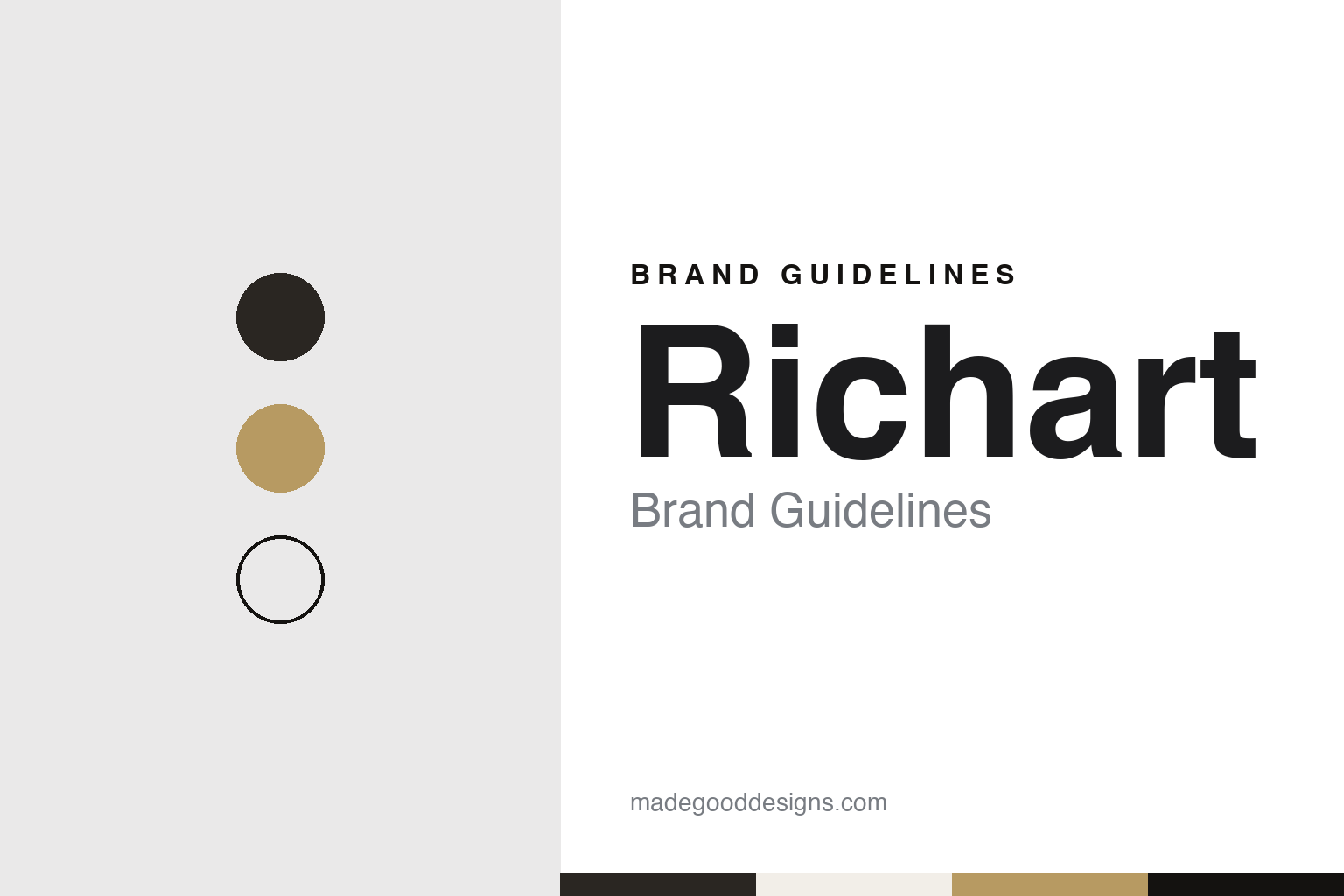
Richart Brand Guidelines
The Lyon chocolatier that screen-printed its chocolates.
Aa
Two constants: a dark ganache, white and gold palette and a geometric sans register. Abstract homage — not a Richart product or mark; no chocolate, decoration, box or logo is reproduced.
The Croix-Rousse
A Lyon apprentice and a pâtisserie on the hill.
Richart is a Lyon house. It calls itself “chocolatier à Lyon depuis 1925,” and its own history explains the date: 1925 is the year Joseph Richart began his apprenticeship as a pâtissier-chocolatier. According to the company, he trained in houses in Lyon and in Annecy, where he learned to make filled chocolates, and became head chocolatier of the Maison Durand on the cours Franklin-Roosevelt in Lyon. About ten years after he began, the company says, he bought a pâtisserie at 36 boulevard de la Croix-Rousse, on the hill above the city, and turned it towards chocolate. His wife, Renée, ran the shop while he worked in the laboratory.
The company’s account stresses flavour over decoration in those years. It says Joseph came to see chocolate “like wine” — always nearly the same colour, but very different in quality — and built his recipes around aroma, which is why the house later called the trade it practises “chocolatier-arômier.” It says the couple specialised in liqueur chocolates alongside pralinés and ganaches, and that in the 1950s Joseph developed a way of candying orange peel in syrup made with the fruit’s own juice and pulp, which the company still credits for its orangettes.
The business grew through the trade. In the 1950s, the company says, Joseph also sold his chocolates to other chocolatiers and pâtissiers, who resold them in their own boxes under their own names. In 1962, with the Croix-Rousse premises too small, he sold the pâtisserie and moved his laboratory to Fontaines-sur-Saône, north of Lyon, to make chocolate only. In 1968 his two sons took over the business, the company says, and developed sales to professionals in the food trades.
Colour
The Ligne Pure, 1988.
Richart’s design reputation rests on a single collection. In 1988, the company says, Michel Richart, one of Joseph’s sons, launched La Ligne Pure du Chocolat, which it describes as the first collection created by a “chocolatier-designer.” Its innovation was the decoration: instead of traditional ornaments, each small chocolate carried clean graphic patterns printed in pure cocoa butter “on the principle of screen-printing,” the company says, making every piece “a surface for visual expression.” The house presents the collection as treating chocolate “like a jewel,” with design, taste and emotion meeting in one object.
Those small, flat, printed squares became the house’s signature. The company calls the Petits Richart its emblematic collection “since 1988,” and builds its other ranges around the same disciplined format: the Ultra-minces, very thin single-origin squares meant for tasting; the INFUZZ, which it describes in the language of perfume, with top, heart and base notes; and the Rendez-vous, an homage to the recipes it attributes to Joseph Richart.
The second pillar is classification. In 2002, the company says, it introduced a system of aromatic families, borrowing from the way wine, spirits and perfume are described, so that a buyer could choose by taste rather than at random. There are seven: balsamic, toasted, fruity, citrus, herbaceous, floral and spicy. Balsamic covers chocolate itself, vanilla and liquorice; toasted covers pralinés, caramels and nougatine; citrus covers oranges, lemons and yuzu. The company says the classification now applies across its chocolates, macarons, pâtisseries, ice desserts and biscuits, and the families double as the organising idea of its boxes.
Typography
The French chocolatier tradition.
The seven brands in this group are all French chocolatiers: La Maison du Chocolat, Patrick Roger, Jean-Paul Hévin, Debauve & Gallais, Chapon, Richart and Puyricard. Most are names people meet first in a shop window rather than on a supermarket shelf, and their identities are built as much from boutiques, boxes and ribbons as from the chocolate inside.
France’s chocolate trade has a vocabulary of its own. A chocolatier is not always a chocolate maker: many houses buy couverture from specialist producers and put their craft into ganaches, pralinés and moulded or enrobed bonbons, while a growing number roast their own beans and make bars from bean to bar. Paris has long been the trade’s shop window, and the title Meilleur Ouvrier de France, awarded after a national competition, is one of the distinctions a chocolatier can carry on the door. Regional houses, often family-run, sell their own specialities alongside the chocolate.
Each guide separates what independent sources record from what the company says about itself — who founded it, who owns it now, where its chocolate is made and whether it makes that chocolate or shapes it — and marks plainly what rests only on the company’s own word.
Aa
A clean geometric sans, for the house of the printed square. (Specimen set in Jost, a sans STAND-IN; NOT the Richart logo.)
Richart
Still made near Lyon.
Richart has stayed close to Lyon. The company says that in 1983 it set up a new workshop and production unit about 25 kilometres from the city. French company records, read in October 2026, place its chocolate-making company, La Maison de la Dégustation — a name the website also uses as its tagline — at Saint-André-de-Corcy, in the Ain, north-east of Lyon, registered in 1997 and classed under the manufacture of chocolate and confectionery. The same records show the company chaired by a holding company. The website says the house is led today by Gautier Richart, Joseph and Renée’s grandson, and that its working methods have changed while its “aromatic obsession” has not.
The brand has long looked beyond Lyon. Archived pages of its website from 2001 to 2003 show country pages for the United States, Japan, Sweden, Switzerland, Spain and Monaco, and an English-language site that styled the house “RICHART Paris” and described its chocolates as made in France. Today the website lists shops in Paris’s 6th arrondissement and in Lyon’s 2nd and 3rd, plus a factory shop; French Wikipedia lists Richart among the traders of the Halles de Lyon-Paul Bocuse, the city’s covered food market. It also sells online, runs chocolate workshops for children, adults and families, and takes corporate orders.
We found no published brand book, logo designer or official colour for Richart, and the company does not say on the pages we read where its cocoa comes from or who makes its couverture, so we make no claim about either. Its identity lives in the product: small squares, printed patterns, and a vocabulary of aroma.
For a design guide, Richart shows how a chocolatier can make the chocolate itself the graphic surface — a printed square that works as both product and logo — and then organise a whole range by taste. Compare Pralus, another Rhône–Alpes family house, and Valrhona, the Rhône valley couverture maker. For this guide we use a dark ganache, gallery white and a cocoa-butter gold with a geometric sans, an unofficial interpretation; no product or logo is reproduced.
Explore & save
Keep Richart’s identity on hand — save it to a board in the Made Good inspiration library.
Richart identity set
Pin the Richart dark ganache, white and gold palette and the geometric sans register to your own board.