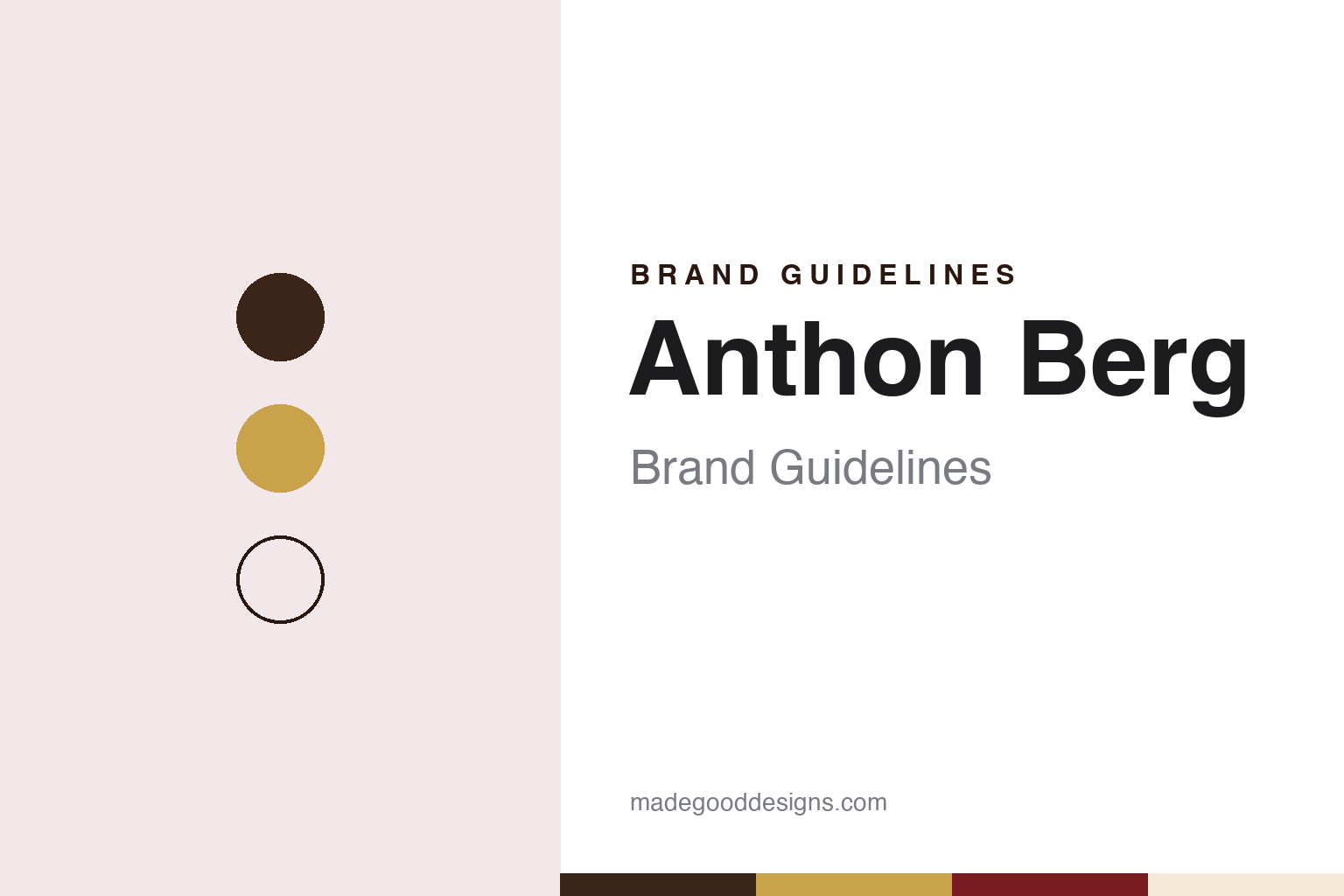
Anthon Berg Brand Guidelines
The Copenhagen marzipan house that a queue of customers built.
Aa
Two constants: a marzipan gold, cocoa and court red palette and a heritage serif register. Abstract homage — not an Anthon Berg product or mark; no wrapper, logo or crest is reproduced.
Gammel Strand
A grocer, a confectioner and a queue of customers.
Anthon Berg began as a shop, not a factory. Danish Wikipedia says Anthon Berg (1829–1916) opened a grocer’s shop on Gammel Strand in Copenhagen, trading under his own name as a trademark. In 1884, when his own sales were going poorly, he bought a confectionery business. A confectioner came with it, and with Berg’s son Gustav as his assistant he began making filled dessert chocolates. English and Danish Wikipedia both give 1884 as the founding year and name father and son as the founders.
The product that made the name came out of the queue. Danish Wikipedia says Berg handed small marzipan-filled chocolates to customers waiting in line, and that in 1898 the chocolate-covered marzipan bar — the “marcipanbrød,” or marzipan bread — went into production as a product in its own right. It is still what the brand is best known for in Denmark.
Gustav Berg took over in 1901 and turned the business into a national one, with a factory of about 200 employees, Danish Wikipedia says. After his death in 1938, Kai Berg became director. By the early 1950s the factory stood in Teglværksgade, in Copenhagen’s Østerbro district. Much of this early history rests on the company’s own account, repeated by both Wikipedias with few independent citations, so we give it as the brand’s story rather than as settled fact.
Colour
Marzipan, tea cakes and chocolate bottles.
Anthon Berg’s range is built on marzipan and filled chocolate rather than on plain bars. Danish Wikipedia lists the marzipan bread in several versions, among them classic, nougat and spirit-flavoured, alongside boxes of filled chocolates and marzipan tea cakes: rounds of marzipan and fruit covered in chocolate, in flavours such as plum in Madeira and strawberry in Champagne. English Wikipedia adds chocolate bars, mini bars with nougat or marzipan fillings, and Easter “Robin’s Eggs.” Danish Wikipedia also lists bars under an “Origins” name, made with beans from Ghana, Ecuador, New Guinea and Venezuela, and a “Grand Cru” box of chocolates from Venezuelan beans; we could not confirm which of these are still on sale in 2026.
Outside Denmark the brand is best known for its liqueur chocolates. In January 2015 the Indian newspaper DNA described them as the most popular of their kind in airport duty-free shops in Singapore, Europe and America, and “easily identifiable due to their packing”: small chocolate bottles filled with liqueur, each labelled with a spirits brand such as Cointreau, Drambuie or Ricard. That miniature bottle, wearing another company’s label, is the most distinctive documented element of Anthon Berg’s packaging, and it ties the brand closely to travel and gift-giving rather than to the everyday chocolate shelf.
The brand has held the title Purveyor to the Royal Danish Court since 1957. Danish Wikipedia says the title was granted to Anthon Berg A/S that year; English Wikipedia gives the same year but marks it as needing a citation. The warrant matters for a design reading, because it places Anthon Berg among the Danish names that present themselves as part of national ceremony — Christmas, Easter and the boxed gift — rather than as an impulse buy.
Typography
Design and documentation.
The seven brands in this group all make chocolate, and they come from six countries across the Nordic region and Central Europe: Anthon Berg from Denmark, Marabou from Sweden, Fazer from Finland, Freia from Norway, Kalev from Estonia, and Wawel and E. Wedel from Poland. Most are the kind of name a shopper in their home country grows up with: the everyday milk-chocolate bar, the boxed assortment brought out for guests, the sweet that friends abroad ask to have sent home.
Many of these national brands no longer belong to the families or towns that started them. Over the past century, and especially since the 1990s, chocolate makers across Northern and Central Europe have been bought, merged and sold again, and several of the names in this group now sit inside multinational food companies or regional confectionery groups, while others have stayed closer to home. A brand can outlive several owners while keeping its wrapper, its lettering and its place on the shelf, and that continuity is often the most valuable thing a buyer acquires.
Each guide separates what independent sources record from what the company says about itself — who founded it, who owns it now, where its beans come from and where its chocolate is made — and marks plainly what rests only on the company’s own word.
Aa
A heritage serif — for a house that sells marzipan as a gift. (Specimen set in Playfair Display, a serif STAND-IN; NOT the Anthon Berg logo.)
Toms
Owned by a foundation, made in Ballerup — with Poland announced.
The Berg family sold in 1954. Both Wikipedias say the buyer was Toms, the Copenhagen chocolate maker then led by Victor B. Strand; Danish Wikipedia says Anthon Berg A/S was a subsidiary of Toms Gruppen from 1954 until 2001, after which the name continued as a brand within the group rather than as a separate company. Toms itself was founded in 1924 by the pharmacists Hans Trojel and Victor Hans Meyer, and Strand took it over in 1942, according to English Wikipedia. Toms Gruppen A/S is wholly owned by Gerda og Victor B. Strands Fond, a foundation, according to the group’s 2010 annual report and its foundation web page as archived in 2023, both cited by Wikipedia. The group also bought the Bremen chocolate maker Hachez in 2011, English Wikipedia says.
Where Anthon Berg is made is about to change. In 1962 Toms brought all production together at its new factory in Ballerup, west of Copenhagen, designed by the architect Arne Jacobsen; English Wikipedia describes a 22,000-square-metre factory hall and a 3,000-square-metre office building. The plant gave its name to the “chocolate crossing” of Ring 4 and Ballerup Byvej. On 27 November 2024 the Danish broadcaster DR reported that Toms would move all of its chocolate production, naming Anthon Berg among the brands made in Ballerup, to a factory in Nowa Sól in western Poland that the group is expanding, within three to four years. Chief executive Annette Zeipel told DR that fewer than 100 of the roughly 170 chocolate-production staff would lose their jobs, that the group would keep its headquarters near Copenhagen, and that sweets and liquorice would still be made at its Hvidovre plant. Fagbladet 3F reported the move the same day. On that timetable Ballerup production would end around 2027 or 2028; we could not confirm in October 2026 how far the move has progressed.
For a design guide, Anthon Berg shows how a heritage gift brand can rest on a few repeatable formats — the marzipan bar, the tea cake, the chocolate bottle — more than on any single mark. Compare Friis-Holm, a Danish bean-to-bar maker working at the opposite scale, and Marabou, a Nordic chocolate name that went the other way, into a multinational group. For this guide we use marzipan gold, cocoa brown and a deep court red with a serif, an unofficial interpretation; no product or logo is reproduced.
Explore & save
Keep Anthon Berg’s identity on hand — save it to a board in the Made Good inspiration library.
Anthon Berg identity set
Pin the Anthon Berg marzipan gold, cocoa and court red palette and the heritage serif register to your own board.