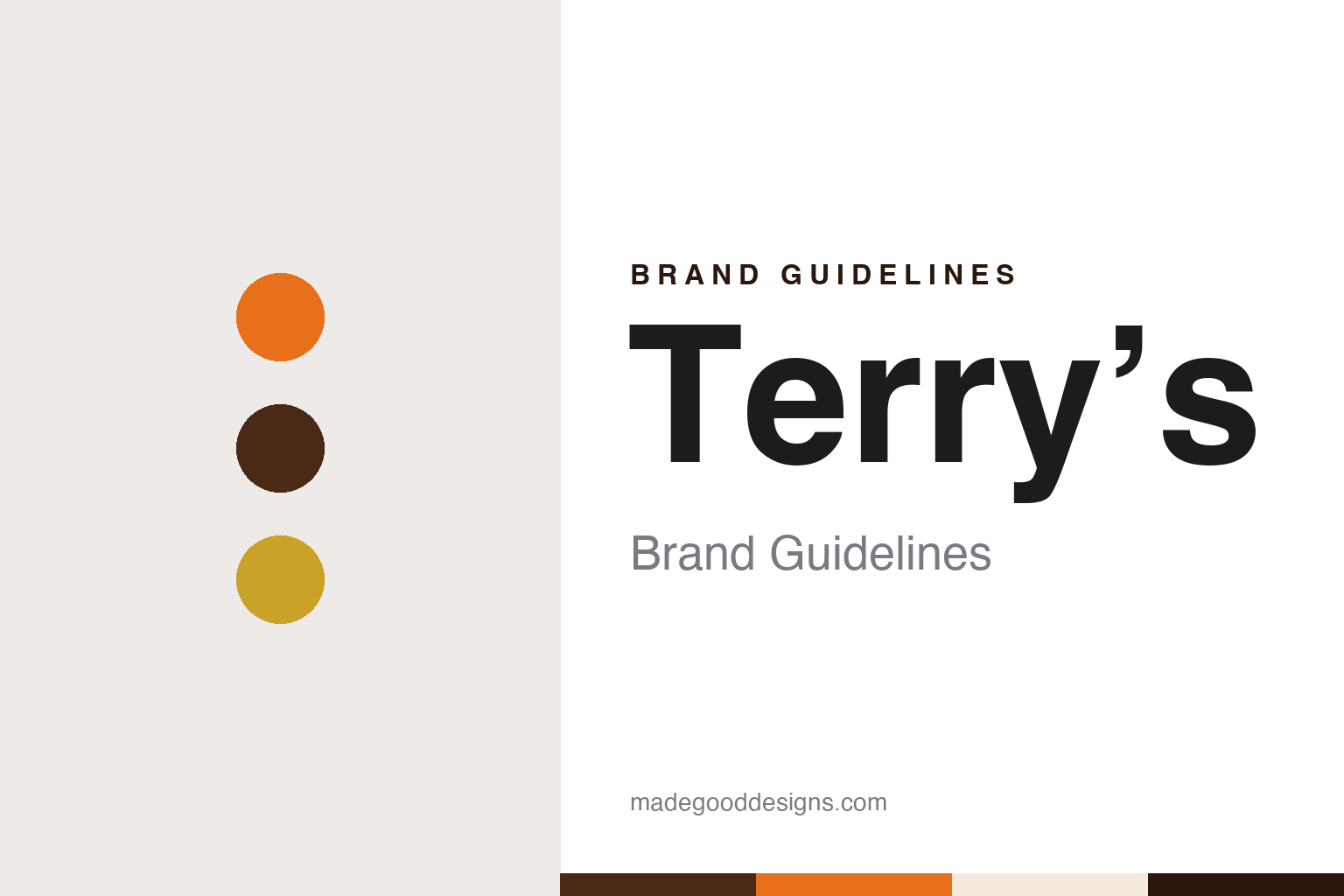
Terry’s Brand Guidelines
The York confectioner behind the Chocolate Orange.
Aa
Two constants: a Terry’s chocolate, orange and gold palette and a Deco serif register. Abstract homage — not a Terry’s product or mark; no wrapper, logo or packaging is reproduced.
From a York shop to the Chocolate Works
A confectioner’s shop, a chemist and two factories.
The business that became Terry’s did not begin with a Terry. English Wikipedia, drawing on Paul Chrystal and Joe Dickinson’s A History of Chocolate in York (2012), traces it to 1767, when a shop near Bootham Bar in York sold cough lozenges, candied lemon and orange peel and other sweets. Under Robert Berry and William Bayldon it traded as Bayldon and Berry, and by 1818 it had moved to St Helen’s Square. The present owner’s own history makes the same point: the story “begins in 1767 with the opening of a shop in York,” and Joseph Terry joined in 1823.
Joseph Terry, born in Pocklington in 1793, had trained as an apothecary and worked as a chemist in Walmgate. In 1823 he married into the Berry family and joined the confectionery business. It became Terry & Berry in 1825 and Joseph Terry and Company in 1828, and within two years he was its sole owner. He used the new railways to send his sweets — coltsfoot rock, candied eringo, conversation lozenges — to more than 75 towns by 1840, according to English Wikipedia.
After his death in 1850 his sons took over. Joseph Terry junior moved production to a site at Clementhorpe, beside the River Ouse, where ships brought sugar, cocoa and coal; he was knighted in 1887 and served several times as Lord Mayor of York. The firm became Joseph Terry & Sons, a limited company from 1895, and in 1899 launched its Neapolitans, small wrapped chocolates. In the 1920s Frank and Noel Terry built a new factory on Bishopthorpe Road: Terry’s Chocolate Works, an Art Deco complex with a clock tower, designed by the architect J. E. Wade and opened in 1926. The Chocolate Apple came first; the Chocolate Orange followed in 1932, and All Gold, the boxed assortment, in the same decade. The company was listed on the London Stock Exchange in 1934, and during the Second World War part of the works was turned over to making aircraft propeller blades.
Colour
Forte, Colgate, United Biscuits, Kraft — and France.
The Terry family sold the business in 1963 to the Forte group, which paid £4.25 million in shares, English Wikipedia says. Colgate-Palmolive bought it from Trust House Forte in 1977, and United Biscuits bought it in 1982, making it the core of a confectionery division later called the Terry’s Group. In 1993 the group passed to Philip Morris and its subsidiary Kraft, and Terry’s was combined with Suchard as Terry’s Suchard. From 2000 the name “Terry’s of York” was shortened to Terry’s.
In 2004 Kraft decided to close the York works and move the remaining lines, including the Chocolate Orange, to factories in Belgium, Sweden, Poland and Slovakia. The Chocolate Works closed on 30 September 2005 with the loss of 316 jobs, the BBC reported. When Kraft split in 2012, Terry’s went to Mondelēz International.
In 2016 an investment group led by the French firm Eurazeo bought a set of brands from Mondelēz — Carambar, Poulain, Suchard, Kréma, La Pie qui Chante, Vichy and Terry’s — together with five French factories, among them a plant in Strasbourg making Suchard and Terry’s products. The business became Carambar & Co, also called CPK; French Wikipedia dates the company’s formation to May 2017. English Wikipedia says the Chocolate Orange has been made in Strasbourg since 2018, when the group brought production home to France. In February 2019 Carambar & Co set up a UK company, Terry’s Chocolate Co, in London to sell the range in Britain.
The latest change came in 2025. Eurazeo announced the sale of CPK in July and completed it on 31 October 2025, selling it to the European holding company of Ferrara, the Chicago candy maker that the Ferrero group bought in 2017. Eurazeo’s release said CPK would run as a standalone company with headquarters in France and four French production sites, Strasbourg among them.
Typography
British chocolate and its owners.
The seven brands in this group all make or sell chocolate, and they come from two countries: Fry’s, Rowntree’s, Terry’s, Paul A. Young and Willie’s Cacao from England, and Lily O’Brien’s and Butlers from Ireland. Together they span most of the history of chocolate on these islands, from names that were household words long before the modern supermarket to makers who started within living memory.
Some of the oldest names in British chocolate grew out of Quaker family firms, and several of them now belong to multinational groups, so the name on the wrapper and the company behind it can tell two different stories. Ireland has its own tradition of chocolatiers, whose boxes and bars carry an Irish identity to shoppers at home and abroad. And a newer generation of makers has grown up in London shops and Devon workshops, where the founder’s own name and story often do the work a corporate logo would do elsewhere.
Each guide separates what independent sources record from what the company says about itself — who founded it, who owns it now, where its cocoa comes from and where its chocolate is made today — and marks plainly what rests only on the company’s own word.
Aa
A Deco serif — after the Art Deco Chocolate Works of 1926. (Specimen set in Playfair Display, a serif STAND-IN; NOT the Terry’s logo.)
Terry’s
Foil, a tap and a box of gold.
Terry’s packaging has a documented history of its own. In the 1920s and 1930s the company moved to ornate, luxurious boxes, and its 1930 product catalogue, quoted by English Wikipedia, argued that a chocolate box must be “worthy of the confections it contains — in distinction of design and harmony of colours.” All Gold, the assortment named for its gold box, once held about a fifth of the British assortment market, by English Wikipedia’s account, before it was discontinued in 2020.
The Chocolate Orange is the brand’s best-known object: a ball of orange-flavoured chocolate in twenty segments, wrapped in foil printed to look like orange peel. Its advertising has leaned on the ritual of opening it — “tap it and unwrap it,” later “whack and unwrap” — and on comic campaigns: a 1982 spoof of Raiders of the Lost Ark, ten years of Dawn French insisting “It’s not Terry’s, it’s mine” from 1997, and, since 2020, the “Deliciously Unsquare” line, which Carambar & Co still uses on its website. Carambar & Co says 66 million Terry’s chocolate balls are sold each year, in eight countries including Britain, Ireland, the United States and Japan, citing its internal data; the ball now also comes in mint and plain milk versions.
York keeps the brand’s architecture. The St Helen’s Square shop, with “Terry” cut into its 1922 stone front, was Grade II listed in 1974 and carries a York Civic Trust blue plaque unveiled in 2017 for the elder Joseph Terry. The Chocolate Works’ factory, clock tower and offices were listed in March 2005, six months before the factory closed, and the site has since been redeveloped as homes and a care village called The Chocolate Works.
For a design guide, Terry’s shows how a single shape, a foil wrap and an opening ritual can carry a name through a long string of owners and a move from York to France. Compare Thorntons, another British confectioner now in the Ferrero orbit, and Charbonnel et Walker, for which Terry’s made chocolate during the Second World War. For this guide we use dark chocolate, foil orange and box gold with a serif, an unofficial interpretation; no product or logo is reproduced.
Explore & save
Keep Terry’s’s identity on hand — save it to a board in the Made Good inspiration library.
Terry’s identity set
Pin the Terry’s chocolate, orange & gold palette and the Deco serif register to your own board.