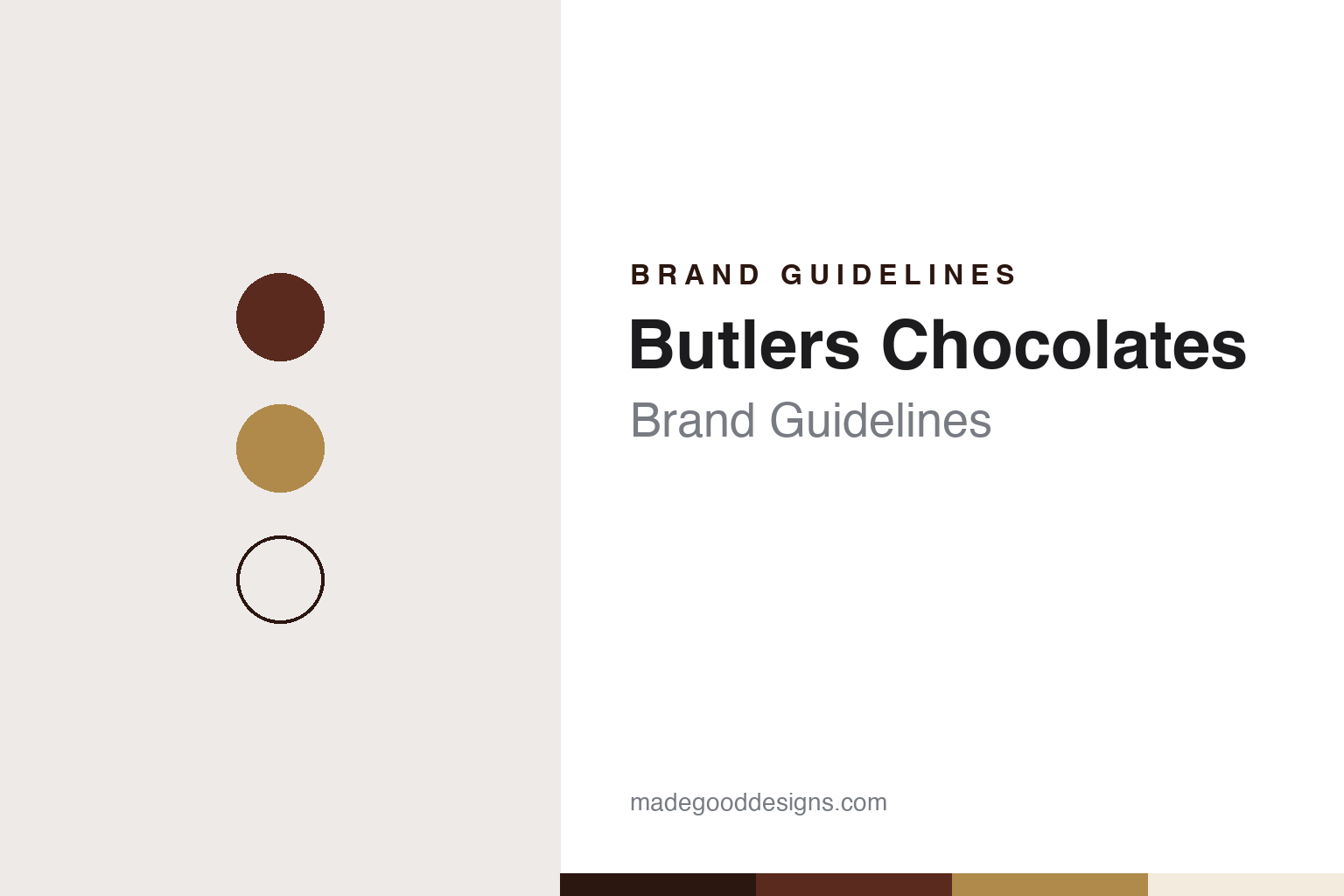
Butlers Chocolates Brand Guidelines
The Dublin chocolatier owned by one family since 1959.
Aa
Two constants: a cocoa brown, cream and gold palette and a Georgian serif register. Abstract homage — not a Butlers Chocolates product or mark; no box, wrapper, logo or nameplate is reproduced.
Lad Lane
A chocolatier in Georgian Dublin.
Butlers Chocolates began in 1932 on Lad Lane, a mews street in the Georgian quarter of south Dublin. The company names its founder as Marion Butler, who it says was born in India and moved to Ireland as a young woman, and who sold her handmade chocolates under the name Chez Nous Chocolates; English Wikipedia gives her name as Marion Bailey-Butler. She made chocolates by hand on Lad Lane until 1959.
That year the business was bought by Seamus Sorensen, from Cork. Ownership has stayed in the family since: The Irish Times reported in August 2011 that Butlers was “owned by the Sorensen family, who acquired the business in 1959,” and the company today describes itself as “100% Irish family-owned.” According to the company, the next generation of the Sorensen family began running the business in 1978, and in 1984 it was renamed Butlers Irish Chocolates — later simply Butlers Chocolates — as a tribute to the founder.
The workshop moved several times as it grew. The company’s own timeline puts it on Pearse Street from 1988 and on Sir John Rogerson’s Quay, overlooking the Liffey, from 1996, before a move in 2003 to a purpose-built production site in Clonshaugh, Dublin 17, on the north side of the city. Wikipedia, too, gives 2003 for the move to Clonshaugh, and the factory remains the company’s base.
Colour
From a Grafton Street shop to a café chain.
Butlers opened its first shop in 1989 on Grafton Street, Dublin’s main shopping street. The company describes that shop as the foundation of its retail idea, and in 1998 — the same year its mail-order website went live — the first Butlers Chocolate Café opened on Wicklow Street, selling chocolates alongside hot chocolate and coffee. A second café, on Chatham Street, followed in 1999, and in 2005 the chain left Dublin for Cork’s Oliver Plunkett Street.
By August 2011 there were 15 outlets in Ireland, plus cafés in London, New Zealand and Pakistan, The Irish Times reported; the same article noted that the privately held company does not disclose its finances, but that its most recent published figures showed a turnover of €23.2 million and profits of just over €2.1 million in 2006. When the café at the Crescent Shopping Centre in Limerick opened in early 2015, The Irish Times described it as the chain’s 26th store. The company’s website now gives the number of cafés in Ireland as 30 on one page and 28 on another, so we give the figure as “around 30.” It says it employs more than 500 people across the factory and the cafés.
Not every outpost lasted. English Wikipedia, citing the New Zealand news site Stuff, says the company that ran five Butlers Chocolate Cafés in New Zealand, Chocolate Cafes (New Zealand), went into liquidation in July 2025 after 18 years, closing its stores; Wikipedia also lists cafés in Pakistan and the United Arab Emirates.
The factory has become part of the brand. A café opened there in December 2010, and the company says its visitor attraction, the Butlers Chocolate Experience, opened in February 2011 and was extended in 2012. Butlers chocolates are also sold through airports: the company says they are available in more than 30 countries and 50 international airports, and lists a Frontier Award, won at the TFWA duty-free show in Cannes in 2009, among its prizes.
Typography
Heritage chocolate in Britain and Ireland.
The seven brands in this group all make or sell chocolate, and they come from two countries: Fry’s, Rowntree’s, Terry’s, Paul A. Young and Willie’s Cacao from England, and Lily O’Brien’s and Butlers from Ireland. Together they span most of the history of chocolate on these islands, from names that were household words long before the modern supermarket to makers who started within living memory.
Some of the oldest names in British chocolate grew out of Quaker family firms, and several of them now belong to multinational groups, so the name on the wrapper and the company behind it can tell two different stories. Ireland has its own tradition of chocolatiers, whose boxes and bars carry an Irish identity to shoppers at home and abroad. And a newer generation of makers has grown up in London shops and Devon workshops, where the founder’s own name and story often do the work a corporate logo would do elsewhere.
Each guide separates what independent sources record from what the company says about itself — who founded it, who owns it now, where its cocoa comes from and where its chocolate is made today — and marks plainly what rests only on the company’s own word.
Aa
A Georgian serif — a nod to the Lad Lane origin. (Specimen set in Cormorant Garamond, a serif STAND-IN; NOT the Butlers Chocolates logo.)
Butlers Chocolates
Truffles, fudge and a hot chocolate.
Butlers makes milk, dark and white chocolate assortments, truffles flavoured with liqueurs, fudge, toffee, filled and solid bars, hot chocolate and seasonal ranges for Christmas, Easter and Valentine’s Day, the company says. Its own list of landmarks includes the Platinum Collection in 2016 and gin truffles made in 2017 with The Shed Distillery, maker of Drumshanbo gin. In 2011 it won the contract to supply chocolates for the National Lottery’s Christmas scratch-card game, which The Irish Times said Cadbury had traditionally held, and the first time an Irish-owned company had won it.
On sourcing, Butlers says its chocolate is made from “100% sustainably sourced cocoa” through Cocoa Horizons, the cocoa-farming programme set up by the chocolate maker Barry Callebaut, that its recipes use no palm oil, and that it supports programmes for cocoa-farming families in Côte d’Ivoire; we give these as the company’s claims. It says the chocolates are made at its Clonshaugh factory, where in 2017 it installed what it calls the largest solar-panel system on an industrial building in the Republic of Ireland.
Packaging is where the company documents most change. It says that in 2025 it moved its twist-wrapped truffles to a fully recyclable paper wrap, saving about 15 tonnes of waste a year, and that its Easter eggs have moved from plastic to paper protection, with ribbon made from recycled plastic bottles. It lists awards from Bord Bia, the Irish food board — including a brand-marketing award in 2003 — and more than 30 Great Taste awards; no official colour or typeface is published.
For a design guide, Butlers Chocolates shows how a family-owned maker can turn a factory and a café chain into its brand. Compare Lily O’Brien’s, another Irish chocolate maker, and Thorntons, which also built a chain of its own shops. For this guide we use cocoa brown, cream and a muted gold with a serif, an unofficial interpretation; no product or logo is reproduced.
Explore & save
Keep Butlers Chocolates’s identity on hand — save it to a board in the Made Good inspiration library.
Butlers Chocolates identity set
Pin the Butlers Chocolates cocoa brown, cream & gold palette and the Georgian serif register to your own board.