Lily O’Brien’s Brand Guidelines
The Kildare kitchen chocolatier that became a Colian brand.
Aa
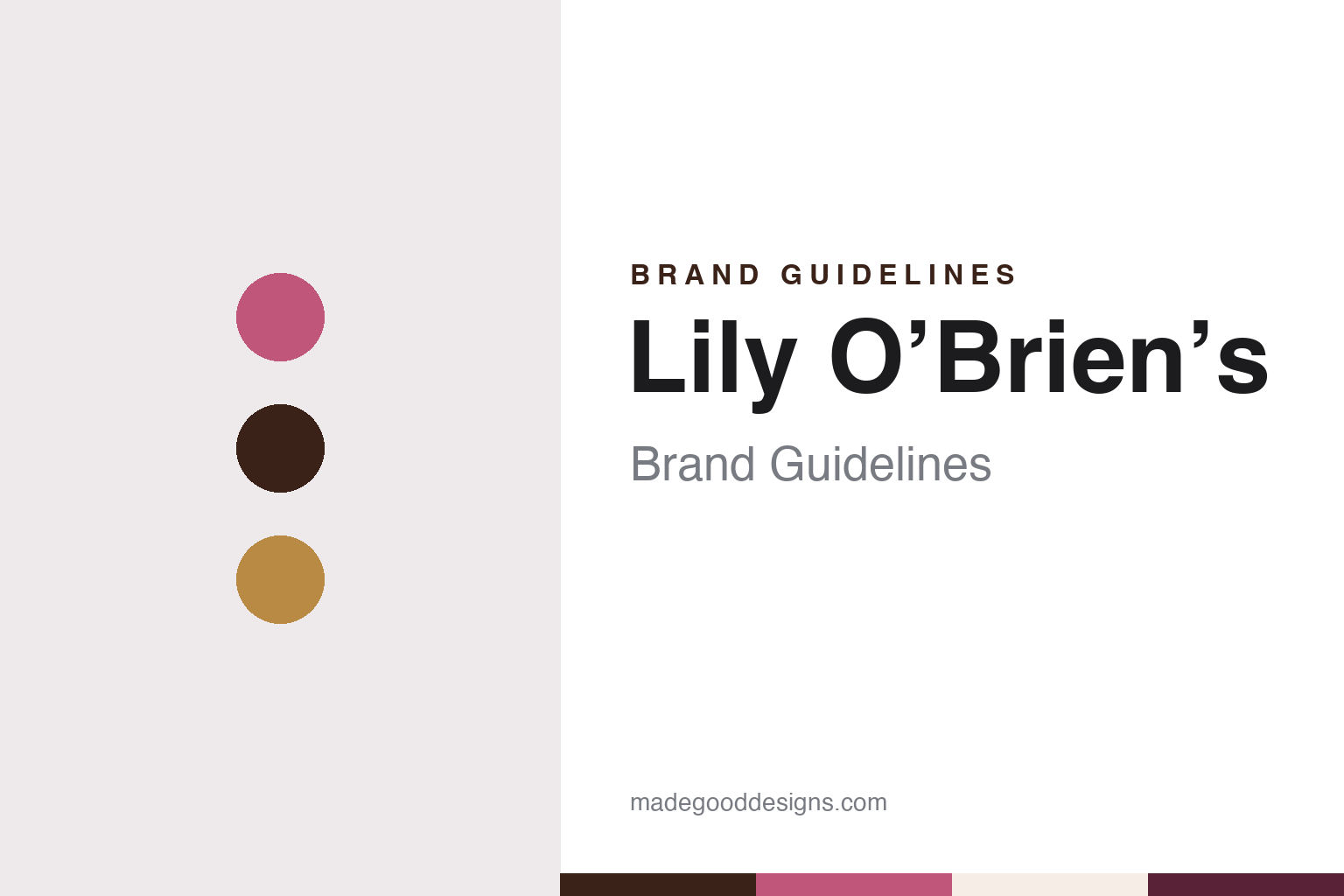
Two constants: a Lily O’Brien’s brown, rose and gold palette and a gift-box serif register. Abstract homage — not a Lily O’Brien’s product or mark; no box, logo or packaging is reproduced.
A kitchen in Kildare
Two saucepans, a wooden spoon and a daughter’s name.
Lily O’Brien’s began in 1992 in the kitchen of Mary Ann O’Brien in County Kildare. The company’s account is homely: she started, it says, “with little more than two saucepans, a wooden spoon and her then toddler, Lily, acting as production manager,” making chocolates for friends and family. English Wikipedia, citing the Leinster Leader, gives the same kitchen start, and adds that the business was named after her daughter Lily, then two years old. Among her first creations, the company says, were chocolate honeycomb hedgehogs.
Before starting out, O’Brien had learned chocolate-making “among world class chefs and chocolatiers in both South Africa and Europe,” according to the company’s history. The business soon outgrew the kitchen. It is now based in Newbridge, County Kildare, the town where the company has its factory, and it describes itself as “one of Ireland’s best-loved chocolatiers.”
O’Brien has remained its public face. English Wikipedia names her as the company’s founder and chairman. She also had a career in public life: the Oireachtas records her as a senator nominated by the Taoiseach, Enda Kenny, from May 2011 to June 2016, and in 1997 she co-founded the Jack and Jill Foundation, a charity providing home care for very sick babies. The company’s website still speaks in her voice, with a signed note that opens, “I wish I could invite you into my kitchen where the Lily O’Brien’s story began in 1992.”
Colour
From an Irish independent to a Polish group.
For a quarter of a century Lily O’Brien’s was an Irish independent. That ended in 2018, when it was acquired by Colian, the Polish confectionery group. Colian’s own history records that in 2018 the “recognised Irish producer of chocolate products and desserts” (our translation) joined its foreign range, and English Wikipedia’s article on Colian’s Jutrzenka business lists the same purchase; the Leinster Leader headlined the sale at €40 million.
Colian is a family business. Its history says Barbara and Jan Kolański founded it in 1990 near Kalisz as a small herbs-and-spices firm called Ziołopex; English Wikipedia describes Colian Holding as a group controlled by Jan Kolański and based at Opatówek, in western Poland. Its brands include Goplana, Grześki and Jutrzenka in Poland. In 2016 Colian bought the British chocolate brand Elizabeth Shaw, and in 2021, it says, Elizabeth Shaw and Lily O’Brien’s were merged to form Colian UK, to build its business in Britain and Ireland. In 2025 Colian joined forces with the German chocolate maker Gubor Schokoladen, taking what its history calls a key role in that company.
Production has stayed in Ireland. Lily O’Brien’s says its chocolates “are made in Newbridge, Co. Kildare, Ireland,” that the factory produced close to 141 million chocolates in 2025, and that Colian is “a family-owned business with 12 production sites across Germany, Poland and Ireland.” It says Newbridge belongs to Origin Green, Ireland’s national food and drink sustainability programme, holds a British Retail Consortium AA+ grade, and is a member of Love Irish Food, which promotes food made in Ireland. The sources we checked do not say where its cocoa comes from.
Typography
British chocolate and its owners.
The seven brands in this group all make or sell chocolate, and they come from two countries: Fry’s, Rowntree’s, Terry’s, Paul A. Young and Willie’s Cacao from England, and Lily O’Brien’s and Butlers from Ireland. Together they span most of the history of chocolate on these islands, from names that were household words long before the modern supermarket to makers who started within living memory.
Some of the oldest names in British chocolate grew out of Quaker family firms, and several of them now belong to multinational groups, so the name on the wrapper and the company behind it can tell two different stories. Ireland has its own tradition of chocolatiers, whose boxes and bars carry an Irish identity to shoppers at home and abroad. And a newer generation of makers has grown up in London shops and Devon workshops, where the founder’s own name and story often do the work a corporate logo would do elsewhere.
Each guide separates what independent sources record from what the company says about itself — who founded it, who owns it now, where its cocoa comes from and where its chocolate is made today — and marks plainly what rests only on the company’s own word.
Aa
A gift-box serif — for a brand sold as boxed chocolates. (Specimen set in Cormorant Garamond, a serif STAND-IN; NOT the Lily O’Brien’s logo.)
Lily O’Brien’s
Desserts in a box.
Lily O’Brien’s sells mainly boxed and gift chocolates, and its best-known idea is to turn puddings into chocolates. Its Desserts Collection, which the company calls its best-selling range, puts flavours such as Key Limey Pie, Crème Brulée and Hazelnut Torte into individual pieces; in February 2024 ConfectioneryNews reported the range being extended in Britain, with the marketing director, Karen Crawford, describing the brand as “luxury without the premium price tag.” The company also sells truffles, share bags, advent calendars and personalised photo boxes through websites in euros, sterling and dollars.
Its award list, as the company gives it, mixes food and packaging prizes. It says its Key Limey Pie chocolate won Gold at the Guild of Fine Food’s Great Taste awards in 2013 and 2014, its Sticky Toffee box took Silver at Ireland’s Blas na hÉireann awards in 2015, and a halal-certified range of airline desserts won a Mercury award for on-board catering the same year. In 2023, it says, its Salted Caramel Truffles took Bronze in the confectionery category of The Grocer’s New Product & Packaging Awards and won Product of the Year in the chocolate category, a title decided by a Kantar consumer survey.
The company makes some packaging claims too: it says 80 per cent of its packaging is recyclable, that it has installed solar panels and planted 500 trees at Newbridge, and that palm oil is not added to its milk, dark or white chocolate, appearing only in some bought-in fillings and inclusions made with segregated RSPO-certified palm oil. These are its own statements.
For a design guide, Lily O’Brien’s shows how a founder’s kitchen story and a daughter’s name can carry a gift brand into a multinational group. Compare Butlers Chocolates, the Dublin chocolatier, and Thorntons, a British gift-chocolate name that also passed to a larger group. For this guide we use truffle brown, rose and caramel gold with a serif, an unofficial interpretation; no product or logo is reproduced.
Explore & save
Keep Lily O’Brien’s’s identity on hand — save it to a board in the Made Good inspiration library.
Lily O’Brien’s identity set
Pin the Lily O’Brien’s brown, rose & gold palette and the gift-box serif register to your own board.