Dhaka Art Summit Brand Guidelines
A free summit for art and architecture, held at one Dhaka venue.
Aa
Two constants: a delta teal, brick and jute palette and a soft serif register. Abstract homage — not a Dhaka Art Summit graphic or mark; no artwork, logo or edition identity is reproduced.
Samdani Art Foundation
A collector couple’s foundation, 2011.
The Dhaka Art Summit (DAS) is organised by the Samdani Art Foundation (SAF), which the foundation’s website says was founded in 2011 by the collector couple Nadia and Rajeeb Samdani. The foundation says all of its education and exhibition programmes are free and ticketless, and English Wikipedia describes the summit as a non-commercial research and exhibition platform for art and architecture in South Asia, held every two years, with no sales and free entry for the public.
The initial summit was held in Dhaka in 2012. Studio International, reviewing the 2023 edition in March of that year, wrote that the summit was originally developed to support artists from Bangladesh who lacked opportunities to show their work, and that it takes place over nine days every other year. English Wikipedia says the 2012 edition was held in collaboration with the Bangladesh Shilpakala Academy and the Bangladesh National Museum, concentrated on local artists and galleries, and showed the work of 249 artists and 19 galleries, with a programme of talks alongside.
From the second edition, held from 7 to 9 February 2014 with the Shilpakala Academy, the summit turned its focus to South Asia as a whole, English Wikipedia says. That edition brought together five curated exhibitions by international and Bangladeshi curators, 14 solo projects curated by the foundation’s artistic director, Diana Campbell (credited as Diana Campbell Betancourt in earlier coverage), a public art project across the city, performances, screenings of experimental film, panel discussions and the participation of 15 Bangladeshi and 17 South Asia-focused galleries.
Colour
Editions at the Shilpakala Academy.
The summit’s home is the Bangladesh Shilpakala Academy in Dhaka. Studio International wrote in 2023 that the summit had been held there since its inception, and English Wikipedia names the academy as the venue of each edition from 2014 onwards.
The third edition ran from 5 to 8 February 2016. English Wikipedia says it presented 17 solo projects curated by Campbell, most of them newly commissioned, alongside curated group exhibitions, talks, critical writing ensembles, performances, a film programme, book launches and a historical exhibition, “Rewind.” The same edition included an exhibition on architecture in Bangladesh, giving the summit’s interest in architecture a section of its own.
The fourth edition ran from 2 to 10 February 2018 under Campbell’s direction, with work by more than 350 artists, curators and thinkers, according to English Wikipedia, which says its large group exhibition “Bearing Points” and a second exhibition made for the summit later travelled to venues in Yangon, Hong Kong, Chiang Mai, Trondheim and Warsaw. Around the exhibitions, the 2018 edition ran critical writing ensembles, children’s programmes, an education pavilion, film screenings and panel discussions. The fifth edition, “Seismic Movements,” ran from 7 to 15 February 2020 with Campbell as chief curator and more than 500 participants from over 44 countries, English Wikipedia says. Studio International reported that the 2020 edition took in half a million visitors.
The 2020 edition also gave space to collaborative practice and research. English Wikipedia says its exhibition “The Collective Body” brought together more than thirty collaborative, artist-led initiatives, around half of them from Bangladesh, and that the summit hosted a Dhaka session of MAHASSA (Modern Art Histories in and across Africa, South and Southeast Asia), a research collaboration with Cornell University’s Institute for Comparative Modernities and Asia Art Archive, supported by the Getty Foundation’s Connecting Art Histories initiative, with seminars and panels on modern architecture, art schools and collectives.
English Wikipedia also records a design strand of the 2020 edition: its exhibition-making was shaped by Srijan-Abartan, a cross-cultural workshop for exhibition design led by the practice common-interest with support from Pro Helvetia, which developed locally rooted ways of displaying work for the summit and published its process as open-access research.
Typography
Smaller-city and specialist biennials.
Not every biennial is staged in a capital with a large museum behind it. Many of the events in this series grew up in smaller cities, or around one art form, and their identities reflect that. A visitor may meet the name on a banner in a provincial town, on a library wall or on a printed programme rather than on a museum façade, so the name has to carry most of the recognition on its own.
Short names do a lot of that work. Long official titles, often in two languages, are cut down to a handful of capitals: GIBCA in Gothenburg, RIBOCA in Riga, EVA in Limerick. An acronym reads the same in the local language and in English, fits a small poster or a social-media handle, and can be extended to side programmes and partner networks while keeping the parent name in view.
Some biennials define themselves by a medium rather than a place. A printmaking biennial such as Ljubljana’s, or a festival devoted to photography, draws its audience through the technique itself, and its graphic language can lean on that technique: paper, ink, the frame of a print. Others define themselves by movement. The Thailand Biennale changes host province with each edition, so its fixed national name sits beside a changing place name, year and theme.
Modest means show plainly in the design choices. Editions tend to reuse existing buildings, among them art halls, libraries and former industrial sites, rather than build pavilions, and a single strong edition graphic often has to work across every venue at once. This guide looks at how each event has handled those choices, using only what dated sources record.
Aa
A soft serif for a summit whose titles appear in two scripts. (Specimen set in Fraunces, a serif STAND-IN; NOT the Dhaka Art Summit logo.)
Bonna
The 2023 edition, titled with a word and a name.
The sixth edition, বন্যা/Bonna, ran from 3 to 11 February 2023 at the Shilpakala Academy. Studio International explained that the Bengali word means flood and is also a girl’s name, and that Campbell, curating the summit for the fifth time, used that double meaning as a curatorial thread: the theme unfolded through the imagination of a fictional young girl, and the participating artists explored the relationship Bangladeshis have had with weather and water over time.
The magazine described five sub-exhibitions within the summit. One, “Very Small Feelings,” brought children’s perspectives forward through storytelling; English Wikipedia adds that it was co-commissioned with the Kiran Nadar Museum of Art in New Delhi, where the project later travelled. Another, “To Enter the Sky,” considered how buildings can give people a sense of belonging in places that are always changing. At the entrance, Studio International wrote, a laser animation was projected onto the tall wall framing the academy’s entrance hall, and the presence of local visitors, from students to families, was particularly noticeable; the magazine observed that Dhaka has no contemporary art museum, which makes the summit one of the few places in the city to see experimental work.
The foundation’s website, read in November 2026, lists six editions of the summit, the most recent held in February 2023, and names Campbell as its artistic director.
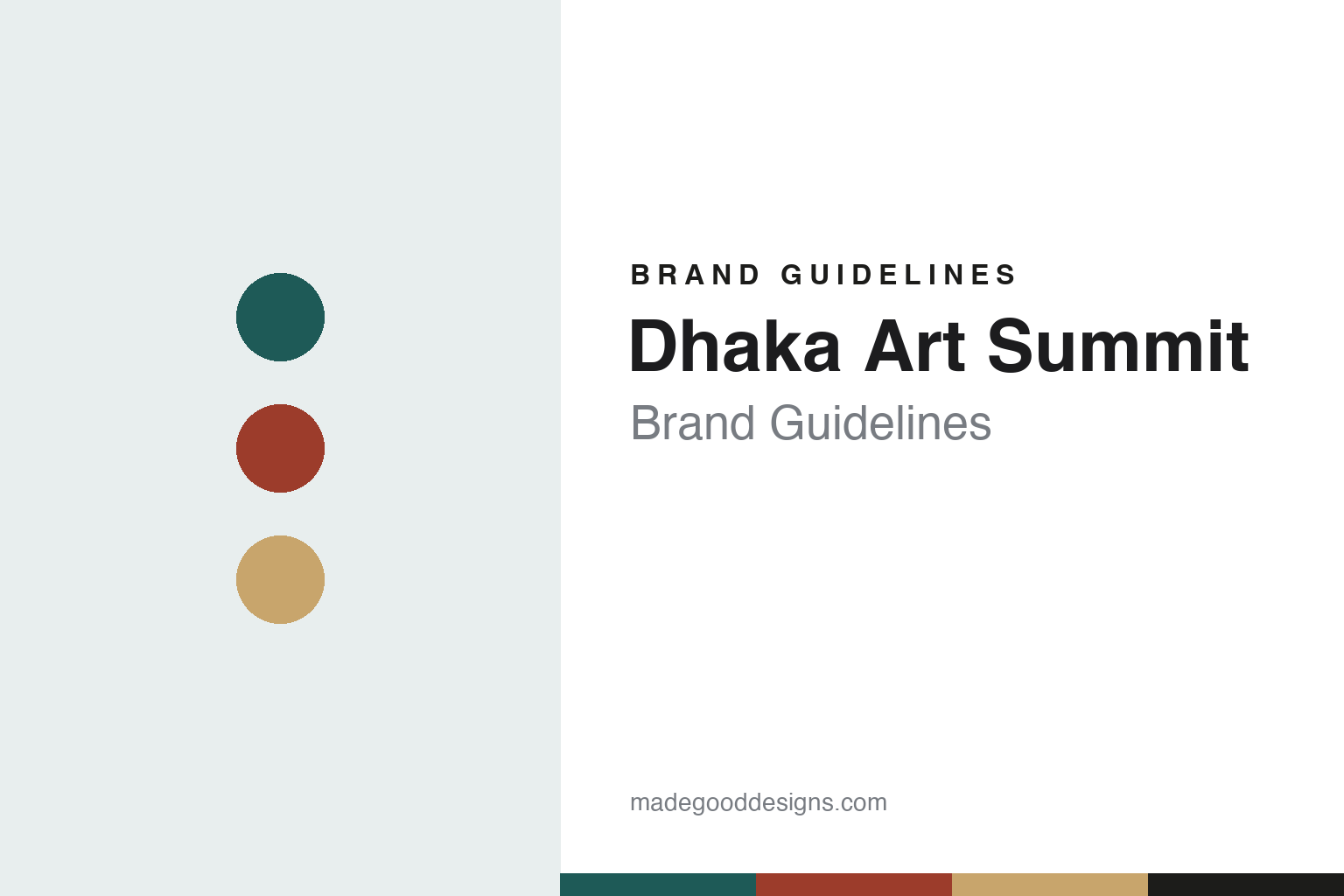
For a design guide, the Dhaka Art Summit shows how a free, non-selling event can build its identity around one venue, a foundation’s name and edition titles set in two scripts, as in বন্যা/Bonna. Compare Biennale Jogja, another recurring Asian event shaped by regional exchange, and Kochi-Muziris Biennale, also in South Asia. For this guide we use a delta teal, a brick red and a jute gold with a serif, an unofficial interpretation; no product or logo is reproduced.
Explore & save
Keep Dhaka Art Summit’s identity on hand — save it to a board in the Made Good inspiration library.
Dhaka Art Summit identity set
Pin the Dhaka Art Summit delta teal, brick and jute palette and the soft serif register to your own board.
Source & notes
Frequently Asked Questions
What font can I use to match the Dhaka Art Summit look?
This guide describes Dhaka Art Summit’s type as “A soft serif for a summit whose titles appear in two scripts”. Its type specimen is set in Fraunces from Google Fonts as a stand-in; Fraunces is not Dhaka Art Summit’s own lettering.
What colours are in the Dhaka Art Summit palette?
This guide’s Dhaka Art Summit palette is Delta teal #1E5A57, Brick #9C3C2B, Jute #C8A56C, Ink #1C1C1A and Paper #F5F2EA. The tones are the guide’s own unofficial interpretation, not official Dhaka Art Summit hex codes.
When was Dhaka Art Summit founded?
Dhaka Art Summit was founded in 2012, in Dhaka, Bangladesh.