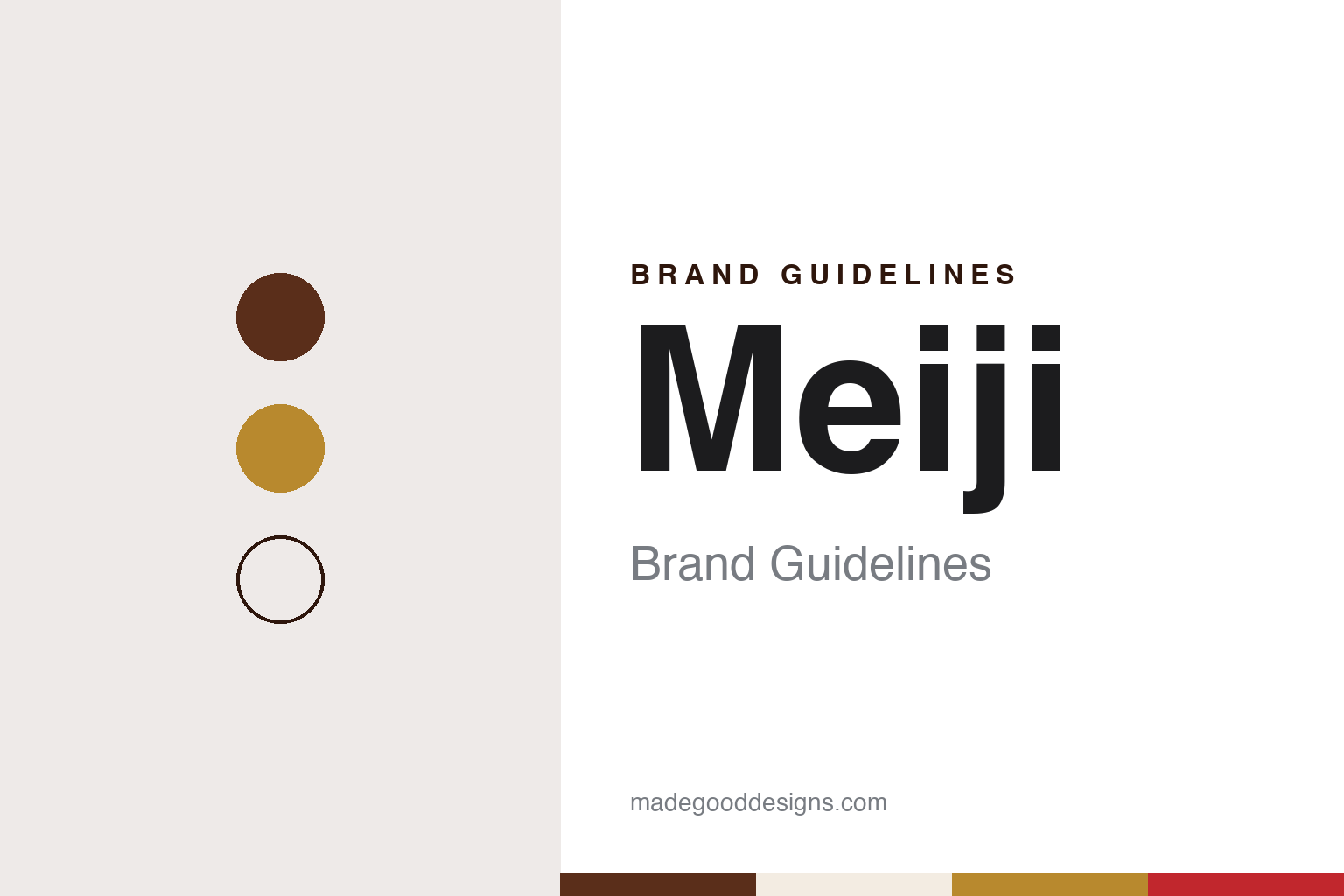
Meiji Brand Guidelines
The Tokyo confectioner whose milk chocolate turned 100 in 2026.
Aa
Two constants: a Meiji brown, gold and red palette and a rounded sans register. Abstract homage — not a Meiji product or mark; no package, logo or wordmark is reproduced.
Tokyo Kashi
A sugar company’s confectioner.
The company that makes Meiji chocolate began in Tokyo on 9 October 1916 as Tokyo Kashi, “Tokyo Confectionery,” according to Japanese Wikipedia. Two months later Meiji Seito, the sugar refiner, set up its own confectionery arm, Taisho Seika; the two merged in March 1917. Japanese Wikipedia names Hanji Soma, the sugar company’s founder, among the confectioner’s founders.
The firm opened a factory at Okubo, in today’s Shinjuku, in 1917, and later one at Kawasaki, south of Tokyo. It first sold chocolate in 1918, Japanese Wikipedia says, and took the name Meiji Seika on 1 September 1924.
Its best-known product came two years later. Meiji Milk Chocolate went on sale on 13 September 1926. It was not Japan’s first milk chocolate bar — Morinaga had launched its own in 1918, Japanese Wikipedia notes — but it became Meiji’s signature, known in Japan by the nickname “Miruchi,” which Meiji has registered as a trademark, and the company now calls it the bar that made chocolate, “until then a luxury,” something ordinary people could buy.
Colour
A wrapper that changed six times.
The bar’s package has its own history, which Meiji tells on its centenary website. In the early Showa years, from the late 1920s, the backs of the wrappers were printed with points: collect 100 and a sweet shop would exchange them for more Milk Chocolate or Meiji caramels. During the war the bar disappeared from sale. It returned about ten years later — Japanese Wikipedia dates the restart of production to 1951 — in what Meiji calls a bright package meant to bring cheer back to the streets.
Television made the bar famous. Meiji’s jingle, “Chocolate wa Meiji” (“Chocolate is Meiji”), written by the composer Taku Izumi, has run in its advertising since 1966, according to Japanese Wikipedia, sung over the decades by performers from the Three Graces to Kyoko Koizumi. For the bar’s 55th anniversary in 1980 it ran advertisements starring the actor Koji Ishizaka, with copy by Koichi Tsuchiya. The range grew too: a thicker Milk Chocolate Deluxe in 1957, Black Chocolate in 1961 and High Milk in 1967. The package of that era, Meiji says, is the one most people remember.
That design lasted until September 2009, when the company introduced a new brand mark and a new package. Meiji says the old package had lasted 43 years; Japanese Wikipedia calls the redesign the first in 38 years. Both agree that the current package is the bar’s sixth, and Japanese Wikipedia notes that its Japanese lettering was changed to match the new corporate logotype. The bar is so familiar that in February 2011 Meiji fixed a giant replica of it, about 166 metres long, to its Osaka factory at Takatsuki, Japanese Wikipedia says.
Typography
Japanese chocolate and its makers.
The seven brands in this group all sell chocolate, and they come from three countries: Royce’, Meiji and Morinaga from Japan, Garoto, Cacau Show and Kopenhagen from Brazil, and Ibarra from Mexico. Each guide looks at one name on its own terms, at home first and abroad second.
Chocolate brands reach people in different ways, and the differences show in their design. A mass-market confectioner sells bars and boxes through supermarkets and corner shops, where a wrapper has a moment to be recognised on a crowded shelf. A gift brand sells mainly through its own shops and counters, where the box, the ribbon and the shop itself carry much of the identity. A maker of a traditional product — a tablet bought for the kitchen rather than as a treat — may keep the same carton for decades, so that the package itself becomes the brand. Many firms do more than one of these things at once.
Each guide separates what independent sources record from what the company says about itself — who founded it, who owns it now, where its cocoa comes from and where its chocolate is made — and marks plainly what rests only on the company’s own word.
Aa
A rounded sans — for a wrapper Japan has known for a century. (Specimen set in Inter Tight, a sans STAND-IN; NOT the Meiji logo.)
Meiji
From Meiji Seika to Meiji Holdings.
The company behind the bar has changed shape more than the bar has. On 1 April 2009 Meiji Seika and Meiji Dairies — which shared roots but were separate companies — formed a joint holding company, Meiji Holdings, listed in Tokyo and a member of the Nikkei 225 index, according to Wikipedia. In April 2011 the group was reorganised: the food business, chocolate included, went to the former Meiji Dairies, renamed Meiji Co., Ltd., while Meiji Seika became the pharmaceutical company Meiji Seika Pharma. The chocolate is therefore no longer made by a company called Meiji Seika.
The 2009 brand mark, the lower-case “meiji” used across the group, was given a story by the company: Japanese Wikipedia says the “m” was meant to suggest fresh cream, the “e” a smile and the “iji” a mother holding a child.
Japanese Wikipedia lists three factories from the old Meiji Seika that make chocolate: Sakado in Saitama, Tokai and Osaka. The range around the Milk Chocolate bar includes Apollo, from 1969, and the rival chocolate snacks Kinoko no Yama and Takenoko no Sato, from 1975 and 1979; in 2011 Meiji Seika’s last new product, an “agroforestry” chocolate, used cacao from Tomé-Açu in Brazil, Japanese Wikipedia says, and in 2014 came Meiji The Chocolate, a range sold on the taste of cacao.
On 13 September 2026 Meiji Milk Chocolate turned 100, and the company marked it with a television advertisement featuring the idol group FRUITS ZIPPER and a run of collaborations, including what it called the bar’s first wearable bath towel, made with the catalogue retailer Felissimo. The group itself had marked its own centenary in 2016, the year it moved its head office to Kyobashi in central Tokyo, Japanese Wikipedia says; in 2021 it adopted a new group slogan built around health, replacing Ashita o motto oishiku, roughly “making tomorrow more delicious,” which had been introduced with the 2009 mark.
For a design guide, Meiji shows how a single wrapper can carry a company through a century of change. Compare Morinaga, whose milk chocolate came first, and Fazer, the Finnish confectioner. For this guide we use a milk chocolate brown, a foil gold and a red with a sans, an unofficial interpretation; no product or logo is reproduced.
Explore & save
Keep Meiji’s identity on hand — save it to a board in the Made Good inspiration library.
Meiji identity set
Pin the Meiji brown, gold and red palette and the rounded sans register to your own board.