Glico Brand Guidelines
The Osaka caramel maker behind Pocky and the running man.
Aa
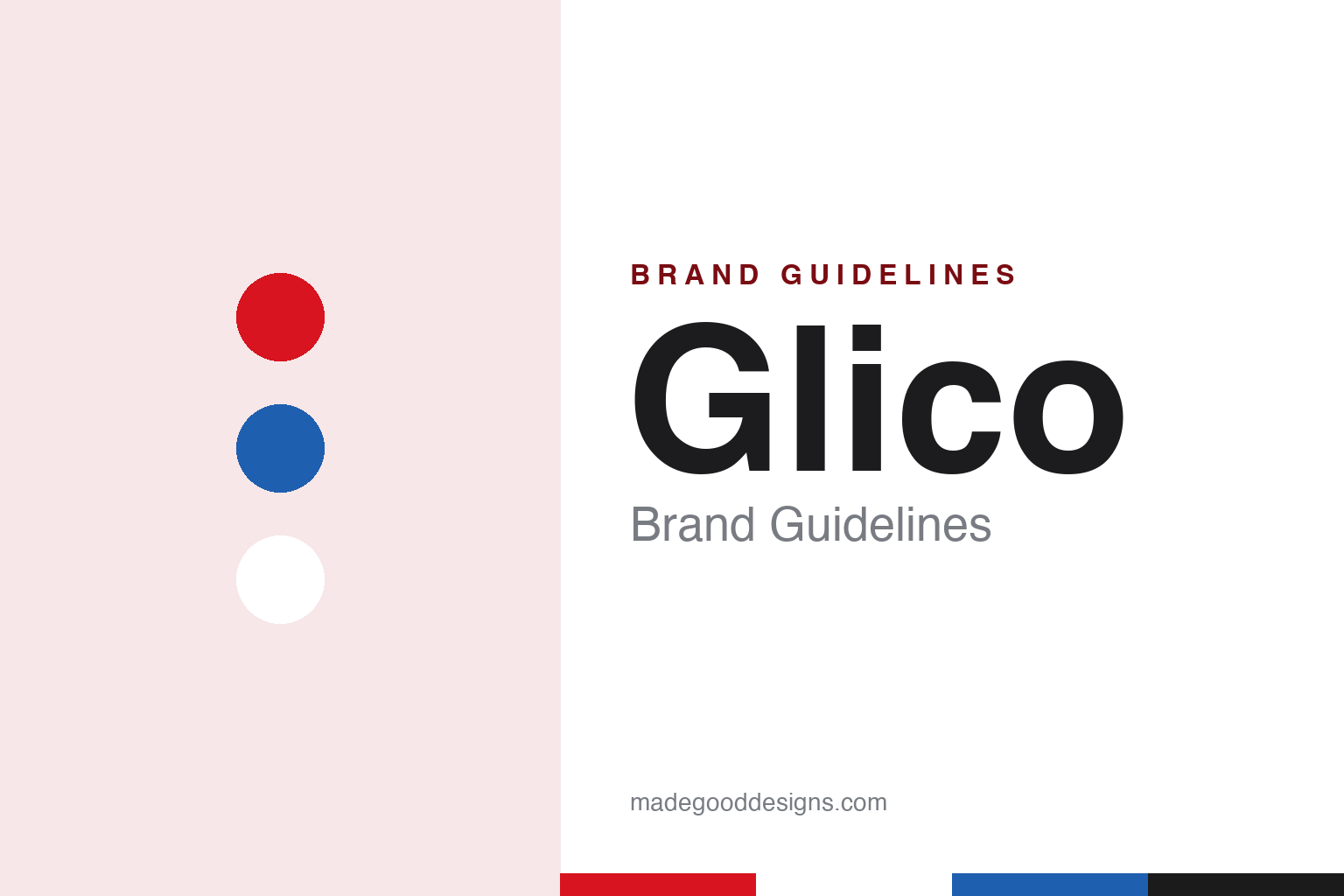
Two constants: a Glico red, blue and white palette and a rounded sans register. Abstract homage — not a Glico product or mark; no package, runner or logo is reproduced.
Glico Caramel
Oyster glycogen and a department-store debut.
Glico began not with chocolate but with a caramel. Its founder, Riichi Ezaki, came from Saga Prefecture in Kyushu, where, Japanese Wikipedia says, his family ran a medicine trade. The company says that in 1919 he confirmed that oyster broth contained generous amounts of glycogen, and set out to put it into food. The caramel he made was named “Glico,” a shortening of the word glycogen, English Wikipedia says.
The company dates its founding to 11 February 1922, the day Glico Caramel went on sale at the Mitsukoshi department store in Osaka. It says Ezaki had approached the store again and again, believing that good products would not be considered first-rate unless a leading retailer sold them. The company itself was incorporated in February 1929 and has been renamed several times; it has carried the name Ezaki Glico Co., Ltd. since 1958, according to English Wikipedia.
Its headquarters stand at Utajima in Osaka’s Nishiyodogawa ward, the site of a factory that opened in 1931. The company says all of its plants, at home and abroad — including a factory in Dalian, China, opened in 1932 — were destroyed by the end of the Second World War, and that its Osaka and Tokyo factories were rebuilt and reopened in 1951. Japanese Wikipedia says its shares have been listed on the Tokyo Stock Exchange since 1961. The Ezaki family still leads it: the company names Katsuhisa Ezaki, the founder’s grandson according to Japanese Wikipedia, as chairman and Etsuro Ezaki as president.
Colour
Almond Chocolate, Pocky and TCHO.
Chocolate came after the war. The company says it launched Almond Chocolate in 1958, with one almond in each piece, at a time when chocolate products “generally contained only chocolate,” and that it won a Monde Selection award in Belgium in 1962, which it describes as the first for a Japanese product. In 2012 it added Kobe Roasted Chocolate, a bite-size chocolate made, the company says, with cacao roasted by Kobe Glico.
Its best-known chocolate product is Pocky, launched in 1966, which the company calls the world’s first chocolate-coated biscuit stick. The idea was practical: one end of each stick is left uncoated, the company says, “so that no chocolate gets on the fingers.” It followed PRETZ, the uncoated stick, which the company says was trialled in Hiroshima in 1962. Since 1999 the company has promoted 11 November as “Pocky & PRETZ Day,” and in 2020 Glico announced that Guinness World Records had certified Pocky as the world’s best-selling chocolate-coated biscuit brand.
Pocky travels under other names. In Europe it has been sold as Mikado since 1982, when General Biscuit Glico France was set up, the company says; English Wikipedia says Mikado is produced under licence by Mondelēz International. In Malaysia the sticks were sold as “Rocky” until a 2014 rebrand to Pocky with a new pack, English Wikipedia says. The company dates Pocky’s sales in Indonesia and Vietnam to 2012, Korea to 2013 and Malaysia to 2014, and says a new factory of PT Glico Manufacturing Indonesia began shipping Pocky to the Indonesian market in 2023. In Japan, it says, production was brought together in 2020 under Glico Manufacturing Japan, which took over the businesses of 14 manufacturing subsidiaries.
In 2018 Glico moved into craft chocolate. That February, Confectionery News reported that it had bought a majority of TCHO, the bean-to-bar maker founded in 2005 with a factory in Berkeley, California, from the investor Emil Capital Partners; Glico said the purchase would help it “enhance its chocolate business.” Glico’s corporate history now lists TCHO Ventures as a wholly owned subsidiary.
Typography
Chocolate makers around the world.
The seven brands in this group all make chocolate, and they come from six countries on four continents: Ganong and Chocolats Favoris from Canada, Abuelita from Mexico, La Ibérica from Peru, Glico from Japan, Orion from the Czech Republic and Simón Coll from Spain. Read together, they show how differently a chocolate name can be built, kept and presented from one market to the next.
A chocolate brand can belong to the family that started it or to a group that bought it later, and the name on the wrapper and the company that owns it are not always the same thing. It can be known for bars and boxed chocolates, for a drink or for a seasonal novelty, and its packaging can draw on very different local traditions. Each guide looks at how one brand’s own history shows up in what it puts on the shelf.
Each guide also separates what independent sources record from what the company says about itself — who founded it, who owns it now, where its cocoa comes from and where its chocolate is made — and marks plainly what rests only on the company’s own word.
Aa
A rounded sans — for a brand whose logotype became a red script “glico” in 1992. (Specimen set in Nunito, a sans STAND-IN; NOT the Glico logo.)
Glico
The Goal-in mark and the Dotonbori sign.
Glico’s brand starts with its first package. The company says the caramel came in a distinctive red box carrying the Glico logo and “a marathon runner with arms raised in the air resembling victory.” Its sales line was “300 Meters in a Single Piece,” English Wikipedia says. Japanese Wikipedia calls the runner the “Goal-in mark” and says that since around 2019 the company’s other products have carried only the glico logotype. Toys came in the box too — picture cards from 1922 and small toys from 1927, the company says — and the Glico Museum in Osaka, opened in 1972, displays about 4,000 of them.
The runner is also a landmark. In 1935 Glico put up a neon sign in Osaka’s Dōtonbori district, 33 metres high in its first version, the company says. It has been rebuilt several times: a fifth version of 1998 added Osaka symbols including Osaka Castle and Tsutenkaku Tower, and the sixth, lit by LEDs, has run since 2014. English Wikipedia describes the sign as a runner crossing a finish line on a blue track, and calls it a major tourist attraction in Dōtonbori and Osaka.
The wordmark changed in April 1992, for the company’s 70th anniversary, from a gothic “Glico” to a red script “glico,” Japanese Wikipedia says; the company dates its new corporate logo and the philosophy “A Wholesome Life in the Best of Taste” to that year. For its centenary in 2022 it adopted a new purpose, “Healthier days, Wellbeing for Life.”
For a design guide, Glico shows how one figure on a 1920s caramel box can carry a company for a century, from packaging to a city landmark. Compare Dandelion Chocolate, another bean-to-bar maker from the San Francisco Bay Area, where TCHO is based, and La Ibérica, a chocolate maker founded in Peru in 1909. For this guide we use red, blue and white with a rounded sans, an unofficial interpretation; no product or logo is reproduced.
Explore & save
Keep Glico’s identity on hand — save it to a board in the Made Good inspiration library.
Glico identity set
Pin the Glico red, blue and white palette and the rounded sans register to your own board.