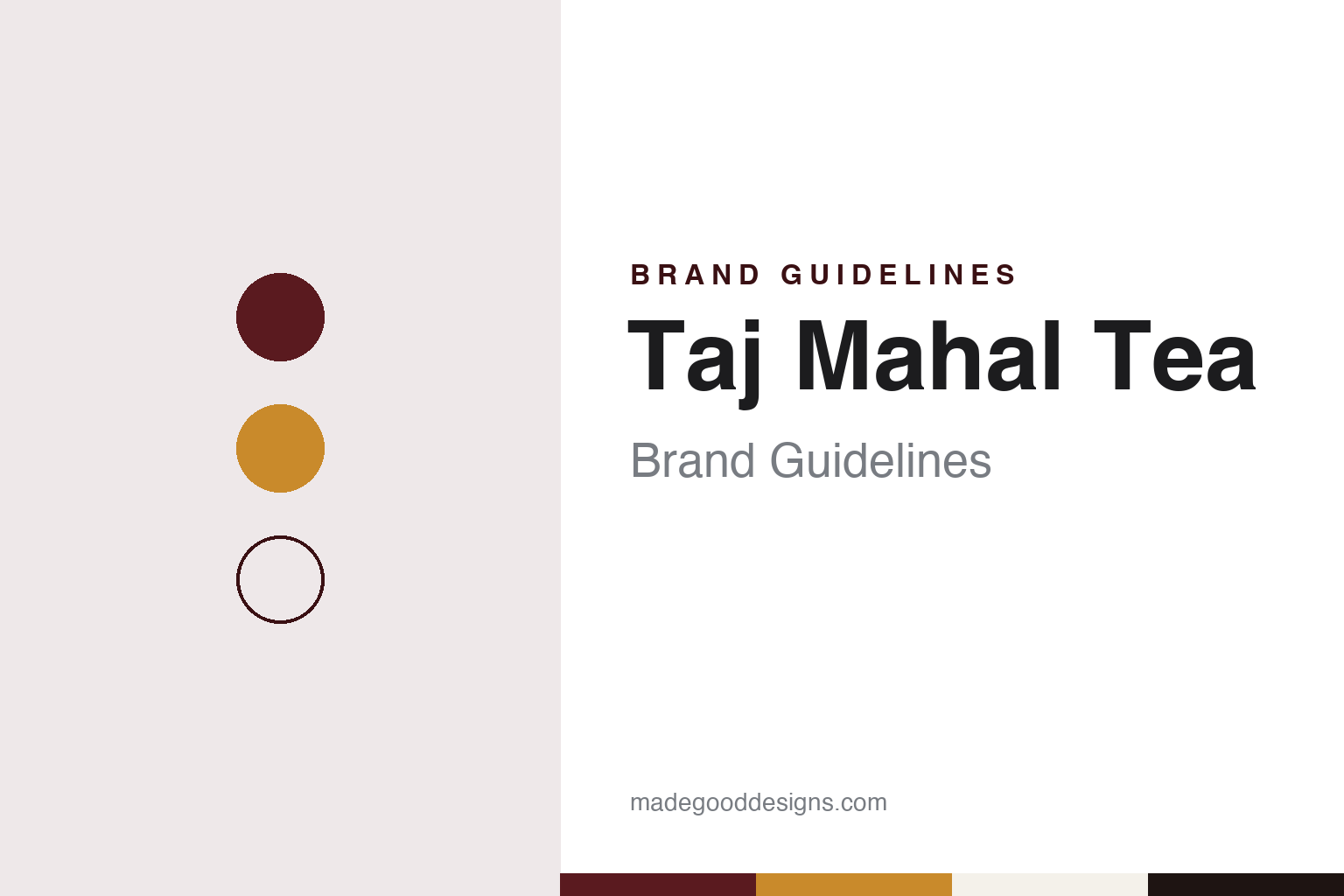
Taj Mahal Tea Brand Guidelines
Brooke Bond’s 1966 premium tea and the line “Wah Taj!”
Aa
Two constants: a maroon, badami amber and marble white palette and a classical serif register. Abstract homage — not a Taj Mahal Tea product or mark; no pack, logo or advertisement is reproduced.
Brooke Bond, 1966
A premium blend from a British tea company’s Indian arm.
Taj Mahal is a tea brand that Brooke Bond launched in India in 1966. Hindustan Unilever’s own brand page, archived in 2012, gives that year under “key facts” and calls the brand “India’s best tea since 1966”; in August 2015 The Economic Times described it as HUL’s “49-year-old premium tea brand,” and in February 2016 a 14-hour Indian classical concert in Mumbai marked its 50th anniversary, English Wikipedia says. The full name on the pack today is Brooke Bond Taj Mahal.
Brooke Bond was already old in India by then. According to Hindustan Unilever’s published company history, the British tea firm’s presence there dates back to 1900; it had launched Red Label in the country by 1903, and Brooke Bond & Co. India Limited was formed in 1912. By 1957, English Wikipedia says, Brooke Bond probably held a third of both the British and the Indian tea markets.
The brand’s owner changed through a chain of mergers. Brooke Bond joined Unilever in 1984 through an international acquisition, HUL says. In 1994 Brooke Bond India and Lipton India merged to form Brooke Bond Lipton India Limited, and that company merged with Hindustan Lever with effect from 1 January 1996. Hindustan Lever became Hindustan Unilever Limited in June 2007, The Financial Express reported, and the company, a subsidiary of Unilever, is headquartered in Andheri, Mumbai.
When Unilever agreed in November 2021 to sell most of its tea business to the private equity firm CVC Capital Partners — the deal that created Lipton Teas and Infusions in July 2022 — it kept the Brooke Bond name for tea in India, Nepal and Indonesia, English Wikipedia says. Taj Mahal therefore stays with Hindustan Unilever, alongside its sister brands Red Label, Taaza and 3 Roses.
Colour
A tabla, a monument and two words.
The brand’s best-known advertising began with a rethink in the late 1980s. In a 2021 history of the campaign, ETBrandEquity reported that Pranab Barua, Brooke Bond’s marketing head, asked the agency Hindustan Thompson Associates — now JWT — to look at Taj Mahal “from zero”; the brand, the article says, was “doing rather badly.” The team was KS “Chax” Chakravarty, KV “Pops” Sridhar and the planner Dharen Chadha.
Until then the tagline had been “Ah! Taj,” in English-language commercials featuring the model Malvika Tiwari. Consumer research by the agency Quantum found that loyal drinkers prized two things: the tea’s “badami” colour, a clear yellowish tinge, and its mehek, or aroma. Barua, the article says, described that amber as typical of the high-altitude Assam teas then used in the blend.
The answer was an Indian idea of premium. On 26 July 1988, across the Yamuna from the Taj Mahal, the tabla player Zakir Hussain was filmed performing; when a listener calls out “Wah Ustad!”, he replies, “Arey huzoor, Wah Taj boliye” — “Sir, say Wah Taj.” The first film was on television by the end of 1988, ETBrandEquity reported. Writing in December 2024, Chakravarty recalled that his art partner Sridhar set the musician’s name huge and his picture small in the press layouts, because, he wrote, in those days the only way to recognise Hussain was by his tabla cases.
The campaign ran through the 1990s, later pairing Hussain with personalities including the singer Alisha Chinai and the actor Ruby Bhatia, The Economic Times reported after his death in December 2024. HUL’s 2012 brand page calls Hussain the brand’s first brand ambassador and says he held the role for more than a decade; by then the actor Saif Ali Khan was the face of the brand, and that year he voiced “Aapka Taj Andaaz,” a phone-in contest that HUL says drew more than 85,000 entries.
In 2015 The Economic Times wrote that HUL had “always tried to create a premium imagery” around Taj Mahal through classical musicians, naming Hussain, Niladri Kumar and Rahul Sharma.
Typography
Design and documentation.
The seven brands in this group all sell tea, and they come from five countries: Taj Mahal Tea and Society Tea from India, Akbar and Mlesna from Sri Lanka, Betjeman & Barton from France, Hälssen & Lyon from Germany, and Nordqvist from Finland. Two of those countries grow tea on a large scale; the other three do not, so the tea sold under a brand from there was grown somewhere else.
That split makes the usual questions sharper. For a brand from a growing country, the label may promise a garden, a region or a national style of tea; for one from a country that grows none, the promise rests on the blend, the flavouring, the shop and the box. In both cases the name on the front and the place where the tea was grown, blended and packed can be several countries apart.
Each guide separates what independent sources record from what the company says about itself — who started it, who owns it now, where its leaf is bought and where its tea is actually blended and packed — and marks plainly what rests only on the company’s own word.
Aa
A classical serif — for a brand built on a monument and a raga. (Specimen set in Playfair Display, a serif STAND-IN; NOT the Taj Mahal Tea logo.)
Taj Mahal Tea
A tea house, a santoor and a singing kettle.
HUL has made a series of claims for the brand. Its 2012 page described Taj Mahal as India’s first premium tea, the first brand to launch tea bags in the Indian market and the only one sold in vacuum-sealed packs, and listed variants including Cardamom, Darjeeling, Earl Grey, Ginger and Masala; it also ran tea-appreciation workshops called “Taj Tea Trails.” These are the company’s descriptions. On where the leaf comes from, English Wikipedia’s Brooke Bond article names estates in Upper Assam, Darjeeling and Tripura, without a citation; we found no HUL statement in the sources checked on where Taj Mahal is blended and packed.
The music carried into physical spaces. In August 2015 HUL opened the Brooke Bond Taj Mahal Tea House in Bandra, Mumbai — the company’s first tea restaurant, The Economic Times reported — a 3,500-square-foot room of about 80 seats with marble furniture and motifs inspired by the monument in Agra, and a baithak space designed acoustically for classical musicians. English Wikipedia credits the design to the brothers Ayaz and Zameer Basrai.
In October 2023 the brand put up “Megh Santoor” opposite Vijayawada Junction railway station: a 2,250-square-foot billboard with 31 strings that played the monsoon raga Megh Malhar when it rained, made with Ogilvy and the percussionist Taufiq Qureshi. HUL’s Shiva Krishnamurthy said it had been recognised by Guinness World Records as the world’s largest environmentally interactive billboard, and called Vijayawada “one of the biggest citadels for Taj Mahal Tea.” In April 2025 Ogilvy followed it with the Chai Bansuri, a kettle beside the Krishna river whose steam sounds a flute; ETBrandEquity reported that the santoor billboard had won a Silver at Cannes Lions.
For a design guide, Taj Mahal Tea shows how a mass-market pack can borrow its idea of premium from a monument and a musician rather than from luxury imagery. Compare PG Tips, Brooke Bond’s British brand, and Red Rose Tea, its North American one. For this guide we use maroon, badami amber and marble white with a serif, an unofficial interpretation; no product or logo is reproduced.
Explore & save
Keep Taj Mahal Tea’s identity on hand — save it to a board in the Made Good inspiration library.
Taj Mahal Tea identity set
Pin the Taj Mahal Tea maroon, badami amber and marble white palette and the classical serif register to your own board.