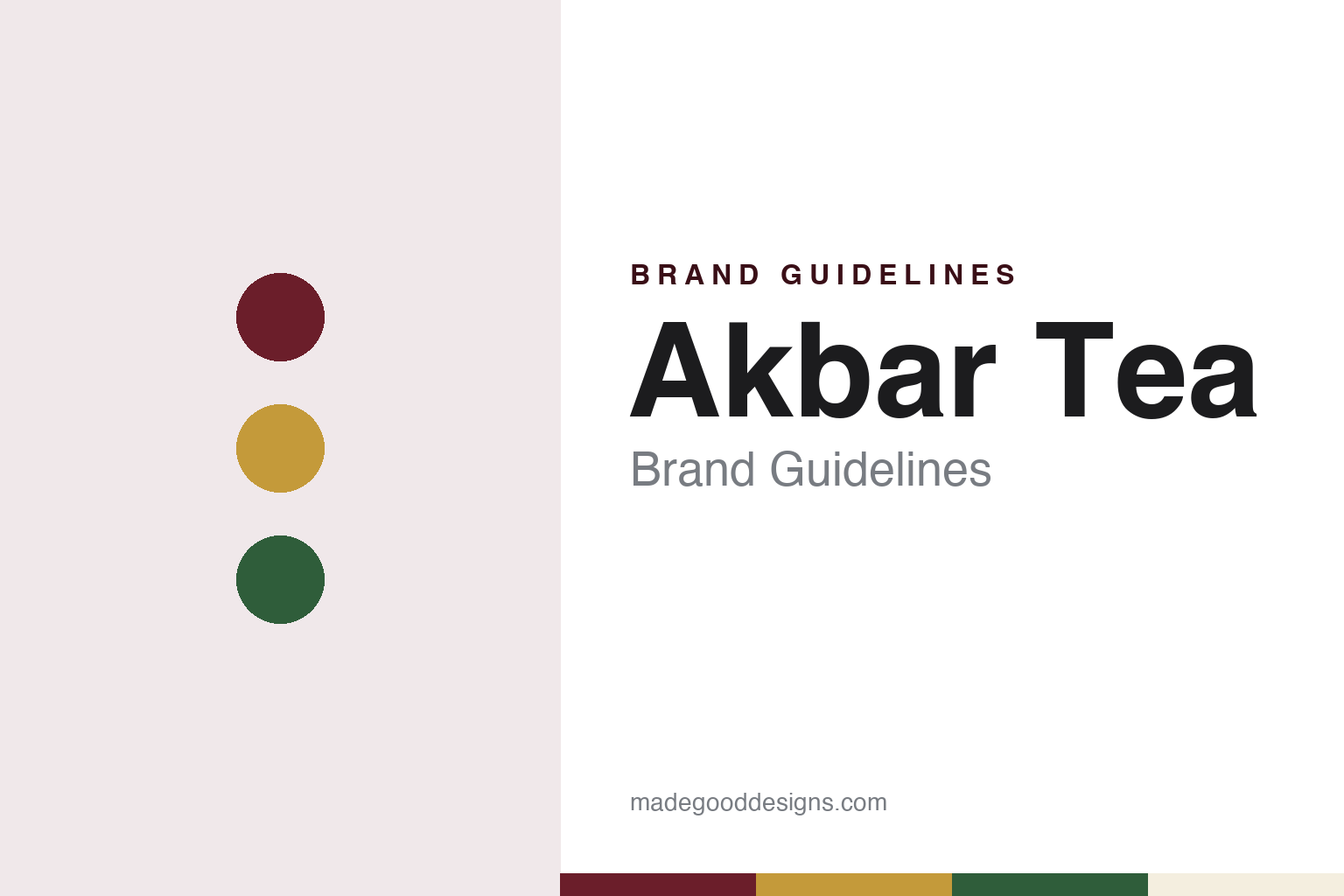
Akbar Tea Brand Guidelines
The family firm behind Sri Lanka’s largest tea exporter.
Aa
Two constants: an Akbar maroon, gold and green palette and a heritage serif register. Abstract homage — not an Akbar product or mark; no pack, logo or label is reproduced.
Akbar Brothers
Two brothers and a family tea trade.
Akbar Tea is the consumer brand of Akbar Brothers, a Sri Lankan tea exporter. English Wikipedia dates the firm to 1969, when the brothers Abbas Akbarally and Inayet Akbarally left the family business, Hebtulabhoys and Co., and set up on their own. The company’s website names the two brothers as its founders.
The family trade is older. English Wikipedia says the brothers’ great-grandfather, Shaikh Hebtulabhoy, came to Ceylon from India in 1864 and set up a food import and export business in Pettah, Colombo’s old market district, and that his son, Tyeabally Shaikh Hebtulabhoy, founded M. S. Hebtulabhoy and Company, which began shipping tea overseas in 1907. That date belongs to the earlier family firm, not to Akbar Brothers.
Within three years of starting, Wikipedia says, the brothers were exporting to tea markets in the Middle East. Akbar Brothers Limited was incorporated in 1972, and their father, Shaikh Akbarally, left the chairmanship of Hebtulabhoys to join them. Today the business trades as Akbar Brothers (Pvt) Ltd and is still owned and run by the family, according to both Wikipedia and the company.
Colour
Blended and packed at Kelaniya.
Akbar’s main claim is scale. The company says it has been Sri Lanka’s largest tea exporter “unchallenged since 1992.” Outside sources give similar but not identical dates: in June 2014 the Daily FT reported that Akbar Brothers had marked 20 years as the country’s largest tea exporter, and in July 2022 the Times of Oman described it as the largest Ceylon tea exporter “for more than 29 years.”
The Daily FT gave figures from a company spokesman: shipments in 2013 of more than 50 million kilos, which the spokesman said were 17% of Sri Lanka’s tea export earnings and almost 2.5% of the country’s total exports. Of that, 37 million kilos, or 74%, were value-added consumer products — tea bags, tea packets and ready-to-drink teas — and around 22 million kilos were sold under the company’s own Sri Lankan brands. The rest of its trade is tea packed for other companies’ labels, which the article did not name.
Where the tea is made is documented on the company’s own terms. Akbar says its teas are blended, processed and packaged at a facility in Kelaniya, near Colombo, covering more than 276,000 square feet, which it calls Sri Lanka’s largest tea manufacturing facility. It says the lines use machinery from Germany, Italy and Japan; the Daily FT reported the same three countries in 2014, along with in-house tasting laboratories, and said both the tea-bagging and tea-packing facilities were ISO 9002 and HACCP certified. The company also says tea bags are made by a subsidiary, Quick Tea (Pvt) Ltd, which it says was named South Asia’s first “Carbon-Inset” facility, and that “every consignment of Akbar tea is personally approved by a family member before it is shipped.”
The company lists certifications including ISO 9001 and ISO 22000, and says it was the first Sri Lankan tea company to hold ISO 9001 and HACCP certificates; we give that as its claim.
Typography
The Ceylon tea trade.
The seven brands in this group all sell tea, and they come from five countries: Taj Mahal Tea and Society Tea from India, Akbar and Mlesna from Sri Lanka, Betjeman & Barton from France, Hälssen & Lyon from Germany, and Nordqvist from Finland. Two of those countries grow tea on a large scale; the other three do not, so the tea sold under a brand from there was grown somewhere else.
That split makes the usual questions sharper. For a brand from a growing country, the label may promise a garden, a region or a national style of tea; for one from a country that grows none, the promise rests on the blend, the flavouring, the shop and the box. In both cases the name on the front and the place where the tea was grown, blended and packed can be several countries apart.
Each guide separates what independent sources record from what the company says about itself — who started it, who owns it now, where its leaf is bought and where its tea is actually blended and packed — and marks plainly what rests only on the company’s own word.
Aa
A heritage serif for an exporter’s brand. (Specimen set in Playfair Display, a serif STAND-IN; NOT the Akbar Tea logo.)
Akbar Tea
A Lion on the pack and many languages.
Akbar sells under more than one name. Besides Akbar itself, English Wikipedia says the company makes Alghazaleen, a Ceylon tea brand it describes as popular in Jordan, Palestine, the United Arab Emirates and Afghanistan. Citing the Sri Lankan Daily News of December 2003 and The Island of October 2005, Wikipedia says Akbar and Alghazaleen won the Sri Lanka Institute of Marketing’s brand of the year award in 2003 and 2005; the company’s website describes the honour as “International Brand of the Year.”
The most visible shared mark on the packs is not the company’s own. Akbar says “virtually every item” in its range carries the Lion logo of the Sri Lanka Tea Board, the certification mark for tea grown and packed in Sri Lanka. Its website is published in seven languages — English, Arabic, Chinese, Portuguese, French, Russian and Spanish — and its product range runs from black and green teas to flavoured and herbal teas, iced tea and gift packs.
The brand also has shops of its own abroad. On 5 July 2022, the Times of Oman reported, Sri Lanka’s ambassador to Oman opened an Akbar Tea outlet at the Boulevard Boutique Mall in Muscat; the paper said the tea was also available in Salalah.
Beyond tea, the parent Akbar Group says it works in renewable energy, healthcare, printing, property development and environmental services, and calls itself the largest privately owned renewable-energy company in Sri Lanka. Two of its businesses sit close to tea: Ethical Extracts, which the group says produces Ceylon tea extracts, and Flexiprint, a printing company. We give these as the group’s own descriptions.
For a design guide, Akbar Tea shows how an exporter’s brand can lean on a national origin mark and print in many languages. Compare Dilmah, another family-owned Ceylon tea brand, and Ahmad Tea, a family tea firm that also sells widely in the Middle East. For this guide we use maroon, gold and a leaf green with a serif, an unofficial interpretation; no product or logo is reproduced.
Explore & save
Keep Akbar Tea’s identity on hand — save it to a board in the Made Good inspiration library.
Akbar Tea identity set
Pin the Akbar Tea maroon, gold and green palette and the heritage serif register to your own board.