Ahmad Tea Brand Guidelines
The Hampshire family tea firm that grew from a shop on London Road.
Aa
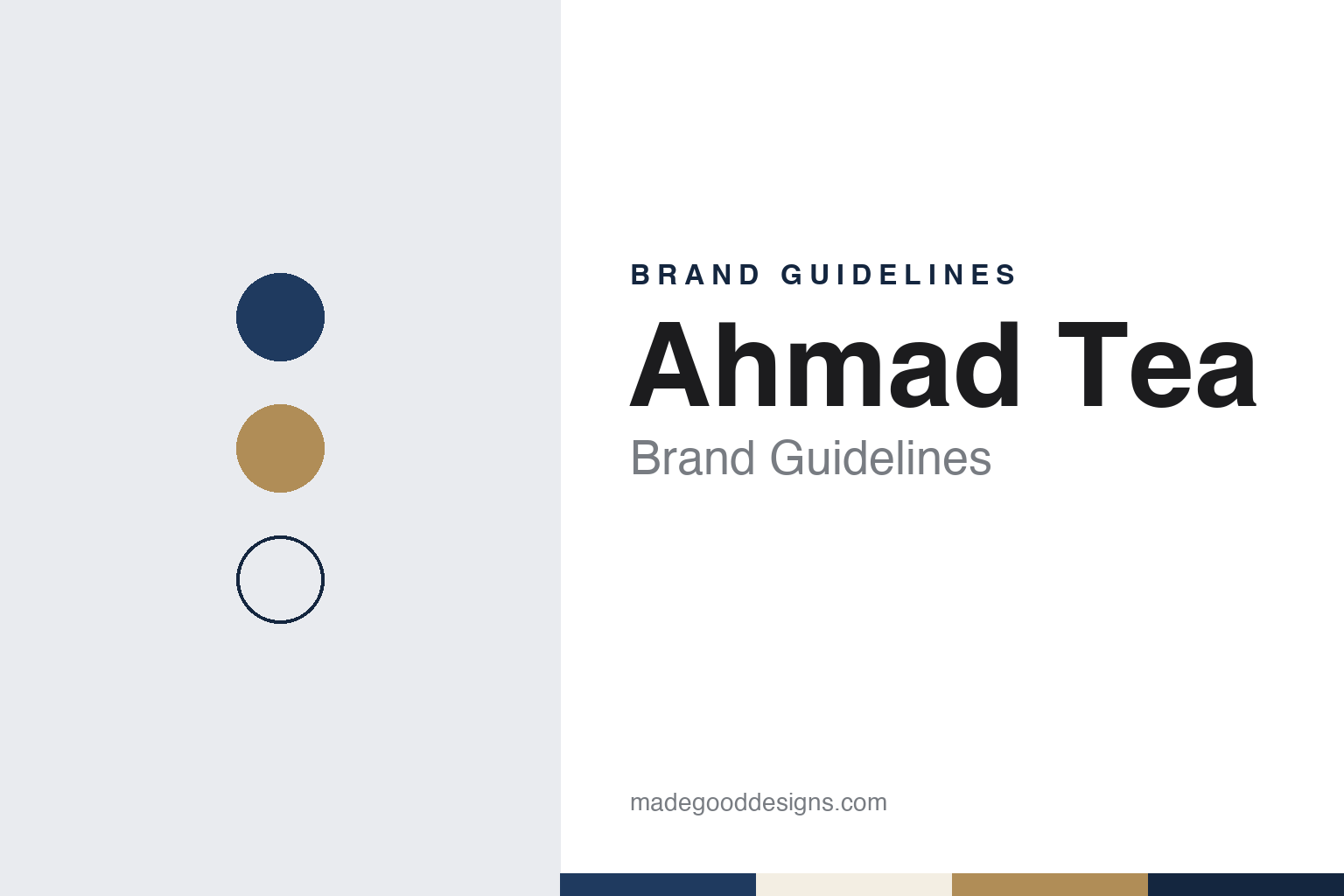
Two constants: a navy, cream and gilt palette and a Classic serif register. Abstract homage — not an Ahmad Tea product or mark; no pack, caddy or logo is reproduced.
London Road
Brothers, a father’s name and an office above a tea shop.
Ahmad Tea is a family company from Hampshire, in the south of England. The UK register Companies House records Ahmad Tea Limited as incorporated on 13 May 1986, classified under tea processing and the wholesale of coffee, tea, cocoa and spices. English Wikipedia describes it as founded that year by the British Iranian businessman Rahim Afshar and his brothers, and says the company is named after their father, Ahmad.
The company’s own timeline fills in the start. It says Rahim Afshar decided to enter the tea trade in 1979, “building upon his family’s history and knowledge in packing and blending tea.” When Ahmad Tea was founded in 1986 it worked at first as an importer, the company says, from a small office above the family’s Kabir Tea Shop on London Road in Southampton. Its first loose-tea blend went on sale in 1987, aimed at the luxury gift market and stocked by retailers in the south of England and in London.
In 1989, the company says, it moved to larger premises in Chandler’s Ford, a town between Southampton and Winchester, and won its first major retail partner, the Spanish department-store group El Corte Inglés. In 2010 it opened new offices there, with a tasting room and a small tea museum; English Wikipedia, citing a Barclays client story of that year, describes the 2010 move as one from London, which the company’s own timeline does not. Chandler’s Ford remains the head office: a Barclays profile published in 2018 put about 70 staff there, out of roughly 1,000 worldwide.
The business has stayed with the family. The company names Rahim Afshar as chairman and says he works with his brothers Karim and Ebraham, and its website says every blend is sampled seven times between garden and cup, a process it says the chairman oversees. Barclays quoted his rule in 2018: “I will not approve anything for sale that I would not drink at home.”
Colour
Imported in Hampshire, packed in four countries.
The company says it entered the markets of the former Soviet Union in 1992, starting with Russia, and that by 2000 it was one of the five leading tea brands in Russia, Ukraine and the Middle East — a ranking we give as its own claim. Barclays, in 2018, named Russia, the Middle East and Africa among its main markets, with the United States as a growth target.
The company describes production abroad. Its timeline mentions a Sri Lanka packing factory supported by an office in Colombo opened in the late 1990s — its UK and US websites give 1997 and 1996 — and says it built its first overseas manufacturing plant at Kharkiv, Ukraine, in 1998, and a third major plant in China in 2008, as demand for green tea grew. Barclays listed the company’s facilities in 2018 as being in the UK, Russia, Ukraine, China and the United Arab Emirates, and said the tea itself is sourced from China, India and Sri Lanka.
Ahmad Tea says its plant at Ras Al Khaimah, in the UAE, opened in 2012, is its “global production facility”: it blends tea in bulk for the group’s other factories and, the company says, produces more than 14 million kilograms of tea a year. Barclays described it as a processing and export hub in a free zone.
On packaging, the company’s website goes into detail. It says teabags with a string and tag make up more than 95 per cent of its annual production; that the bag paper is made from Manila hemp, the string is cotton tied with a knot rather than glue or staples, and the tags are printed on FSC-certified or recycled paper with water- or soy-based inks. It says its teabag envelopes are polypropylene and its cartons cardboard, and it says plainly that the cellophane overwrap on some cartons is not recyclable and that it is working on an alternative.
Typography
Tea, trade and the pack.
The seven brands in this group all sell tea, and they come from three countries: Yorkshire Tea, Taylors of Harrogate, Ahmad Tea, Tetley and PG Tips from England, Teekanne from Germany, and Dammann Frères from France. Tea brands in general sit at many different points in the trade, from boxes of bags on a supermarket shelf to loose-leaf tins sold over the counter of a house’s own shop, and a single company can work at both ends at once.
A tea brand’s identity is usually carried less by a field than by a blend, a box and the cup it promises, because the leaf in the packet may have been grown a long way from where the name on the front was made. That makes the questions behind each name worth asking plainly: who started it, who owns it now, where its leaves are bought, and where its tea is actually blended and packed.
Each guide separates what independent sources record from what the company says about itself — its founding story, its owners over time, where its tea comes from and where it is packed — and marks plainly what rests only on the company’s own word.
Aa
A classic serif for a family tea house. (Specimen set in Cormorant Garamond, a serif STAND-IN; NOT the Ahmad Tea logo.)
Ahmad Tea
A family firm with a global reach.
The company now describes a business of global scale run from a Hampshire town. Its website says Ahmad Tea serves “over 30 million cups of tea a day” in more than 80 countries — one page of its UK site says more than 90 — and Barclays reported in 2018 that it offered more than 300 products. Earlier, in 2003, the company says it held the majority share of the UK tea-gift market and sold in 68 countries; we give both as its own claims.
The company says its blends have won Great Taste Awards, the scheme run by the Guild of Fine Food, since it first entered in 2015, reaching 22 by 2019, and that it was named a Great Taste Producer in 2018; English Wikipedia, citing the Guild, says it has won more than 20. Its website also says it won a King’s Award for Enterprise for sustainable development in 2024, which we report as the company’s statement. It runs a “Beyond the Leaf” range with the Royal Botanic Gardens, Kew, and says each purchase gives back to Kew’s research.
Its charitable work has been reported more widely. English Wikipedia, citing The Business Magazine, says Ahmad Tea received an ethical-investor award in its Solent 250 awards for charity work in the UK and support for orphanages in Mali, Russia, Sri Lanka and Ukraine, and Barclays wrote in 2018 that it had funded a cancer hospital in Sri Lanka and water boreholes in Niger.
For a design guide, Ahmad Tea shows how a family name, a shop on a Southampton street and a quality rule can carry a brand into dozens of export markets. Compare Twinings, the older English tea house, and Dilmah, a family brand built on Ceylon tea. For this guide we use navy, cream and a brass gilt with a serif, an unofficial interpretation; no product or logo is reproduced.
Explore & save
Keep Ahmad Tea’s identity on hand — save it to a board in the Made Good inspiration library.
Ahmad Tea identity set
Pin the Ahmad Tea navy, cream and gilt palette and the Classic serif register to your own board.