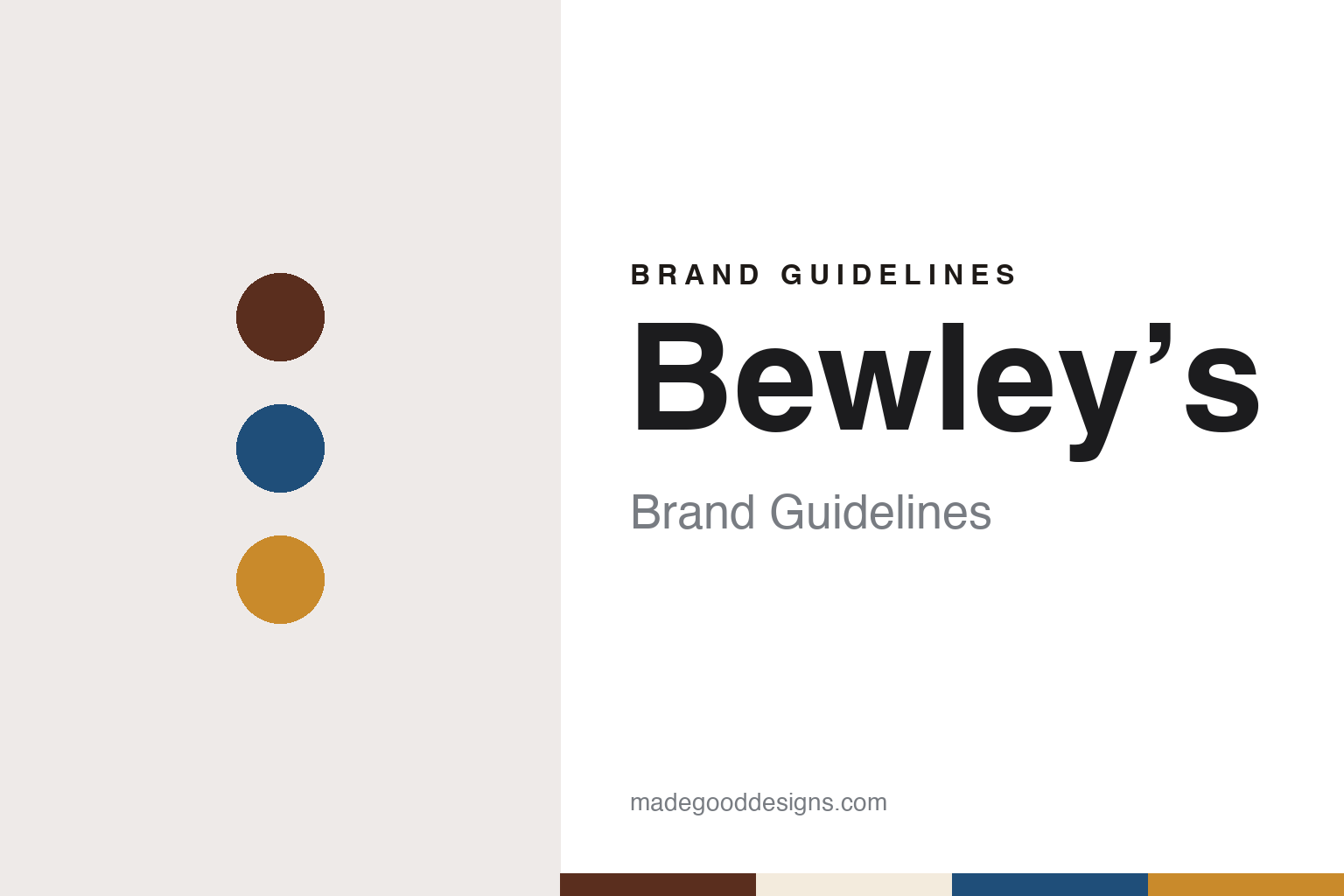
Bewley’s Brand Guidelines
The Dublin Quaker tea house behind the Grafton Street café.
Aa
Two constants: a Bewley’s mahogany, blue and amber palette and a café serif register. Abstract homage — not a Bewley’s product or mark; no pack, window, logo or café sign is reproduced.
The China Tea Company
A Quaker family, a clipper ship and a tea company.
Bewley’s dates itself to 1840 in Dublin. The Bewleys were Quakers who had come to Ireland from Cumberland in the 17th century, according to a family history published in Dublin in 1902. The company’s own heritage timeline, as archived in 2017, starts five years before its founding date: in 1835, it says, Samuel Bewley and his son Charles imported 2,099 chests of tea directly from Canton to Dublin on the clipper ship Hellas, which the company presents as breaking the East India Company’s monopoly and introducing tea to Ireland.
The same timeline gives 1840 as the year Bewley’s was “officially founded,” when Charles’s brother Joshua Bewley set up the China Tea Company, which it calls the precursor of the tea and coffee business of today. Its current website says Bewley’s “started life in a small shop on Sycamore Alley in Dublin” and that its Quaker origins still guide the business; we give those as the company’s account.
Coffee and cafés came at the end of the century. The company says its first café opened on George’s Street in 1894, and that it was the first to roast coffee in-store; English Wikipedia lists cafés on South Great George’s Street in 1894 and Westmoreland Street in 1896. Joshua’s son Ernest Bewley imported Jersey cows in 1903 to supply milk and cream for his cafés and bakery, the company says, and in 1932 Ernest’s son Victor Bewley became managing director, running the business for some four decades by the company’s account.
Colour
Millar & Symes, Harry Clarke and a long lease.
The best-known Bewley’s building is the café at 78–79 Grafton Street, which Ernest Bewley opened in 1927. Ireland’s National Inventory of Architectural Heritage attributes the building to the Dublin architects Millar & Symes and notes a façade with an Egyptian Revival mosaic, a style rare in Dublin; the upper floors once housed Whyte’s Academy, a school founded in 1758 whose pupils included Robert Emmet and the Duke of Wellington, The Irish Times reported in 2015.
Inside are six stained-glass windows by Harry Clarke: four known as “The Four Orders,” showing orders of architecture, and two called “Swan Yard.” RTÉ reported that they were commissioned in 1927 for £460 and installed in 1928. The café also holds a window by Jim Fitzpatrick, moved from the closed Mary Street branch, and one by Pauline Bewick called Cafe Society, The Irish Times and TheJournal.ie have reported.
The café has had a turbulent recent history. It closed for refurbishment from November 2004 to May 2005, and again from February 2015 until November 2017, a closure RTÉ described as a multimillion-euro refurbishment. In May 2020 management told staff it would close permanently, with 110 job losses, RTÉ reported; in July 2020 a phased reopening was announced. The windows then became the subject of a court case: the landlord, RGRE Grafton Ltd, argued that they were part of the building, while the tenants, Bewley’s Cafe Grafton Street Ltd and Bewley’s Ltd, argued that they were movable artworks. The High Court split the windows in January 2023, the Court of Appeal found for the landlord in July 2024, and in February 2026 the Supreme Court ruled that all six belong to the building’s owner, RTÉ reported.
Typography
Design and documentation.
The seven brands in this group all sell tea, and they come from two countries on either side of the Irish Sea: Typhoo, Clipper, Whittard and Fortnum & Mason from England, and Barry’s Tea, Lyons and Bewley’s from Ireland. Tea brands in general sit at many different points in the trade, from boxes of bags on a supermarket shelf to caddies sold over the counter of a house’s own shop, and a single company can work at both ends at once.
A tea brand’s identity is usually carried less by a field than by a blend, a box and the cup it promises, because the leaf in the packet may have been grown a long way from where the name on the front was made. That makes the questions behind each name worth asking plainly: who started it, who owns it now, where its leaves are bought, and where its tea is actually blended and packed.
Each guide separates what independent sources record from what the company says about itself — its founding story, its owners over time, where its tea comes from and where it is packed — and marks plainly what rests only on the company’s own word.
Aa
A café serif — the register of a 1920s Dublin tea room. (Specimen set in Playfair Display, a serif STAND-IN; NOT the Bewley’s logo.)
Bewley’s
From a family firm to the Campbell Bewley Group.
The Bewley family did not keep the business. In 1986 it was taken over by Campbell Catering, forming the Campbell Bewley Group, the Irish Independent reported in 2013; the company’s own timeline says Bewley’s was acquired that year by Patrick Campbell. Expansion abroad followed: the Boston café chain Rebecca’s Cafe in 1997, according to the Irish Independent, and the Californian coffee business Java City in 2000, according to Tea & Coffee Trade Journal. In 2010 The Irish Times reported that the group employed about 800 people, supplied more than 4,000 food-service customers in the Republic and sold branded tea and coffee through hotels and the grocery trade.
Britain came next. Bewley’s bought London-based Darlington’s coffee in late 2011 and the Yorkshire company Bolling Coffee, maker of the Grumpy Mule brand, in 2013, RTÉ reported; English Wikipedia adds the UK food-service distributor Peros in 2015. On manufacturing, the company says it opened a 110,000 sq ft coffee-roasting and tea-packing plant in Dublin in 1999; we give that as its claim. It also says it brought the first Fairtrade-certified coffees to Ireland in 1996 and that it holds B Corp certification.
Today Bewley’s describes itself as “an independent, family-owned business” and “Ireland’s leading coffee and tea company,” with operations in Ireland, the UK and the USA; those are its own words. One name trap: the Bewley’s Hotels chain used the name under licence, owned by Slaney Foods and the Moran Hotel Group, and the arrangement ended by mid-2015 after Dalata Hotel Group bought the hotels, The Irish Times reported.
For a design guide, Bewley’s shows how a tea brand can borrow its character from a building, a café and its windows. Compare Barry’s Tea, another Irish family tea name, and Twinings, the London tea merchant. For this guide we use mahogany, stained-glass blue and amber with a serif, an unofficial interpretation; no product or logo is reproduced.
Explore & save
Keep Bewley’s’s identity on hand — save it to a board in the Made Good inspiration library.
Bewley’s identity set
Pin the Bewley’s mahogany, blue and amber palette and the café serif register to your own board.