Community Coffee Brand Guidelines
The Baton Rouge family roaster known for its red bag.
Aa
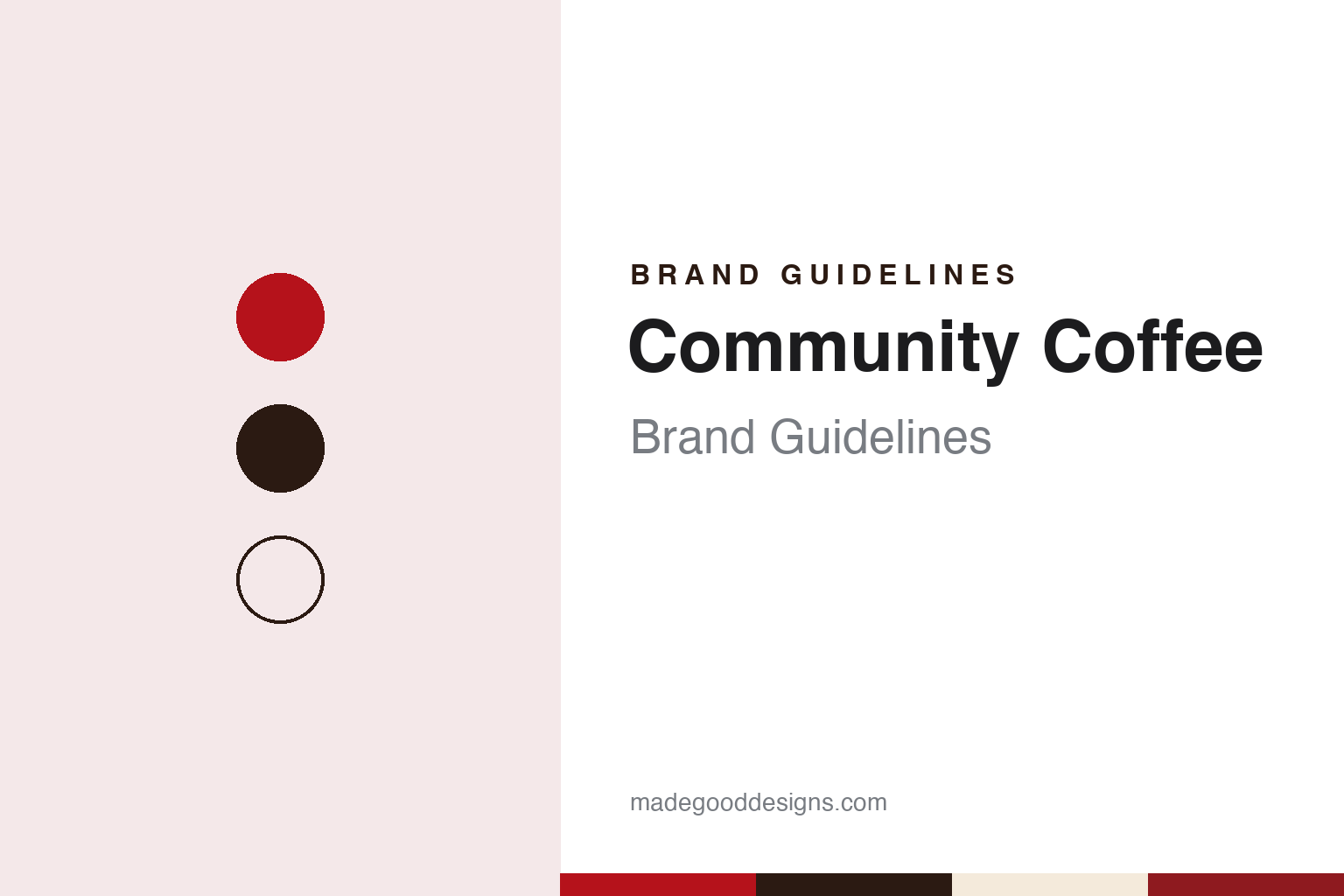
Two constants: a Community Coffee red and brown palette and a bookish serif register. Abstract homage — not a Community Coffee product or mark; no bag, logo or label is reproduced.
Cap’s blend
A grocer’s coffee in Baton Rouge.
Community Coffee was founded in Baton Rouge, Louisiana, in 1919 by Henry Norman “Cap” Saurage. The company says Cap served free cups of his own blend in his Baton Rouge grocery store as a South Louisiana “lagniappe,” and named the coffee “Community” in appreciation of the customers who stopped to talk over it. Its 2019 centenary release adds that Cap had opened a general store in 1910, that by 1919 he was grinding and packaging the coffee himself, and that he delivered it by horse-drawn cart with the name stencilled on brown paper bags. A 2024 campaign release names the shop as the F.L. and H.N. Saurage General Merchandise Store, which Cap ran with his brother.
The company dates its founding to 1 April 1919, and says Cap left the grocery business in 1924 to concentrate on coffee, converting a horse barn behind his home into a coffee-grinding mill. English Wikipedia, citing The Advocate of Baton Rouge, gives a similar sequence: production moved to a converted barn by 1923, and Cap left the grocery business in 1924.
According to the company’s timeline, Cap’s eldest son, H. Norman “HN” Saurage Jr., took the business west to Lake Charles in 1934. In 1941 the company bought its first roaster, a Jabez Burns “Jubilee,” so that it could roast its own coffee instead of buying roasted beans; in 1946 it opened its first modern roasting plant in Baton Rouge and began mailing coffee to customers outside Louisiana.
Colour
Red bags, vacuum packs and early Muppets.
Community’s best-known packs are its red bags. In January 2003 the Baton Rouge Business Report wrote that the company had “made its name in the Southeast with its red bag line of hearty ground coffee,” and that dark-roast drinkers who moved away from Louisiana often asked friends to mail them “the coveted red bags.” The company does not publish official colour values or a typeface.
The company says it began printing coupons on its coffee packs in 1952, redeemable for housewares, and that in 1980, under third-generation owner H. Norman Saurage III, it became “the first company to successfully introduce vacuum-sealed bags in North America,” with a pack it called the “Firm Pack.” We give that as the company’s claim. Today, it says, the signature of fourth-generation owner Matt Saurage appears on every bag and box of its coffee.
Its advertising has a notable early chapter. English Wikipedia, citing the Henson company’s archive, says Jim Henson made a series of commercials for Community in the late 1950s and the 1960s starring the early Muppet characters Wilkins and Wontkins, mostly remakes of spots first made for Wilkins Coffee; the company dates the first Henson ads to 1957. In 2024 Community launched a campaign called “Generations,” produced by TMA, a Dallas marketing agency, the company said.
Since 1988 the company has run a schools programme, now called Community Cash for Schools, in which proofs of purchase are redeemed for funds; in 2024 it said the programme had raised more than $8.5 million.
Typography
Coffee brands of the Americas.
The seven brands in this group all sell coffee, and they come from four countries of the Americas: Café Bustelo, Community Coffee, Folgers and Maxwell House from the United States, Juan Valdez from Colombia, Café Britt from Costa Rica, and Pilão from Brazil. Each guide follows its own name back to where it started and forward to whoever owns it today, rather than treating the group as one story.
A coffee brand’s identity is usually carried by a name, a pack and a promise about the cup, and the beans behind it may have been grown far from where the name on the front was roasted. That makes the plain questions behind each name worth asking: who started it, who owns it now, where its coffee is bought, and where it is actually roasted and packed.
Each guide separates what independent sources record from what the company says about itself — its founding story, its owners over time, where its coffee comes from and where it is roasted — and marks plainly what rests only on the company’s own word.
Aa
A bookish serif for a family name. (Specimen set in Libre Baskerville, a serif STAND-IN; NOT the Community Coffee logo.)
Community Coffee
Five generations of one family.
Community has stayed with the Saurage family. USA Today called it “the USA’s largest family-owned retail coffee brand” in October 2005, when Matt Saurage led the company, and reported that its Baton Rouge roasting plant resumed roasting the day after Hurricane Katrina. The company now calls itself the “#1 family-owned retail coffee brand in America” and says five generations of the family have been involved; it says Matt Saurage has been chairman since 2012, and a 2024 company release named Tom Corley as chief executive.
The company says it opened a roasting plant in Port Allen, across the Mississippi from Baton Rouge, in 1970, and in 2003 the Business Report described its roasting plant “on the banks of the Mississippi River in Port Allen.” English Wikipedia says it imports beans from Brazil, Colombia and Mexico through the ports of New Orleans and Houston. In 2002, according to English Wikipedia, it agreed to buy Maraba coffee from the Abahuzamugambi cooperative in Rwanda, described as the first direct contract between an African farming cooperative and an American coffee roaster; the company says it was a founding member of World Coffee Research in 2012.
Coffeehouses became a separate business. Community opened its first CC’s Coffee House in New Orleans in 1995, and early in 2013 spun its coffee houses off into a separate company, CC’s Coffee House, which the Saurage family also owns, the Business Report reported in April 2013. In June 2026 Community partnered with Dolly Parton on Cup of Ambition coffee, first offered at her Tennessean Travel Stop in Cornersville, Tennessee, English Wikipedia says; the company says it roasts the line.
For a design guide, Community Coffee shows a family brand known in its region by the colour of its bag. Compare Café du Monde, another Louisiana coffee name, and Peet’s Coffee. For this guide we use a red, a dark roast brown and a cream with a serif, an unofficial interpretation; no product or logo is reproduced.
Explore & save
Keep Community Coffee’s identity on hand — save it to a board in the Made Good inspiration library.
Community Coffee identity set
Pin the Community Coffee red and brown palette and the bookish serif register to your own board.