Folgers Brand Guidelines
The 1850 San Francisco coffee mill and the “Wakin’ Up” jingle.
Aa
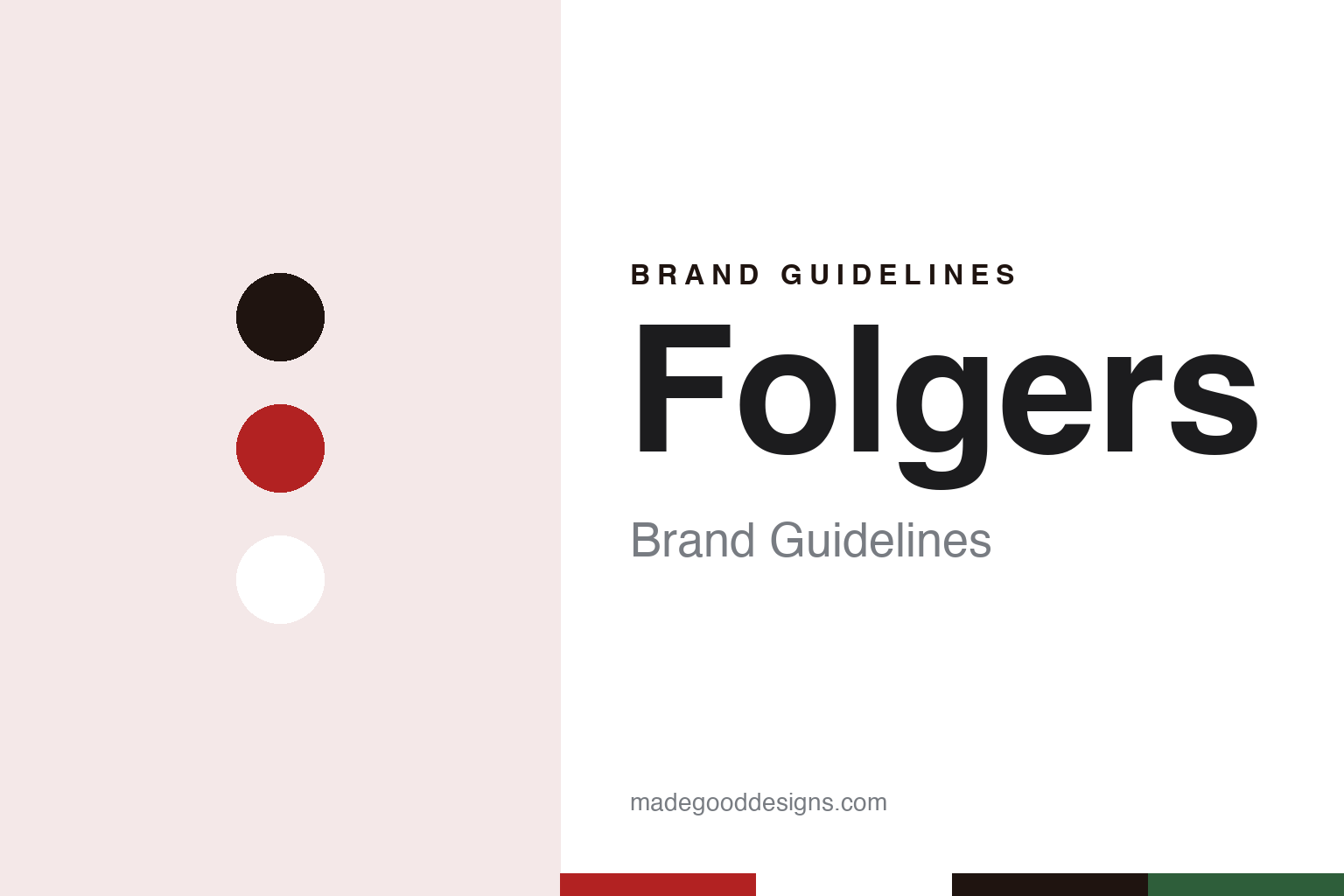
Two constants: a Folgers red, white and roast palette and a Bold slab serif register. Abstract homage — not a Folgers product or mark; no can, logo or label is reproduced.
Pioneer Steam
A Gold Rush coffee mill and a boy from Nantucket.
Folgers began in the California Gold Rush. In 1850 William H. Bovee opened the Pioneer Steam Coffee and Spice Mills in San Francisco to sell coffee already roasted and ground, at a time when, English Wikipedia says, Californians had to buy green beans and roast and grind them themselves. Bovee hired James A. Folger, newly arrived from Nantucket with his two older brothers, to help build the mill — at 15, according to English Wikipedia, or 14, according to the company, which says the brothers left the island after a fire destroyed the family’s livelihood. The company says the mill’s logo showed a gold miner standing beside a Sierra stream.
Folger worked his way into ownership. English Wikipedia says he bought a share of the business, carried coffee and spice samples to grocers while he tried gold mining, became a full partner on his return in 1865 and in 1872 bought out the other partners, renaming the firm J.A. Folger & Co. Sources differ on the dates. The company says the business went bankrupt in the economic collapse of 1865 and that Folger then bought out his partners and renamed it. William Ukers’s 1922 history All About Coffee says the firm was established as Wm. H. Bovee & Co., became Marden & Folger, took the name J.A. Folger & Co. in the early 1860s, and traded as Folger, Schilling & Co. from 1878 until 1881.
The company says it adopted “cup-testing” in 1880, setting standards for taste and aroma. Folger’s eldest son, James A. Folger II, later became president, and in the early 1900s a salesman, Frank P. Atha, took the coffee beyond California: the company says he persuaded grocers in eastern states to stock it, using in-store displays he designed himself, and English Wikipedia says he opened and managed a Folgers plant in Texas. The company says its building was one of the few to survive the 1906 earthquake. The five-storey Folger Coffee Company Building at 101 Howard Street, the former headquarters, is listed on the US National Register of Historic Places and was bought by the University of San Francisco in 2011, English Wikipedia says.
Colour
A New Orleans plant and two corporate owners.
The move south came in 1960, when construction began on a Folger plant in New Orleans; English Wikipedia links it to new shipping routes from Central America, and the company says wartime changes in shipping had made the city the hub of the green-coffee market. Under Peter Folger in the mid-twentieth century, English Wikipedia says, the brand became one of the principal coffee concerns in North America.
Procter & Gamble bought Folger’s in 1963 and dropped the apostrophe from the name, English Wikipedia says, citing Monika Trobits’s 2019 history Bay Area Coffee. P&G kept the brand for 45 years. In January 2008 it announced that Folgers would be spun off as a separate company based in Cincinnati, Dow Jones reported, but in June it agreed instead to combine the business with The J.M. Smucker Company of Orrville, Ohio, the maker of Smucker’s preserves and Jif peanut butter. The deal, structured as a Reverse Morris Trust, closed on 6 November 2008; English Wikipedia puts its value at $3.3 billion, says it brought in Millstone Coffee too, and says it doubled Smucker’s size. Smucker’s coffee brands today include Café Bustelo and Dunkin’ as well as Folgers, English Wikipedia says.
New Orleans remained home. The company says it opened its roasters there in 1960 and that Folgers is “proudly roasted in New Orleans”; English Wikipedia, citing that page, says Folgers roasts its coffee in the city. After Hurricane Katrina damaged the plant in 2005, the company says, it set up temporary housing on its grounds for workers who had lost their homes and was one of the first major businesses in the city to reopen.
Typography
Coffee brands of the Americas.
The seven brands in this group all sell coffee, and they come from four countries of the Americas: Café Bustelo, Community Coffee, Folgers and Maxwell House from the United States, Juan Valdez from Colombia, Café Britt from Costa Rica, and Pilão from Brazil. Each guide follows its own name back to where it started and forward to whoever owns it today, rather than treating the group as one story.
A coffee brand’s identity is usually carried by a name, a pack and a promise about the cup, and the beans behind it may have been grown far from where the name on the front was roasted. That makes the plain questions behind each name worth asking: who started it, who owns it now, where its coffee is bought, and where it is actually roasted and packed.
Each guide separates what independent sources record from what the company says about itself — its founding story, its owners over time, where its coffee comes from and where it is roasted — and marks plainly what rests only on the company’s own word.
Aa
A bold slab serif for a red supermarket label. (Specimen set in Roboto Slab, a slab-serif STAND-IN; NOT the Folgers logo.)
Folgers
“The Best Part of Wakin’ Up.”
Folgers’ identity is as much sound as sight. Its slogan, “The Best Part of Wakin’ Up Is Folgers in Your Cup,” was launched in 1984, the company says, and English Wikipedia says the jingle has featured in almost every advertisement since, with lyrics by Susan Spiegel Solovay and Bill Vernick and music by Leslie Pearl. It has been recorded by performers including Aretha Franklin, Randy Travis, Bonnie Tyler and Rockapella, and the brand marked its 30th anniversary in 2014. Earlier, from 1965 to 1986, the commercials featured “Mrs. Olson,” a Swedish neighbour played by Virginia Christine, and in the 1970s and early 1980s a series showed diners in smart restaurants whose coffee had been secretly switched for Folgers. A 1985 spot by the agency Cunningham & Walsh, “Peter Comes Home for Christmas,” aired every year until 1998, English Wikipedia says.
On the shelf, English Wikipedia says, the brand’s colours were traditionally a moderately dark red background with white lettering, with green signalling decaf and black the Noir dark roasts. The range includes Classic Roast, Black Silk, Folgers Crystals instant coffee and K-Cup pods, and in 2018 a premium line named 1850 after the founding year. The company says it refreshed its voice in 2022 with the campaign #DamnRightItsFolgers, and for its 175th anniversary in 2025 it issued a special-edition metal can of Classic Roast showing the Golden Gate Bridge, a sign for Howard Street, where its original facility stood, and a nod to Folger’s Golden Gate, which it calls its first hit blend. No official hex values or typeface are published.
For a design guide, Folgers shows a mass-market brand held together by a red label, a home city and a jingle. Compare Café du Monde, the New Orleans coffee stand with its own famous tin, and Peet’s Coffee, which began across the bay in Berkeley. For this guide we use red, white and roast brown with a slab serif, an unofficial interpretation; no product or logo is reproduced.
Explore & save
Keep Folgers’s identity on hand — save it to a board in the Made Good inspiration library.
Folgers identity set
Pin the Folgers red, white and roast palette and the Bold slab serif register to your own board.