SP–Arte Brand Guidelines
São Paulo’s art and design fair in the Bienal Pavilion.
Aa
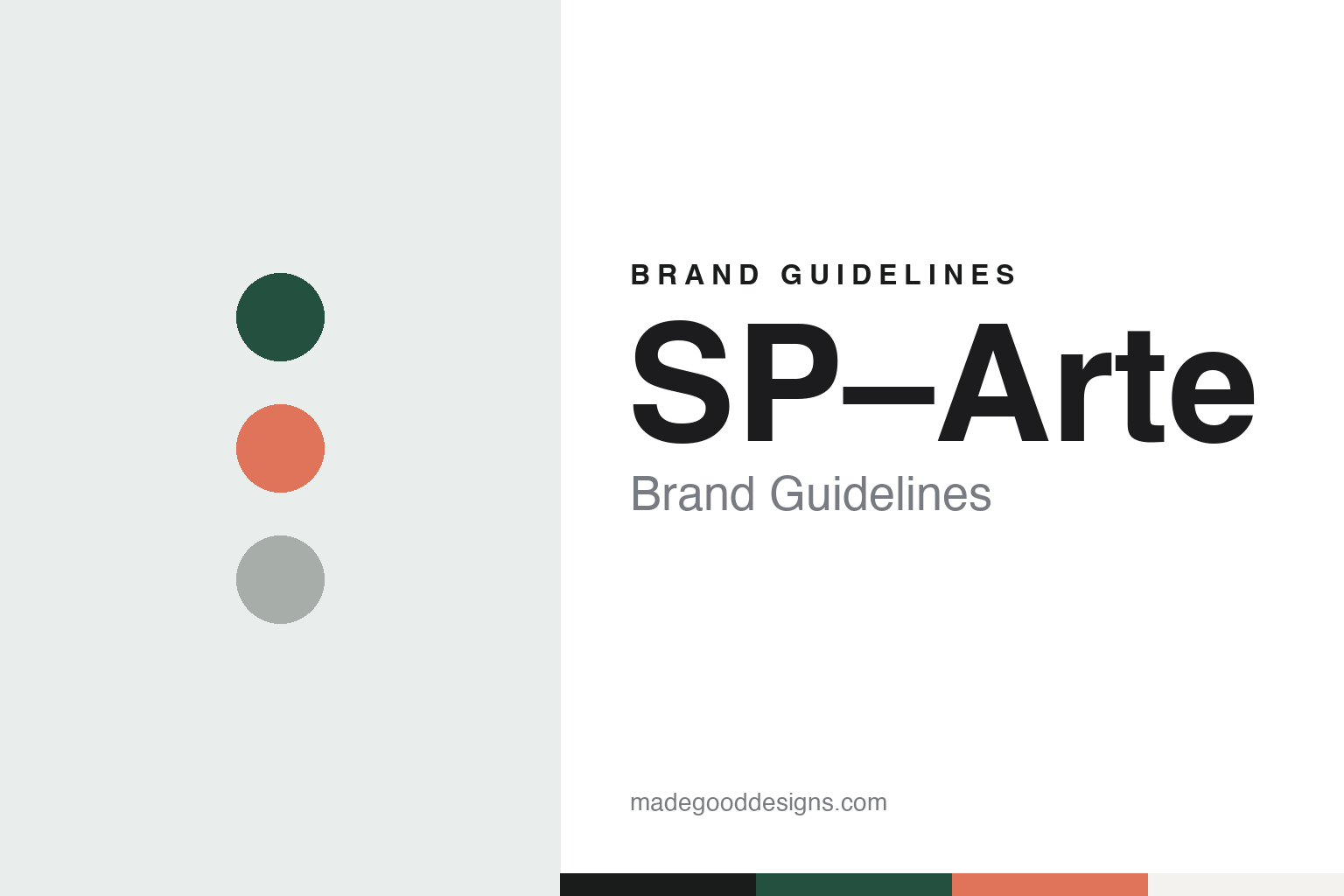
Two constants: an Ibirapuera green, ramp grey and tropical coral palette of our own and a modernist grotesque sans register. Abstract homage — not an SP–Arte asset; no logo, campaign image or artwork is reproduced.
A collector’s fair for São Paulo
A lawyer and collector starts a fair in a modernist pavilion.
SP–Arte was founded in São Paulo in 2005 by Fernanda Feitosa, a lawyer and art collector, according to English and Portuguese Wikipedia. English Wikipedia gives its full name as São Paulo’s International Art Fair.
The fair has kept one venue for its main edition. Portuguese Wikipedia says it began in the Bienal Pavilion in Ibirapuera Park and has been held there in the first half of each year, between March and April. The fair’s own “about” page describes five days a year in the pavilion, with talks with artists, audio guides and a month of exhibition openings and studio visits around the city, which Wikipedia calls the Circuito SP–Arte.
The Art Newspaper called her SP–Arte’s founder in April 2022 and, on 3 April 2025, its founder and executive director. In the 2025 report she said the fair set the mood for the Brazilian art sector for the rest of the semester, and credited part of a renewed foreign interest to the 2024 Venice Biennale, whose central exhibition was curated by Adriano Pedrosa, artistic director of the Museu de Arte de São Paulo.
Pedrosa had worked with the fair before. English Wikipedia says he ran its Curatorial Laboratory from 2012 to 2014, an initiative that encouraged young curators to develop exhibition projects inside the fair. Wikipedia also lists artist residencies run with partner institutions, among them the Delfina Foundation in London, Residency Unlimited in New York and FLORA ars+natura in Colombia.
Colour
Photography, design, an online room and a second fair.
The name grew a family of events. Between 2007 and 2019 the organisers ran SP–Foto, a photography fair held each August, first in the Iguatemi shopping centre and later in JK Iguatemi, both in São Paulo, with 44 exhibitors at its last edition, English Wikipedia says. In 2014 they held SP–Arte Brasília, with 35 Brazilian galleries at the Iguatemi Brasília shopping centre, the fair’s first edition outside São Paulo according to the same article.
Design arrived in 2016, when the fair created a sector of its own for it, Portuguese Wikipedia says, with dealers in modern and contemporary furniture showing alongside art galleries. Ten years later the fair said in its April 2026 review that the design sector had completed its first decade there.
The 2020 edition did not take place in person. Portuguese Wikipedia says the fair moved online with a platform called SP–Arte Viewing Room, two editions in 2020 and one in 2021, the last at the same time as the 17th edition held at ARCA. The Art Newspaper, reporting on 7 April 2022, said the fair had held an entirely virtual edition and a smaller hybrid event in 2021, and that the 18th edition was back in its usual venue and calendar slot for the first time since 2019, with 100 art galleries and 30 design galleries. A new sector that year, Radar, showed five collectives and nine artists who had no gallery representation.
In 2022 SP–Foto became SP–Arte Rotas Brasileiras, a fair of selected individual and collective projects held at ARCA, an industrial shed in the Vila Leopoldina district, according to English Wikipedia. The fair now calls it SP–Arte Rotas; its review of the 2026 edition, the fifth, said it ran from 26 to 30 August at ARCA with 78 exhibitors, including galleries from Argentina, Uruguay, Colombia and Italy.
The main fair kept growing in the pavilion. The Art Newspaper reported that the 21st edition, which ran until 6 April 2025, had around 200 exhibitors, with a strong showing by Brazilian galleries and many design dealers. Art & Object reported on 17 April 2026 that the 22nd edition, from 8 to 12 April 2026, had 180 exhibitors, among them art galleries, design studios, museums, independent spaces and publishers, spread over three floors of the Bienal Pavilion, designed by Oscar Niemeyer. The fair said that edition received 35,000 visits.
The organisers have also used a house. English Wikipedia says that in March 2023 they opened Casa SP–Arte in one of the residences of São Paulo’s Vila Modernista, as a space for exhibitions by partner galleries, opening with a show organised with Gomide&Co.
Typography
How satellite, regional and newer art fairs build an identity.
Many newer art fairs choose their dates in one of two ways. Some open in the same week as a larger fair in the same city, so that collectors and curators who are already in town can walk from one to the other: VOLTA was founded in Basel in 2005 as an alternative fair during the week of Art Basel, and Paris Internationale runs in Paris each October alongside what is now Art Basel Paris. Others take a slot of their own in the calendar and build an audience around it, without a larger neighbour to draw on.
Either way, the name is what holds steady. The city, the building and the edition number change, while the wordmark carries over. VOLTA writes its name in capitals and adds the city, as in VOLTA Basel and VOLTA New York; Paris Internationale kept its Paris name when it held its first edition in Milan in 2026, adding only Milano. A short name travels easily from one city to another and from one building to the next.
Who takes part is decided before the doors open. Some fairs invite their exhibitors; others take applications and pass them to a selection committee, often made up of gallerists, which chooses galleries for the projects they propose as well as for their programmes. The resulting exhibitor list, with each gallery’s city, is published ahead of each edition, as both VOLTA and Paris Internationale do.
The visit itself is designed. Floor plans and maps tell visitors how to move through a hall, a tent or a building of several floors; signage, printed guides, websites and apps carry the exhibitor list, the sections and the programme of talks and tours. At a fair that changes buildings, the signage and stand walls may be reused from year to year, while the campaign image and the venue give each edition its own look.
Aa
A modernist grotesque sans for a fair held under a modernist pavilion roof. (Specimen set in Archivo, a sans STAND-IN; NOT the SP–Arte logo.)
SP–Arte
A city prefix, a dash and a family of names.
The fair writes its name with a dash. Its “about” page and copyright line set it as SP–Arte, the city’s initials and the Portuguese word for art joined by a dash, while news pages, Wikipedia and the press often use a plain hyphen, SP-Arte. The same pattern has carried across its other events: SP–Foto, SP–Arte Brasília, SP–Arte Rotas and Casa SP–Arte all keep the city prefix and change only the second word.
The identity also lives in tools for visitors. The fair’s home page links to its own visitor app. The website itself runs an editorial section with articles by members of the team and invited writers, on subjects from biennials to artists’ archives and design.
The pavilion shapes the fair as much as the name does. The main edition has stayed in the same building in Ibirapuera Park from 2005 to the 22nd edition of 2026, with the main floors given over to art galleries and a growing share to design dealers, and a separate August fair at ARCA for selected projects.
For a design guide, SP–Arte shows how a short city prefix can hold together a main fair, a design sector, a photography fair that became a second fair and a house for exhibitions. Compare arteBA, the Buenos Aires fair whose 2026 international zone included a São Paulo gallery, and Zona Maco, the Mexico City fair that also shows design. For this guide we use an Ibirapuera green, a ramp grey and a tropical coral on pavilion white with a sans, an unofficial interpretation; no product or logo is reproduced.
Explore & save
Keep SP–Arte’s identity on hand — save it to a board in the Made Good inspiration library.
SP–Arte identity set
Pin the SP–Arte Ibirapuera green, ramp grey and tropical coral palette and the modernist grotesque sans register to your own board.
Source & notes
Frequently Asked Questions
What font can I use to match the SP–Arte look?
This guide describes SP–Arte’s type as “A modernist grotesque sans for a fair held under a modernist pavilion roof”. Its type specimen is set in Archivo from Google Fonts as a stand-in; Archivo is not SP–Arte’s own lettering.
What colours are in the SP–Arte palette?
This guide’s SP–Arte palette is Ibirapuera green #24513F, Ramp grey #A7ADA9, Tropical coral #E0745A, Pavilion white #F3F2EE and Ink #1A1C1B. The tones are the guide’s own unofficial interpretation, not official SP–Arte hex codes.
When was SP–Arte founded?
SP–Arte was founded in 2005, in São Paulo, Brazil.
Who founded SP–Arte?
SP–Arte was founded by Fernanda Feitosa (founder and executive director (2025)) in 2005.