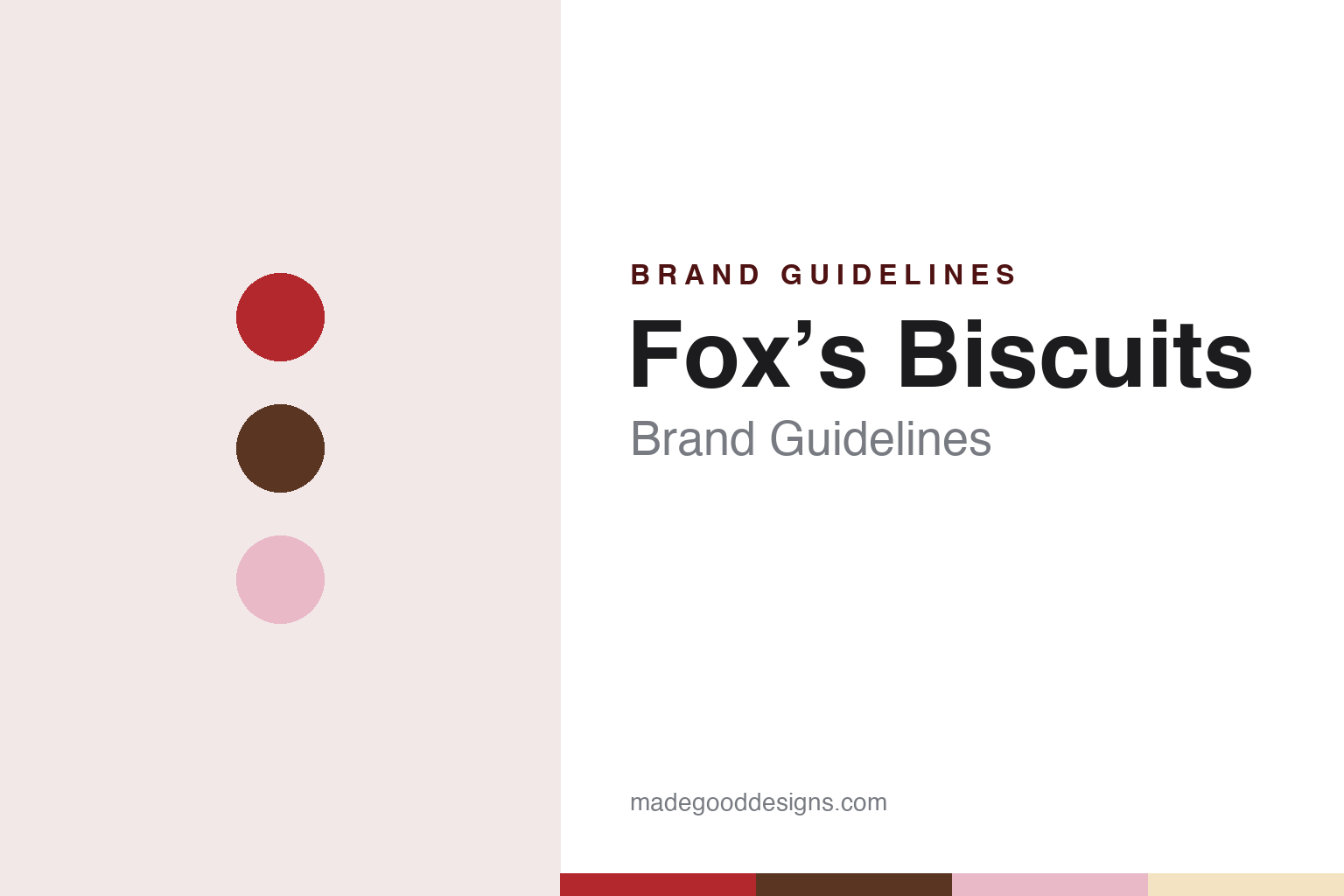
Fox’s Biscuits Brand Guidelines
The Batley baker that grew from brandy snaps to Party Rings.
Aa
Two constants: a Fox’s red, chocolate and pastel palette and a soft serif register. Abstract homage — not a Fox’s product or mark; no pack, logo or biscuit is reproduced.
Brandy snaps in Batley
A Yorkshire bakehouse named after a son-in-law.
Fox’s Biscuits began in Batley, West Yorkshire, in 1853. Its present owner, Fox’s Burton’s Companies, says Michael Spedding baked his first batch of brandy snaps that year and sold them to shows, shops and traders from his Batley bakery. English Wikipedia says he worked from a small bakehouse in a terraced house on Whitaker Street, making “eatables” for the feasts and fairs of northern England; its infobox gives 1852, but its text, the company and the Yorkshire Post use 1853.
The name came through marriage. The company says Fred Ellis Fox, Spedding’s son-in-law, took over the business in 1897 and renamed it F E Fox & Co, “and that’s where Fox’s Biscuits gets its name.” English Wikipedia says Fox married Spedding’s daughter, Hannah.
The business stayed in Batley as it grew. The company says its current Batley bakery dates from 1927, on what Wikipedia describes as a former wartime allotments site, and Wikipedia says the firm became a limited company named Fox’s Biscuits in 1960. In 1966, the company says, Fox’s bought Parkinson’s Biscuits and created its Kirkham bakery in Lancashire. In September 2013 the Yorkshire Society unveiled a White Rose plaque at the site of the first Whitaker Street bakery — the first time the society had marked the founding of a business, the Yorkshire Post reported.
Colour
Crunch Creams, Chocolatey and Party Rings.
Fox’s is a mass-market biscuit brand, known for cream-filled and chocolate-covered biscuits rather than a single hero product. Its current ranges include Fox’s Chocolatey, sold as rounds, cookies, Viennese and cream biscuits; the Crunch Creams; and the Viennese biscuits that Reuters singled out, alongside Crunch Creams, as “British favourites” in 2020. English Wikipedia lists further lines including the Rocky and Echo bars.
Party Rings are the line most defined by colour. The company says they were launched in 1983 and describes their “distinctive pastel icing” and ring shape. In 2025 the company said Party Rings were moving into celebration cakes.
Fox’s has also used characters. In May 2008 The Guardian reported that Fox’s had launched a television campaign, part of a £5 million marketing push, built around Vinnie, a “danda” — half dog, half panda — whom Wikipedia describes as developed with the animation team behind Disney’s Chronicles of Narnia films. In the year to August 2025 the company relaunched Fox’s Chocolatey with a campaign featuring the Strictly Come Dancing judge Craig Revel Horwood, its February 2026 results statement says.
Not every Fox’s-made biscuit carries the Fox’s name. English Wikipedia says the company also bakes own-label biscuits for supermarkets, and the owner’s 2026 results statement reports growth in both branded and “retailer branded” biscuits.
Typography
Biscuits, wrappers and ownership.
The seven brands in this group all bake biscuits, and they come from five countries: McVitie’s, Walker’s Shortbread and Tunnock’s from Scotland, Fox’s from England, Jacob’s from Ireland, Bahlsen from Germany and Lotus Biscoff from Belgium. Biscuit brands in general sit at many different points in the trade, from family-run bakeries that still work from the town where they began to names that have passed through several corporate owners, and a single packet on a supermarket shelf rarely says which of those it is.
A biscuit brand’s identity is usually carried by a wrapper, a shape and a habit — the biscuit eaten with tea or coffee, at a desk, in a lunchbox or on a plane — more than by the factory behind it, because the name on the front may have changed hands, or changed countries, long after the recipe was settled. That makes the questions behind each name worth asking plainly: who started it, who owns it now, and where its biscuits are actually baked.
Each guide separates what independent sources record from what the company says about itself — its founding story, its owners over time, its factories and its packaging — and marks plainly what rests only on the company’s own word.
Aa
A soft serif — warm, rounded and domestic. (Specimen set in Fraunces, a serif STAND-IN; NOT the Fox’s logo.)
Fox’s Biscuits
Northern Foods, 2 Sisters, then Ferrero.
Fox’s has changed hands several times. The company says it was sold to Northern Foods in 1977, a date Northern Foods’ own archived history also gives. In 2011, the company says, Northern Foods was restructured and Fox’s Biscuits was sold to 2 Sisters Food Group; English Wikipedia says 2 Sisters acquired Northern Foods that year.
In October 2020 Reuters reported that Ferrero, the Italian maker of Nutella, had agreed to buy Fox’s through its Belgian holding company CTH, taking Fox’s, other biscuit brands and two production plants from Northern Food Grocery Group, part of Boparan Holdings. Ferrero did not disclose the price; Reuters cited a source putting it at £250 million, while English Wikipedia, citing Insider Media on completion in November 2020, gives £246 million. Reuters said it was Ferrero’s second British acquisition after the chocolate maker Thorntons in 2015. The company describes the buyer as “a Ferrero affiliated company.” Reuters put the acquired brands’ sales at about £157 million in the previous year, said Boparan was expected to focus on its poultry business, and noted that Ferrero had already bought the biscuit makers Kelsen, Delacre and, in 2019, Keebler.
In 2021, the company says, Burton’s Foods — maker of Jammie Dodgers, Wagon Wheels and Maryland cookies — was sold to a Ferrero-affiliated company, and in 2022 the two merged as Fox’s Burton’s Companies, or FBC UK. The company calls itself the UK’s second-largest branded sweet biscuit maker. For the year to August 2025 it reported revenue of £695 million and a 13.0% share of branded sweet biscuits, and it says it employs more than 3,800 people.
Batley is still home: English Wikipedia names it as head office and main factory, with a second site at Wesham in Lancashire. The group says its biscuits are made in several UK locations, “from Dorset, to Batley, to the Isle of Arran,” and Wikipedia says Fox’s biscuits are exported to Europe, North America and Asia. The old domain, foxs-biscuits.co.uk, now shows the FBC UK site.
For a design guide, Fox’s shows how a brand can carry a family name long after it leaves the family. Compare Thorntons, another British business bought by Ferrero, and Ferrero Rocher. For this guide we use a warm red, chocolate brown and pastel icing pink with a serif, an unofficial interpretation; no product or logo is reproduced.
Explore & save
Keep Fox’s Biscuits’s identity on hand — save it to a board in the Made Good inspiration library.
Fox’s Biscuits identity set
Pin the Fox’s red, chocolate and pastel palette and the soft serif register to your own board.


