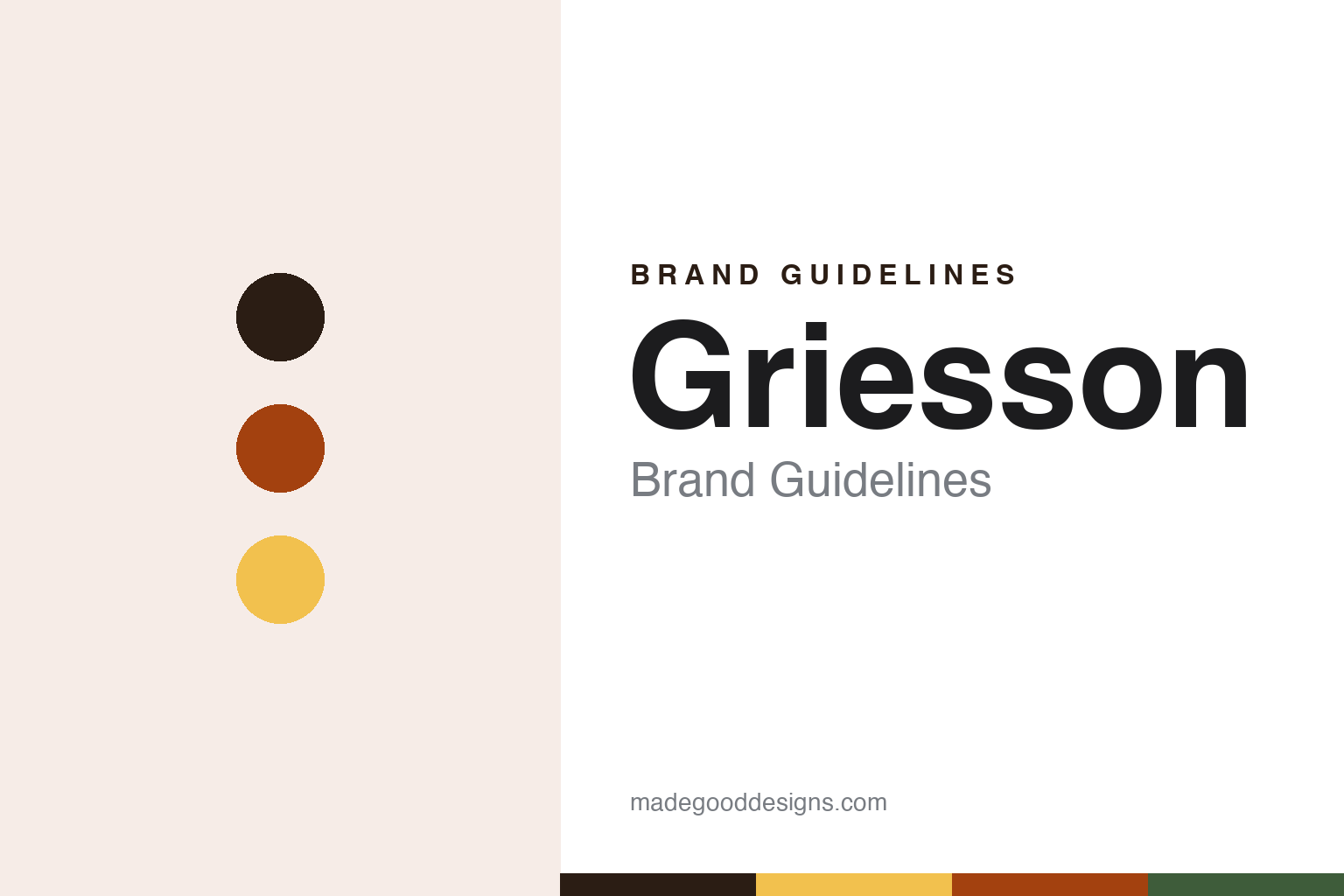
Griesson Brand Guidelines
The Moselle Lebkuchen bakery that became Germany’s Soft Cake maker.
Aa
Two constants: a Griesson orange, cocoa and sponge-gold palette and a rounded geometric sans register. Abstract homage — not a Griesson product or mark; no biscuit, pack or logo is reproduced.
A bakery in Kobern
Three generations of the Gries family on the Moselle.
Griesson began as a village bakery on the Moselle. German Wikipedia says that in 1892 Gottlieb Anton Gries, as the company names him, who had trained in Nuremberg, opened a bakery in Kobern, now part of Kobern-Gondorf, in Rhineland-Palatinate. His son Hans Gries joined the business with his brother Anton in 1918, when it traded as G.A. Gries & Söhne, and in 1924 Hans founded the company Griesson.
Its first speciality was Lebkuchen, the spiced German Christmas biscuit. The company’s history dates the opening of the Griesson Lebkuchen factory to 1924, while German Wikipedia says Hans Gries opened his own Lebkuchen factory in Kobern in 1928, so the sources differ by four years. In 1938, German Wikipedia says, the bakery first used machines to roll out dough and press it into moulds, a step the company describes as the move from handwork to machine production.
The third generation took over in 1966, when Heinz Gries succeeded his father. German Wikipedia says that in his first decade the company built a year-round range, ending its dependence on the seasonal Lebkuchen trade. A new factory opened in Polch in 1969; German Wikipedia counts 30 stages of expansion there between 1969 and 2004.
Colour
Soft Cake and a year-round range.
The product most closely tied to the Griesson name is Soft Cake. The company’s history marks 1977 as the year “the triumphal march of Soft Cake begins,” and German Wikipedia links it to the British Jaffa Cake. Two years later, in 1979, the head office moved from Kobern to Polch, which remains the company’s seat.
Griesson kept growing through the 1990s. It opened a plant in Kahla, Thuringia, in 1993, and in 1997 took a 50 per cent stake in the Ravensburg biscuit maker Tekrum, buying the rest with effect from 1 January 2005, German Wikipedia says; the Ravensburg plant was sold to the Swiss biscuit company Kambly with effect from 1 January 2017. In 1998 Andreas Land joined as managing director alongside Heinz Gries and took a five per cent stake.
Today the Griesson brand pages list ranges including Soft Cake, Chocolate Mountain Cookies, Choco Sticks and Duo Keks, and the company says Soft Cake has been known and loved for more than 30 years. The parent company makes retailers’ own-label biscuits as well as branded ones at its three German plants, German Wikipedia says.
Typography
Design and documentation.
The seven brands in this group all make biscuits, and they come from four countries: Kambly from Switzerland, Delacre from Belgium, Lambertz and Griesson from Germany, Lazzaroni and Matilde Vicenzi from Italy, and De Beukelaer, whose story runs through Belgium and Germany. Biscuit makers in general sit at many different points in the trade, from family bakeries that still carry a founder’s name to large groups that own several brands and plants, and a single name can move from one kind of owner to another over a century or more.
A biscuit brand’s identity is usually carried by a tin, a wrapper and a recipe it promises has not changed, while the company behind the name may have been sold, merged or renamed more than once, and the biscuits themselves may be baked a long way from the town on the packet. That makes the questions behind each name worth asking plainly: who started it, who owns it now, and where its biscuits are actually made.
Each guide separates what independent sources record from what the company says about itself — its founding story, its owners over time, its signature products and where they are baked — and marks plainly what rests only on the company’s own word.
Aa
A rounded geometric sans — an unofficial register for a family biscuit brand. (Specimen set in Outfit, a sans STAND-IN; NOT the Griesson logo.)
Griesson
Griesson – de Beukelaer.
The decisive step came on 1 March 1999. German Wikipedia says Griesson merged with part of the Danone group, its biscuit businesses General Biscuit Deutschland and General Biscuit Österreich, which traded as De Beukelaer, to form Griesson – de Beukelaer GmbH & Co. KG. Heinz Gries and Andreas Land held 60 per cent at first and Danone 40 per cent; the new company carried the Griesson brand alongside Danone’s De Beukelaer, Prinzen Rolle and Leicht&Cross. In 2007 Gries and Land bought out Danone’s 40 per cent, and in March 2008 the company bought Wurzener Dauerbackwaren of Wurzen, Saxony, from Stollwerck.
Heinz Gries stepped down as managing director at the turn of 2008 and 2009, and in 2014 he placed his majority stake in a family foundation, the Gottlieb Anton-Stiftung, which German Wikipedia says now holds 94 per cent. The company’s current pages list its sites as the head office and plant in Polch, plants in Kahla and Wurzen, a logistics centre in Koblenz and a sales office in Vienna. German Wikipedia, citing Lebensmittelpraxis in January 2026, gives 2025 revenue as 783 million euros, up 8 per cent, and puts the workforce at about 2,000. The company also received the Deutscher Verpackungspreis, the German packaging award, in 2014, according to German Wikipedia.
The years after the merger brought licences, investment and recognition. From 2006 to 2012 the company made products under licence from the Swiss brand Mövenpick, German Wikipedia says, and in 2012 its revenue passed half a billion euros for the first time, at 508 million, with about 45 per cent earned abroad. After closing the former De Beukelaer plant in Kempen in 2020, it opened a new hall at Kahla in 2023 that cost about 140 million euros. Heinz Gries received the Lebensmittel Zeitung’s Goldener Zuckerhut award in 2009, and he and Andreas Land were named family entrepreneurs of the year in 2011; the German agricultural society DLG gave the company its 30th prize for long-term product quality in 2018, German Wikipedia records.
In July 2026 the company looked abroad. On 28 July 2026 Griesson – de Beukelaer announced the acquisition of the DeBeukelaer Corporation of Madison, Mississippi, maker of Pirouline rolled wafers; shareholder Susanne Gries said the deal fulfilled “a long-cherished dream – one shared by our father, Heinz Gries.”
For a design guide, Griesson shows how a regional Lebkuchen bakery built a national brand around one everyday product while staying in family hands. Compare Bahlsen, another German family biscuit maker, and Verkade, the Dutch biscuit and chocolate house. For this guide we use Soft Cake orange, dark cocoa and sponge gold with a sans, an unofficial interpretation; no product or logo is reproduced.
Explore & save
Keep Griesson’s identity on hand — save it to a board in the Made Good inspiration library.
Griesson identity set
Pin the Griesson orange, cocoa and sponge-gold palette and the rounded geometric sans register to your own board.