Karachi Biennale Brand Guidelines
A city-wide biennale, organised by a trust, mapped in clusters.
Aa
Two constants: a harbour teal, sandstone and brick palette and a grotesque sans register. Abstract homage — not a Karachi Biennale mark; no logo, artwork or edition graphic is reproduced.
KB17
A trust, a theme and fourteen sites.
The Karachi Biennale is a city-wide exhibition of contemporary art in the port city of Karachi, in Pakistan, organised by the Karachi Biennale Trust (KBT). The trust says it was founded in 2016 by a group of visual art professionals and educators, that it is a registered trust operating as a non-profit organisation, and that it works with philanthropists, cultural and educational organisations and corporate supporters. It calls the biennale its flagship project, designed “to use art as a vehicle to discover, discuss and respond to Karachi.”
The first edition, KB17, ran from 22 October to 5 November 2017 under the theme Witness, according to the trust. Its chief curator was the artist Amin Gulgee, according to an essay on the edition published by Sydney’s 4A Centre for Contemporary Asian Art, which describes KB17 as the city’s inaugural biennale and counts more than 180 participating artists across 14 sites. The essay quotes the curator’s framing of the theme: that “we all bear witness to our times and ourselves, both in the present and the past.”
The trust names the main venue of 2017 as the 160-year-old NJV School building, in the historic precincts of the old city. The other sites were grouped into four clusters, and the 4A essay explains that the cluster in and around Saddar, the old city centre and business district, formed the central node. The trust’s list for 2017 includes the Karachi School of Art, the Capri Cinema, Jamshed Memorial Hall, Pioneer Book House, the Sadequain Gallery at Frere Hall, the gallery at the Alliance Française and the IVS Gallery at the Indus Valley School of Art and Architecture.
The 4A essay singles out three of those places — the Capri Cinema, the library of Jamshed Memorial Hall and Pioneer Book House — which sit within about two kilometres of one another on M. A. Jinnah Road, the artery that leads to the port. It describes them as civic buildings that the biennale used as sites for new work, rather than as conventional galleries.
Colour
Four editions, four themes.
The trust describes a steady format. Its activities usually start about twelve months ahead, with workshops and talks that introduce the coming theme in schools, educational institutions and public forums. The biennale itself lasts about two weeks, with exhibitions in several locations across the city, including heritage sites and public parks, and artist talks, seminars and guided tours that the trust says are free for all. Each edition revolves around a theme anchored in Karachi.
The second edition, KB19, was curated by the Karachi-based artist Muhammad Zeeshan, who trained in miniature painting at the National College of Arts in Lahore, according to the trust. It says it chose to work with curators anchored in the city for its early editions. Zeeshan’s curatorial statement carried the title “Flight Interrupted: Eco-leaks from the Invasion Desk,” and the trust says the edition focused on the “development footprint” on the ecology of Karachi and other cities.
The third edition, KB22, opened in October 2022 under the title “Collective Imagination: Now and the Next”, curated by Faisal Anwar. His statement presented Karachi as a young city taking up digital technology, and the trust says the edition explored the growing integration of technology with art. Its venues were grouped in three clusters and included Hamid Market, the NJV High School, Jamshed Memorial Hall, the City Campus of NED University of Engineering & Technology and the main campus of the Institute of Business Administration. The trust’s website features Microtonal, an installation by the UK collective Invisible Flock made with two musicians from Badin around the borindo, a clay wind instrument, shown at the NED City Campus during KB22.
The fourth edition, KB24, ran from 26 October to 10 November 2024 under the theme “Rizq | Risk — Foodscape of our time,” according to the trust. Its venue list again uses three clusters: the Mahvash & Jahangir Siddiqui Art Gallery at the Alliance Française and the Bagh Ibne Qasim park; Frere Hall and the NED University City Campus; and the Sambara Art Gallery.
Typography
Design and documentation.
Some biennials are defined less by a city or a theme than by a single commitment: one medium, one format or one host. A biennial of moving image, a photography meeting, an assembly or a summit, or an exhibition run by a museum each sets a rule that stays put while everything else changes. That rule becomes the steadiest part of the identity, more lasting than any poster, title or curator.
Numbering is the simplest tool these events use. An edition count turns a series of separate exhibitions into a sequence, and the way the number is written can carry character of its own: spelled out, set as a numeral, or folded into the name itself. A recurring host institution plays a similar role. When the same museum, arts centre or foundation stages every edition, its building and its name give visitors a fixed point to return to, even when the curatorial team is new each time.
Publications often outlast the exhibitions. Catalogues, readers, companion books and printed handouts record what each edition argued and who took part, and some events present them as part of the edition rather than as souvenirs. A consistent format for these books, or a deliberate change from one edition to the next, says as much about the event as its signage does.
Finding the work is the other half of the identity. A moving-image biennial needs screening schedules and running times; a programme spread over several weekends needs a clear calendar; an exhibition spread across a city needs a map and a route from one venue to the next. For a designer, these practical documents are where the event’s rule becomes visible: in how a timetable is set, how venues are numbered and how a visitor is led from one room to the next.
Aa
A plain grotesque sans for edition codes and cluster labels. (Specimen set in Archivo, a sans STAND-IN; NOT the Karachi Biennale logo.)
Karachi Biennale
Edition codes and lettered clusters.
The biennale’s naming system is short and repeatable. Each edition is called “KB” plus the two-digit year — KB17, KB19, KB22, KB24 — and the trust uses those codes across its website for each edition’s curator, venues, artist lists, programming, catalogue and media pages. The gaps between editions have varied: two years after 2017, three after 2019 and two after 2022.
Wayfinding is built into the structure. The venues of every edition are presented as lettered clusters — four in 2017, three in 2022 and 2024 — and the 4A essay links the cluster plan to a practical problem: Karachi has no cohesive public transport network, so visitors move between neighbourhoods rather than walking from one hall to the next. For 2019 the trust also offered a visitors’ guide app with artist information and an events listing. The venues themselves repeat across editions, with Frere Hall, Jamshed Memorial Hall, the NJV school, the NED City Campus and the Alliance Française gallery returning in more than one year, which gives the event a recognisable map of the old city.
At the time of writing, a page on the trust’s website describes KB27, billed as the fifth edition under the curatorial title “Tomorrow,” as cancelled. We could not find a dated announcement or an independent report confirming this, so check the trust’s own channels for the current status.
For a design guide, the Karachi Biennale shows how a short edition code and a cluster map can hold together an exhibition spread across a very large city. Compare Lahore Biennale, the biennial in Lahore, and Dhaka Art Summit. For this guide we use a harbour teal, warm sandstone and a brick red with a sans, an unofficial interpretation; no product or logo is reproduced.
Explore & save
Keep Karachi Biennale’s identity on hand — save it to a board in the Made Good inspiration library.
Karachi Biennale identity set
Pin the Karachi Biennale harbour teal, sandstone and brick palette and the grotesque sans register to your own board.
Source & notes
Frequently Asked Questions
What font can I use to match the Karachi Biennale look?
This guide describes Karachi Biennale’s type as “A plain grotesque sans for edition codes and cluster labels”. Its type specimen is set in Archivo from Google Fonts as a stand-in; Archivo is not Karachi Biennale’s own lettering.
What colours are in the Karachi Biennale palette?
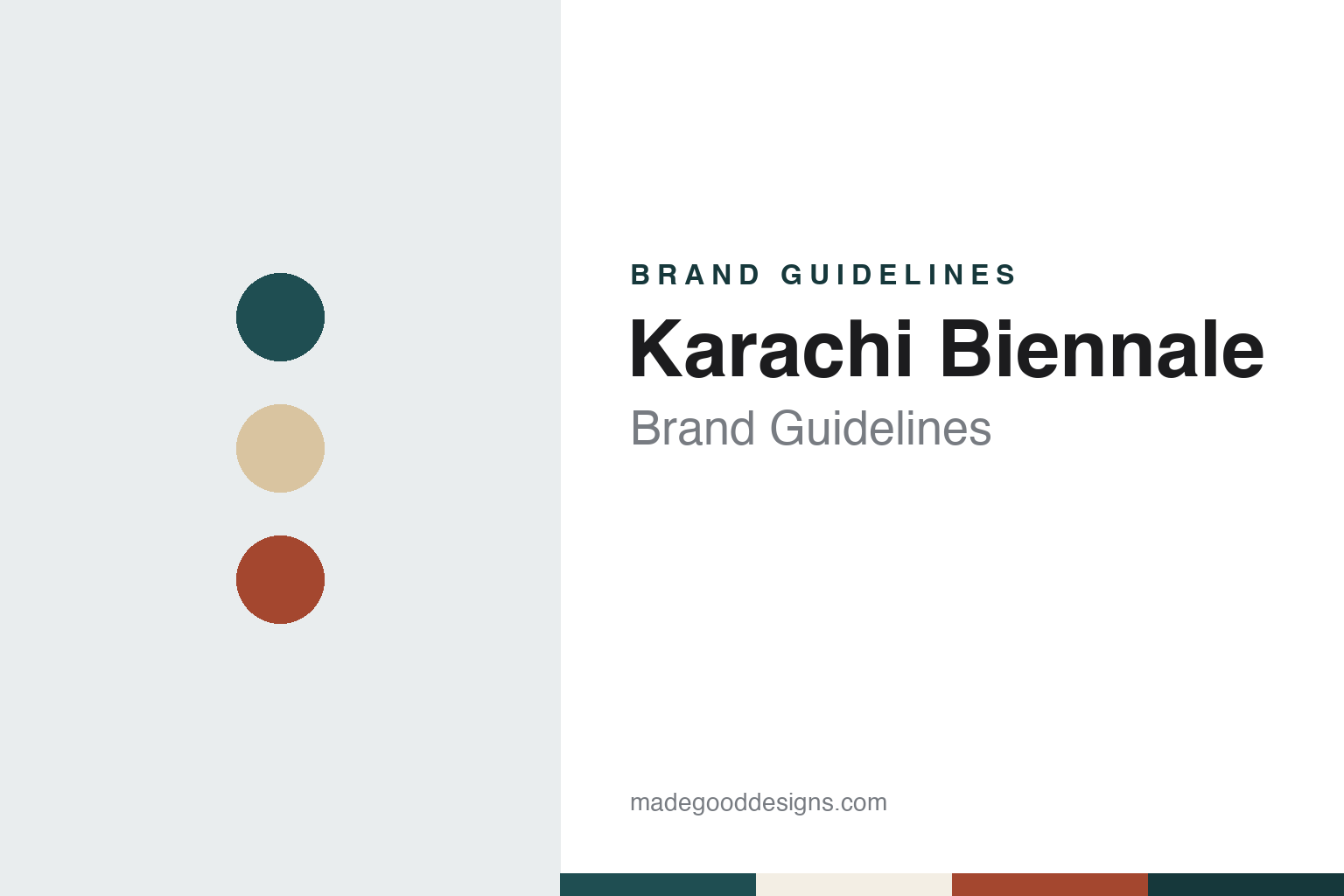
This guide’s Karachi Biennale palette is Harbour teal #1F4E52, Deep ink teal #16383B, Sandstone #D9C4A0, Brick #A4472F and Paper #F3EEE4. The tones are the guide’s own unofficial interpretation, not official Karachi Biennale hex codes.
When was Karachi Biennale founded?
Karachi Biennale was founded in 2016 (trust); first edition 2017, in Karachi, Pakistan.