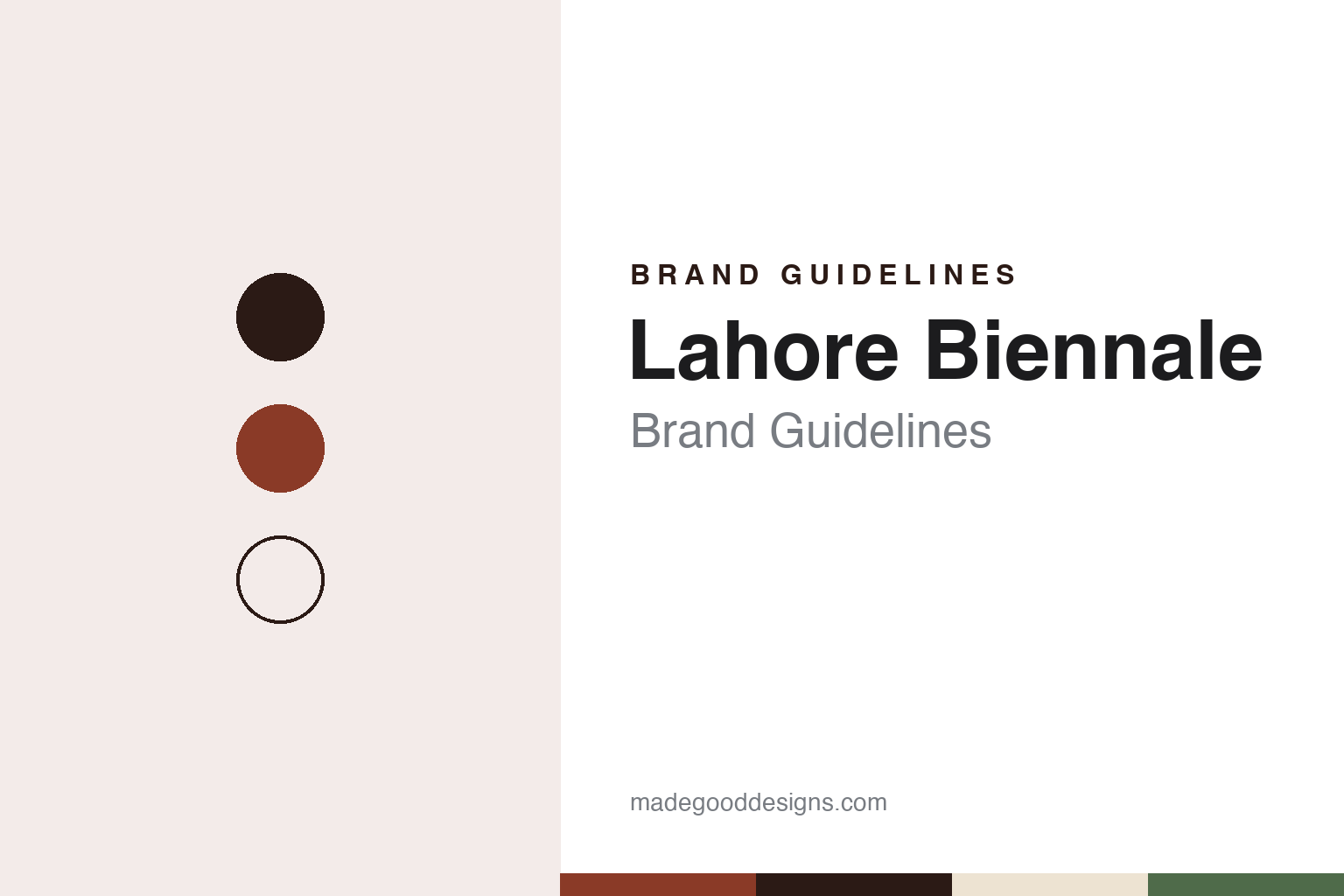
Lahore Biennale Brand Guidelines
A biennial that takes contemporary art into Lahore’s gardens, havelis and Mughal monuments.
Aa
Two constants: a brick red, sandstone and garden green palette and a calligraphic serif register. Abstract homage — not a Lahore Biennale asset; no logo, poster or artwork is reproduced.
Shehr o Funn
A foundation set up in 2014, a first edition in 2018.
The Lahore Biennale is a recurring exhibition of contemporary art held across the city of Lahore, in Pakistan. It is organised by the Lahore Biennale Foundation (LBF), which describes itself on its website as a non-profit organisation supporting art projects across Pakistan, with the biennale as its flagship event, held every two years.
The foundation dates from 2014. Harvard Magazine reported in October 2024 that it was founded that year by Qudsia Rahim, then a professor at the National College of Arts in Lahore, together with a co-founder from the city’s pharmaceutical business. The idea, the magazine says, grew out of an exhibition of Pakistani art in Buenos Aires that Rahim curated in 2014; in 2015 the pair organised a collateral event at the Venice Biennale, titled “My East is Your West.” ArtReview Asia, reviewing the first edition in July 2018, describes the project as initiated in 2014 by a group of artists, academics and cultural producers.
The first edition, Lahore Biennale 01, ran from 18 to 31 March 2018, under the Urdu title Shehr o Funn, which the foundation’s website uses for that edition. ArtReview Asia reported that it was put together by a curatorial team led by Qudsia Rahim, with programmes of performances, lectures, workshops and symposia, and that it showed 56 artists and collectives from Asia and Europe in historic and modern venues across the walled city and the older districts. The Friday Times, in a report of 6 April 2018, gave the opening as 18 March 2018.
From the start, the biennale was a city-wide exhibition rather than a show in one building. Harvard Magazine notes that Lahore had no contemporary art museum in which to show the work, so the organisers placed it in public spaces and monuments, among them the Sheesh Mahal, a seventeenth-century Mughal palace.
Colour
Gardens, havelis, a fort and a museum.
The 2018 sites, as the foundation lists them, were the Alhamra Art Centre, Bagh-e-Jinnah, the canal, the Lahore Fort, the Lahore Museum, the Maktab Khana miniature-painting atelier, Mubarak Haveli and the Shahi Hammam. ArtReview Asia described Mubarak Haveli as a restored Mughal-era compound built around several courtyards. The Friday Times walked readers from Bagh-e-Jinnah, the former Lawrence Gardens, where Ali Kazim stacked fragile clay hearts, to the Alhamra Arts Council, the Lahore Museum and the Summer Palace inside the Lahore Fort, where Imran Qureshi showed an installation of green-lit optical fibres and mirrors. Alongside the exhibitions ran an Academic Forum of lectures, panels and workshops, held at the Alhamra Art Centre, together with a Youth Forum and the artSPEAK talks.
The second edition, LB02, was held in early 2020. Its curator was Hoor Al Qasimi, President and Director of the Sharjah Art Foundation, who chose the theme “between the sun and the moon,” The Friday Times reported on 14 February 2020. The paper counted 70 artists, most of them from outside Pakistan, and 13 locations, including the Lahore Fort, the Lahore Museum, Bradlaugh Hall, Tollinton Market, the National College of Arts and the Alhamra Arts Council, and said the edition ran until 29 February. The foundation’s own list of LB02 sites adds the Gaddafi Stadium, Pak Tea House, the PIA Planetarium and Punjab University’s art college.
The third edition, LB03, was titled Of Mountains and Seas and curated by John Tain. Harvard Magazine reported that it opened on 6 October 2024, ran until 8 November, dealt with ecology and the climate, and showed more than sixty artists from over thirty countries. Its sites, the foundation says, included the Shalimar Gardens, the Mughal garden complex built in 1641–42, as well as Akbari Mahal, Bradlaugh Hall, the Lahore Museum, Pak Tea House and the Royal Kitchens. A Climate Congress of talks and workshops closed the edition in November.
Typography
Art across a region.
Many recurring exhibitions are held far from the cities that host the large art fairs and museum seasons. Instead of a single hall, they use a landscape, a farming region, a valley or the streets and buildings of a whole city. Works sit in fields, on hillsides, in disused schools, warehouses and shopfronts, and visitors move between them over hours or days rather than walking through one set of rooms.
Much of the art is made for the place. Artists are commissioned to respond to a particular site, its history or its people, and some of those works stay behind once an edition closes. In Niigata, the Echigo-Tsumari Art Triennale says about 200 works now remain on view between editions; in California, Desert X installs new temporary works across the Coachella Valley every two years. In both cases the region serves as the venue.
The identity therefore rests on a name that recurs. A biennial or triennale keeps its title, often joined to a place and a year, while each edition brings a new artistic director or curatorial team, a new title and a new list of artists. The graphic work changes with the edition; the name, the place and the rhythm of the calendar stay constant.
Distance makes the visit itself a design problem. Organisers publish maps, suggested routes, passes and opening hours, set up an information hub where a printed guide can be collected, add signage at sites spread over many kilometres and in some cases offer an app with directions and audio. The guides that follow look at how each of these events presents itself, from its founding and organisers to its venues and the way it is named.
Aa
A calligraphic serif — for a biennial set among Mughal monuments. (Specimen set in Cormorant Garamond, a serif STAND-IN; NOT the Lahore Biennale logo.)
Lahore Biennale
Art placed in public space, from a metro station to a Mughal garden.
The Lahore Biennale’s visual character comes less from a single graphic mark than from where its works are placed. In 2024, Harvard Magazine reported, the Filipino artist Leeroy New installed a piece in the Shalimar Gardens built from bamboo and recycled water bottles, and Imran Qureshi turned the blue rooftop water tanks found across Lahore into a project called Water Bodies: he painted some of the tanks with orange splashes and floral patterns, photographed them, and used the images for a tile frieze in an underground pedestrian passage and a window installation at the Shalimar Gardens station on the Orange Line, with painted tanks set on a rooftop visible from the platform. The foundation describes the frieze as permanent.
The foundation numbers its editions in a plain, repeatable way, LB01, LB02 and LB03, and keeps each edition’s title in its own words: an Urdu phrase in 2018, a line about the sun and the moon in 2020, mountains and seas in 2024. The foundation’s publication lists give the first two editions a printed guidebook and a reader each, and the third a Climate Congress booklet among other titles.
Beyond the exhibitions, the foundation says it runs a Research Unit, begun in 2018, which supports archival and theoretical work on art and visual culture in Pakistan, as well as a Youth Forum that brings school pupils to the biennale.
For a design guide, the Lahore Biennale shows how a recurring exhibition can build its identity from a city’s own buildings, numbering each edition simply and letting the sites carry the look. Compare Sharjah Biennial, run by the foundation whose director curated LB02, and Venice Biennale, where the foundation showed a collateral event in 2015. For this guide we use brick red, sandstone and garden green with a serif, an unofficial interpretation; no product or logo is reproduced.
Explore & save
Keep Lahore Biennale’s identity on hand — save it to a board in the Made Good inspiration library.
Lahore Biennale identity set
Pin the Lahore Biennale brick red, sandstone and garden green palette and the calligraphic serif register to your own board.
Source & notes
Frequently Asked Questions
What font can I use to match the Lahore Biennale look?
This guide describes Lahore Biennale’s type as “A calligraphic serif — for a biennial set among Mughal monuments”. Its type specimen is set in Cormorant Garamond from Google Fonts as a stand-in; Cormorant Garamond is not Lahore Biennale’s own lettering.
What colours are in the Lahore Biennale palette?
This guide’s Lahore Biennale palette is Brick red #8A3A27, Fort ink #2B1A15, Sandstone #EDE3D2, Garden green #4F6B4A and Paper #F7F4EE. The tones are the guide’s own unofficial interpretation, not official Lahore Biennale hex codes.