Sharjah Biennial Brand Guidelines
A numbered biennial spread across an emirate since 1993.
Aa
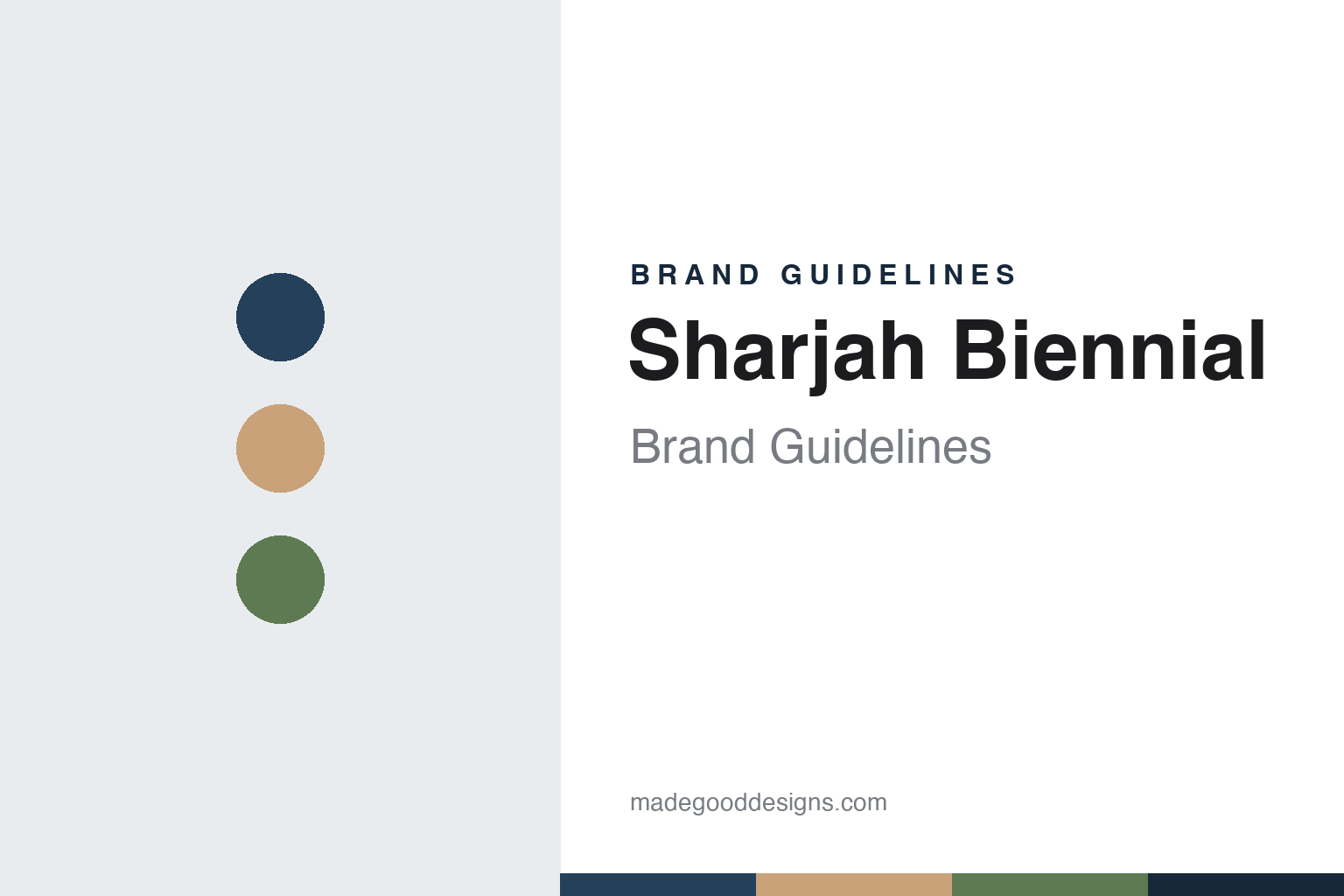
Two constants: a Gulf indigo, coral stone and oasis green palette of our own and a humanist grotesque sans register. Abstract homage — not a Sharjah Biennial or Sharjah Art Foundation asset; no logo, campaign image or artwork is reproduced.
A biennial since 1993
A city exhibition that grew into a foundation.
The Sharjah Biennial is a contemporary art exhibition held once every two years in Sharjah, in the United Arab Emirates. Its first edition took place in 1993, organised by the emirate’s Department of Culture and Information, according to English Wikipedia’s articles on the biennial and on the Sharjah Art Foundation. Hoor Al Qasimi, the foundation’s president and director, gave the same starting year in an interview with The Korea Times published on 19 February 2025, placing it beside two other local markers: the Emirates Fine Arts Society, founded in 1980, and the Sharjah Art Museum, opened in 1997.
Al Qasimi was first appointed curator of the sixth edition, Sharjah Biennial 6, in 2003, and has served as the event’s director ever since, The National reported in May 2023. English Wikipedia describes 2003 as the year the biennial was reoriented under her. Speaking to The National in February 2023, she said she had grown up with the biennial and had been part of the local scene of artists invited to take part, as a young painter, before taking it over.
In 2009 she founded the Sharjah Art Foundation, which has managed and organised the biennial since its creation, according to English Wikipedia and The Korea Times. Wikipedia lists the foundation’s other platforms as residencies, production grants, commissions, exhibitions, research and publications, together with the March Meeting, an annual gathering of art practitioners and institutions launched in 2008. In the 2025 interview Al Qasimi said the aim had been a year-round space for exhibitions and learning, rather than an international festival that arrived once every two years and then left.
Colour
Numbered editions, changing curators, a widening map.
Each edition carries a number and a title of its own, while the curators change. English Wikipedia lists the seventh edition, Belonging, from 6 April to 6 June 2005, and the eighth in 2007, held at the Sharjah Art Museum, the Expo Centre Sharjah, the Heritage Area, the American University of Sharjah and several outdoor locations. The eleventh, Re:emerge: Towards a New Cultural Cartography, ran from 13 March to 13 May 2013 and was curated by Yuko Hasegawa, chief curator of the Museum of Contemporary Art in Tokyo, the same article says.
The venues spread through the old town. The twelfth edition, The past, the present, the possible, from 5 March to 5 June 2015, used public spaces around the Sharjah Art Museum, the foundation’s offices and the Al Mureijah heritage area, according to Wikipedia. The thirteenth, Tamawuj, opened on 10 March 2017 with exhibitions in Sharjah and Beirut and later projects in other cities, among them Dakar and Istanbul, between October 2017 and January 2018. The fourteenth, Leaving the Echo Chamber, opened at the foundation’s premises on 7 March 2019 and ran until 10 June.
The fifteenth edition, Thinking Historically in the Present, opened on 7 February 2023, four years after the fourteenth. The National reported on 6 February 2023 that it brought more than 150 artists from 70 countries to 19 venues in Sharjah city, Al Dhaid, Al Hamriyah, Kalba and Khor Fakkan, with about 70 new works, and that it ran until 11 June. The paper noted that the event was then in its 30th year.
The sixteenth edition took the lowercase title to carry and ran from 6 February to 15 June 2025. ArtReview and The National reported its five curators when the title was announced in 2024; The National described them as an all-female panel. The foundation’s own edition page gives more than 190 participants and more than 200 new commissions, across Sharjah City, Al Hamriyah, Al Dhaid, Kalba, Al Madam and other locations in the emirate. The Korea Times counted about 650 works in museums, heritage houses, disused buildings and desert landscapes. The same edition page placed the March Meeting from 7 to 9 March 2025 at the former Al Qasimiyah School and a programme called April Acts across the biennial venues from 18 to 20 April.
Typography
How biennials outside the big art capitals build an identity.
Many recurring exhibitions are held far from the cities that host the large art fairs and museum seasons. Instead of a single hall, they use a landscape, a farming region, a valley or the streets and buildings of a whole city. Works sit in fields, on hillsides, in disused schools, warehouses and shopfronts, and visitors move between them over hours or days rather than walking through one set of rooms.
Much of the art is made for the place. Artists are commissioned to respond to a particular site, its history or its people, and some of those works stay behind once an edition closes. In Niigata, the Echigo-Tsumari Art Triennale says about 200 works now remain on view between editions; in California, Desert X installs new temporary works across the Coachella Valley every two years. In both cases the region serves as the venue.
The identity therefore rests on a name that recurs. A biennial or triennale keeps its title, often joined to a place and a year, while each edition brings a new artistic director or curatorial team, a new title and a new list of artists. The graphic work changes with the edition; the name, the place and the rhythm of the calendar stay constant.
Distance makes the visit itself a design problem. Organisers publish maps, suggested routes, passes and opening hours, set up an information hub where a printed guide can be collected, add signage at sites spread over many kilometres and in some cases offer an app with directions and audio. The guides that follow look at how each of these events presents itself, from its founding and organisers to its venues and the way it is named.
Aa
A humanist grotesque sans for a biennial that writes its edition titles in lowercase. (Specimen set in Work Sans, a sans STAND-IN; NOT the Sharjah Biennial logo.)
Sharjah Biennial
A number, a title and a set of rebuilt buildings.
The biennial’s name works like a series. The foundation’s website shortens each edition to SB and a number, such as SB16, and pairs the number with a title that changes every time. For the sixteenth edition the title was also used as a running phrase: the edition page sets out a long list that begins “to carry a home, to carry a history, to carry a trade,” so that the two words open every line.
Buildings carry much of the identity. The National reported in May 2023 that the foundation had fully renovated the Kalba Ice Factory, a 20,000-square-metre site on the east coast, for the fifteenth edition; English Wikipedia says the restoration of the former fish-feed mill and ice store was carried out by the Lima practice 51-1 Arquitectos and opened in February 2023. The same National report listed other repurposed sites, among them the Flying Saucer building in Sharjah, a former vegetable market, a former medical clinic in Al Dhaid and a former kindergarten. In 2025 The Korea Times described works at Al Mureijah Art Spaces, in the old government building of Al Diwan Al Amiri and in the courtyard of the former Al Qasimiyah School.
The spread across the emirate is deliberate, Al Qasimi told The National in 2023: she said each town has its own artists and buildings, that biennials are also about discovering places, and that the foundation hires local young people as visitor guides. Wikipedia adds that the foundation built a permanent home for Random International’s Rain Room in Sharjah.
Its director now works on other recurring exhibitions too. The Aichi Triennale named Al Qasimi artistic director of its 2025 edition, in Nagoya and Seto, and The Korea Times reported in February 2025 that she had also been named artistic director of the 2026 Biennale of Sydney.
For a design guide, the Sharjah Biennial shows how a numbered name, a changing title and a set of restored buildings can hold one exhibition together across a city, a desert farming town and the east coast. Compare the Aichi Triennale, whose 2025 edition Al Qasimi directed, and the Biennale of Sydney. For this guide we use a Gulf indigo, a coral stone and an oasis green on courtyard white with a sans, an unofficial interpretation; no product or logo is reproduced.
Explore & save
Keep Sharjah Biennial’s identity on hand — save it to a board in the Made Good inspiration library.
Sharjah Biennial identity set
Pin the Sharjah Biennial Gulf indigo, coral stone and oasis green palette and the humanist grotesque sans register to your own board.
Source & notes
Frequently Asked Questions
What font can I use to match the Sharjah Biennial look?
This guide describes Sharjah Biennial’s type as “A humanist grotesque sans for a biennial that writes its edition titles in lowercase”. Its type specimen is set in Work Sans from Google Fonts as a stand-in; Work Sans is not Sharjah Biennial’s own lettering.
What colours are in the Sharjah Biennial palette?
This guide’s Sharjah Biennial palette is Gulf indigo #24405A, Night harbour #16283A, Coral stone #C9A27A, Oasis green #5E7A52 and Courtyard white #F4F1EA. The tones are the guide’s own unofficial interpretation, not official Sharjah Biennial hex codes.
When was Sharjah Biennial founded?
Sharjah Biennial was founded in 1993, in Sharjah, United Arab Emirates.