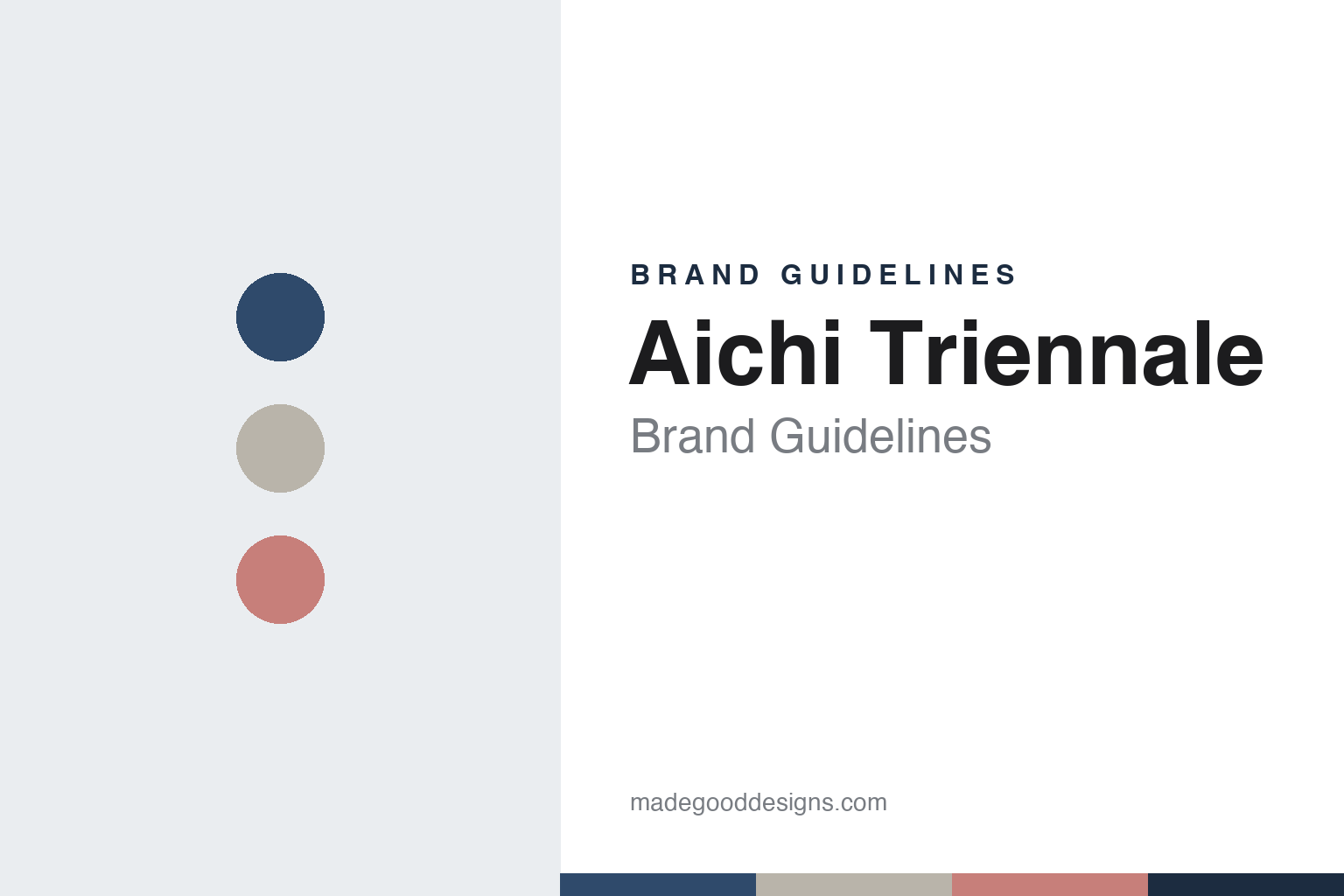
Aichi Triennale Brand Guidelines
Nagoya’s art festival, held every three years since 2010.
Aa
Two constants: a glaze blue, ash grey and dusk rose palette of our own and a Japanese gothic sans register. Abstract homage — not an Aichi Triennale asset; no logo, campaign image or artwork is reproduced.
An art festival for Aichi
A prefectural plan, a name fixed in 2008, a first edition in 2010.
The Aichi Triennale is an international art festival held every three years in Aichi Prefecture, in central Japan, with the Aichi Arts Center in Nagoya at its centre. Japanese Wikipedia, citing the Chunichi Shimbun, says the outline of a festival for autumn 2010 centred on the Aichi Arts Center was announced in September 2007, and that in February 2008 the prefecture decided to hold it every three years. It was first called the Aichi International Art Festival; in July 2008 Tatehata Akira, then director of the National Museum of Art in Osaka, was chosen as artistic director, and in October 2008 the name Aichi Triennale was fixed, the same article says.
The festival’s own outline describes it as an urban international art festival held every three years since 2010 across a wide region, with contemporary art at its core and performing arts, learning programmes and collaborations with art universities in the prefecture around it. The Aichi Arts Center, which the festival describes as a cultural complex opened in central Nagoya in 1992, houses the Aichi Prefectural Museum of Art and the Aichi Prefectural Art Theater.
The first edition, Arts and Cities, ran from 21 August to 31 October 2010. The festival’s archive lists 131 artists and groups and 572,023 visitors, in the Aichi Arts Center, the Nagoya City Art Museum and two city sites, Choja-machi and Nayabashi, as well as Nagoya Castle and the Oasis 21 complex. Japanese Wikipedia says the Choja-machi site used empty shops and wall surfaces in a textile wholesale district, and the Nayabashi site a former bowling-alley building near Nayabashi bridge.
The festival also had its own vehicles between sites. The same article says velotaxis wrapped in the festival’s 2010 livery carried visitors between sites, and that cars covered in polka dots designed by Yayoi Kusama were used as shuttles, with one more displayed at the Aichi Arts Center.
Colour
Five cities, two names and a ceramic town.
Later editions moved beyond central Nagoya while keeping the arts centre as their base. The festival archive lists the second edition, Awakening — Where Are We Standing? — Earth, Memory and Resurrection, from 10 August to 27 October 2013, in Nagoya and in Okazaki, with 122 artists and groups and 626,842 visitors. The third, Homo Faber: A Rainbow Caravan, from 11 August to 23 October 2016, added Toyohashi to Nagoya and Okazaki, with 119 artists and groups and 601,635 visitors. The fourth, Taming Y/Our Passion, from 1 August to 14 October 2019, used venues in Nagoya and in Toyota, with 93 artists and groups and 675,939 visitors, according to the same archive.
The name changed in Japanese for the fifth edition. Japanese Wikipedia says that from 2022 the festival’s Japanese name became International Art Festival “Aichi 2022”, while the English name remained Aichi Triennale 2022, and that the organiser became a new organising committee for the Aichi festival. Its artistic director was Kataoka Mami, director of the Mori Art Museum in Tokyo and a native of Aichi, the article says. The archive gives the theme as Still Alive, the dates as 30 July to 10 October 2022, the venues as the Aichi Arts Center, Ichinomiya City, Tokoname City and the Arimatsu district of Nagoya, and 100 artists and groups from 32 countries and regions, with 487,834 visitors.
The sixth edition, Aichi Triennale 2025, ran from 13 September to 30 November 2025, 79 days, under the title A Time Between Ashes and Roses, taken from a verse by the poet Adonis, the festival’s outline says. Its main venues were the Aichi Arts Center, the Aichi Prefectural Ceramic Museum and the city of Seto. The artistic director was Hoor Al Qasimi, president and director of the Sharjah Art Foundation, whom ArtAsiaPacific described in its November 2025 review as the triennale’s first non-Japanese artistic director. The outline counts 62 participating artists and groups, 26 of them from Japan; the organiser was the Aichi Triennale Organizing Committee.
Typography
How biennials outside the big art capitals build an identity.
Many recurring exhibitions are held far from the cities that host the large art fairs and museum seasons. Instead of a single hall, they use a landscape, a farming region, a valley or the streets and buildings of a whole city. Works sit in fields, on hillsides, in disused schools, warehouses and shopfronts, and visitors move between them over hours or days rather than walking through one set of rooms.
Much of the art is made for the place. Artists are commissioned to respond to a particular site, its history or its people, and some of those works stay behind once an edition closes. In Niigata, the Echigo-Tsumari Art Triennale says about 200 works now remain on view between editions; in California, Desert X installs new temporary works across the Coachella Valley every two years. In both cases the region serves as the venue.
The identity therefore rests on a name that recurs. A biennial or triennale keeps its title, often joined to a place and a year, while each edition brings a new artistic director or curatorial team, a new title and a new list of artists. The graphic work changes with the edition; the name, the place and the rhythm of the calendar stay constant.
Distance makes the visit itself a design problem. Organisers publish maps, suggested routes, passes and opening hours, set up an information hub where a printed guide can be collected, add signage at sites spread over many kilometres and in some cases offer an app with directions and audio. The guides that follow look at how each of these events presents itself, from its founding and organisers to its venues and the way it is named.
Aa
A Japanese gothic sans for a festival that names each edition by its year. (Specimen set in Zen Kaku Gothic New, a sans STAND-IN; NOT the Aichi Triennale logo.)
Aichi Triennale
A prefecture’s name and a year.
The festival’s name is built from a place and a date. In English each edition is the Aichi Triennale followed by its year; in Japanese, since 2022, the festival has used the prefecture’s name and the year alone, as in “Aichi 2022” and “Aichi 2025”. The website keeps each edition under its own year: the 2025 site sits at its own address, with a separate archive for the editions from 2010 to 2019.
Venues give each edition its character. For 2025 the festival described Seto as a city about 20 kilometres north-east of central Nagoya, with about 130,000 people, and as one of Japan’s Six Ancient Kilns, with pottery made there since the medieval period. The Aichi Prefectural Ceramic Museum, it says, opened in Seto in 1978 and changed its name in 2013 to stress its status as an art museum. ArtAsiaPacific wrote in November 2025 that ceramics formed a focus of that edition, with the museum acting almost as a kiln for rethinking the relationship between people and the earth, and described glass tablets by the artist Rui Sasaki, holding local plants reduced to ash, installed in a former bathhouse in Seto.
The earlier editions used a similar pattern of a central arts complex and a ring of city sites: shops and offices in a wholesale district, a former bowling alley, station areas in Okazaki and Toyohashi, a historic merchant district in Arimatsu. The festival’s programme pages pair the contemporary art exhibitions with theatre and dance at the Aichi Arts Center, learning programmes and pop-up exhibitions by participating artists at sites around the prefecture.
For a design guide, the Aichi Triennale shows how a festival can keep one base and one place name while each edition’s year, title and second city change. Compare the Sharjah Biennial, whose director led the 2025 edition, and the Mori Art Museum, whose director led the 2022 edition. For this guide we use a glaze blue, an ash grey and a dusk rose on porcelain white with a sans, an unofficial interpretation; no product or logo is reproduced.
Explore & save
Keep Aichi Triennale’s identity on hand — save it to a board in the Made Good inspiration library.
Aichi Triennale identity set
Pin the Aichi Triennale glaze blue, ash grey and dusk rose palette and the Japanese gothic sans register to your own board.
Source & notes
Frequently Asked Questions
What font can I use to match the Aichi Triennale look?
This guide describes Aichi Triennale’s type as “A Japanese gothic sans for a festival that names each edition by its year”. Its type specimen is set in Zen Kaku Gothic New from Google Fonts as a stand-in; Zen Kaku Gothic New is not Aichi Triennale’s own lettering.
What colours are in the Aichi Triennale palette?
This guide’s Aichi Triennale palette is Glaze blue #2F4A6B, Kiln night #1C2C40, Ash grey #B9B4AA, Dusk rose #C77F7A and Porcelain #F5F3EE. The tones are the guide’s own unofficial interpretation, not official Aichi Triennale hex codes.
Where is Aichi Triennale based?
Aichi Triennale is based in Aichi Arts Center, Nagoya (every edition 2010–2025).