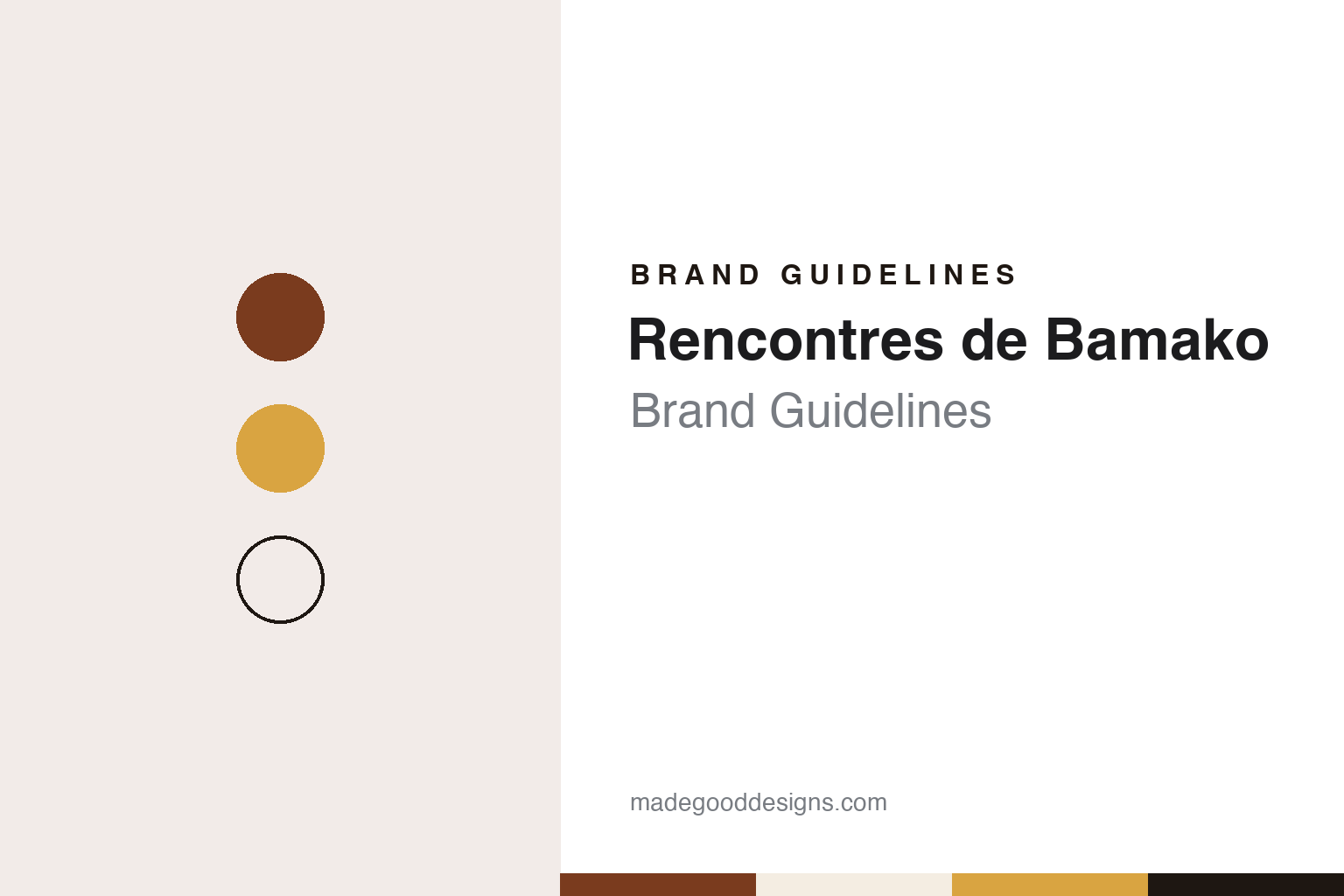
Rencontres de Bamako Brand Guidelines
A photography biennial that turns a capital city into an exhibition.
Aa
Two constants: a laterite, river ochre and print white palette and an editorial serif register. Abstract homage — not a Rencontres de Bamako mark; no logo, poster or photograph is reproduced.
A biennial for African photography
Two photographers, a capital city and a medium.
The Rencontres de Bamako, in full the Rencontres africaines de la photographie and in English the Bamako Encounters, is a biennial of photography held in Bamako, the capital of Mali. It began in 1994. Writing in Aperture in its summer 2017 issue, the curator of the tenth edition said the biennial was founded by the French photographers Françoise Huguier and Bernard Descamps, two years after the Dak’Art biennial in Senegal had set itself up as a forum for contemporary art; French Wikipedia gives the same two founders and dates the first edition to December 1994.
The medium came first. Artforum, in a review published in March 2006, wrote that the international discovery of Bamako’s studio photographers Seydou Keïta and Malick Sidibé, whose black-and-white portraits had been made for local families from the 1950s to the 1970s, spurred the launch of the pan-African Rencontres africaines de la photographie in 1994. The same review described the biennial as a joint venture between the Malian Ministry of Culture and the French agency AFAA, partly funded by the European Union.
That two-part structure has lasted. English Wikipedia describes the event as run jointly by the government of Mali and the Institut français, the French cultural agency, and French Wikipedia names the Ministry of Culture of Mali and the Institut français as the organisers of the 2017 edition. French Wikipedia adds that from 2004 the event has been placed under the Maison africaine de la photographie, a Malian body set up to run the biennial. In a review published on 19 December 2024, the online magazine Contemporary And (C&) also wrote that the event had historically been run by the government and the Institut français.
The name works on two levels. In French the word rencontres means meetings or encounters, and the long form names the continent and the medium, while the short form names the city. Each edition is then numbered and given a title of its own, so the brand reads as a place, a medium and a running series at once.
Colour
Numbered editions, titles and venues across the city.
The editions are counted in sequence. French Wikipedia lists the sixth edition in November 2005 under the theme Un autre monde (Another World); the seventh from 24 November to 23 December 2007, Dans la ville et au-delà (In the City and Beyond); the eighth from 7 November to 7 December 2009 on the theme of borders; and the ninth, in 2011, Pour un monde durable (For a Sustainable World). Artforum wrote in 2006 that one senior curator had led the 2005 edition and the two before it, producing sprawling exhibitions across several genres, each with a comprehensive catalogue, and that each edition invited a different non-African guest nation, Spain in 2005.
No edition was held in 2013. English Wikipedia dates the tenth edition, Telling Time, from 31 October to 31 December 2015; Aperture recorded that it was the first time in the biennial’s history that a curator based in the region had been chosen as artistic director. The eleventh ran from 2 December 2017 to 31 January 2018 under the title Afrotopia, according to French Wikipedia, and the twelfth from 30 November 2019 to 31 January 2020, English Wikipedia says. The thirteenth opened on 8 December 2022 and ran to 8 February 2023, under a title in Bambara drawn from the thought of a Malian writer, French Wikipedia says.
The 14th edition marked the biennial’s 30th anniversary. It ran from 16 November 2024 to 16 January 2025, English Wikipedia says, under the theme KUMA, which Contemporary And translated from Bambara as “speech” or “voice.” Its artistic director was the Bamako gallerist Lassana Igo Diarra, with a team of five further curators, and the central group exhibition, La Panafricaine, showed thirty photographers, Contemporary And reported. Announcing the selection in July 2024, the organisers described the theme as an exploration of dialogue between the word and the image.
The biennial has always spread across the city. Aperture named the Palais de la Culture as the main site before the event moved to the National Museum of Mali, alongside the Musée du District de Bamako and the Modibo Keïta Memorial. Artforum in 2006 described an exhibition inside the city’s train station and another at the Pyramide du Souvenir, and French Wikipedia lists the National Library, the railway station and the Maison africaine de la photographie among other venues used over the years.
Typography
Single-medium and format-led biennials.
Some biennials are defined less by a city or a theme than by a single commitment: one medium, one format or one host. A biennial of moving image, a photography meeting, an assembly or a summit, or an exhibition run by a museum each sets a rule that stays put while everything else changes. That rule becomes the steadiest part of the identity, more lasting than any poster, title or curator.
Numbering is the simplest tool these events use. An edition count turns a series of separate exhibitions into a sequence, and the way the number is written can carry character of its own: spelled out, set as a numeral, or folded into the name itself. A recurring host institution plays a similar role. When the same museum, arts centre or foundation stages every edition, its building and its name give visitors a fixed point to return to, even when the curatorial team is new each time.
Publications often outlast the exhibitions. Catalogues, readers, companion books and printed handouts record what each edition argued and who took part, and some events present them as part of the edition rather than as souvenirs. A consistent format for these books, or a deliberate change from one edition to the next, says as much about the event as its signage does.
Finding the work is the other half of the identity. A moving-image biennial needs screening schedules and running times; a programme spread over several weekends needs a clear calendar; an exhibition spread across a city needs a map and a route from one venue to the next. For a designer, these practical documents are where the event’s rule becomes visible: in how a timetable is set, how venues are numbered and how a visitor is led from one room to the next.
Aa
An editorial serif for a biennial of photographs and catalogues. (Specimen set in Fraunces, a serif STAND-IN; NOT the Rencontres de Bamako logo or its identity typeface.)
Rencontres de Bamako
A city, a medium and a running number.
The programme has always gone beyond prints on walls. Artforum listed art photography, photojournalism, commercial studio work, installations, film, video and performance in 2005, together with projects for children, workshops and master classes. English Wikipedia adds colloquia and film showings, and the same source says the 2024 edition credited two scenographers for its displays.
For designers, the biennial’s identity is less a fixed logo than a set of names that must work together: the long French title, the city name, the English translation, the edition number and a new edition title that may be in French, English or Bambara. A photography biennial also has to let the images lead. Wayfinding, captions and catalogue pages need a quiet frame that sits beside black-and-white studio portraits and colour documentary work alike, and that reads in venues as different as a national museum, a memorial and a railway station.
The catalogue matters for the same reason. Artforum singled out the comprehensive catalogues of the early 2000s editions, and a biennial that moves between many venues across a city depends on printed guides and maps to hold its parts together. A clear hierarchy, with the edition number and title first and the venue second, helps a visitor follow the exhibitions from one site to the next.
For a design guide, the Rencontres de Bamako shows how a biennial can build its name from a city and a medium, and keep it for three decades by numbering each edition and giving each a title of its own. Compare the Dak’Art Biennale, the Dakar biennial that opened two years earlier, and the 1-54 Contemporary African Art Fair. For this guide we use a laterite, a river ochre and a print white with a serif, an unofficial interpretation; no product or logo is reproduced.
Explore & save
Keep Rencontres de Bamako’s identity on hand — save it to a board in the Made Good inspiration library.
Rencontres de Bamako identity set
Pin the Rencontres de Bamako laterite, river ochre and print white palette and the editorial serif register to your own board.
Source & notes
Frequently Asked Questions
What font can I use to match the Rencontres de Bamako look?
This guide describes Rencontres de Bamako’s type as “An editorial serif for a biennial of photographs and catalogues”. Its type specimen is set in Fraunces from Google Fonts as a stand-in; Fraunces is not Rencontres de Bamako’s own lettering.
What colours are in the Rencontres de Bamako palette?
This guide’s Rencontres de Bamako palette is Laterite #7A3B1E, Ink #1E1712, River ochre #D9A441, Print white #F4EDE2 and Indigo cloth #2E3A5C. The tones are the guide’s own unofficial interpretation, not official Rencontres de Bamako hex codes.
When was Rencontres de Bamako founded?
Rencontres de Bamako was founded in 1994, in Bamako, Mali.
Who founded Rencontres de Bamako?
Rencontres de Bamako was founded by Françoise Huguier and Bernard Descamps in 1994.