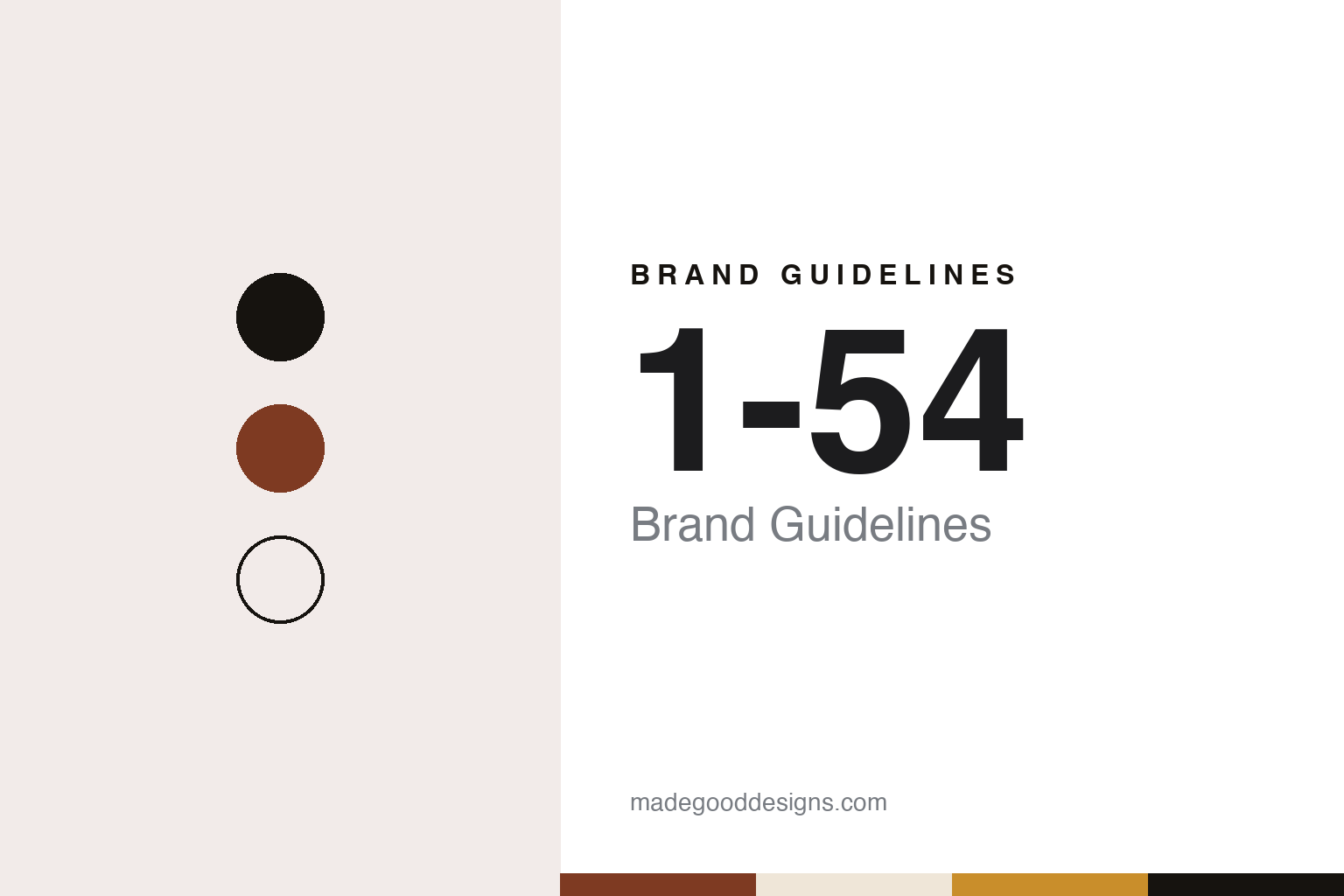
1-54 Brand Guidelines
One continent, fifty-four countries, three cities.
Aa
Two constants: a terracotta, ochre and ink palette and a grotesque sans register. Abstract homage — not a 1-54 mark; no logo, artwork or campaign image is reproduced.
One continent: 54 countries
A fair named for a continent.
1-54 Contemporary African Art Fair was founded in 2013 by the Moroccan curator Touria El Glaoui, and it held its first fair in London in October 2013, according to the fair’s own timeline. English Wikipedia, citing Okay Africa and ArtReview, places that debut at Somerset House during the October Frieze week, with about 6,000 visitors. The name refers to the fifty-four countries that make up the African continent. English Wikipedia describes it as a ratio, “one continent: 54 countries,” and writes it with a colon; the fair itself uses a hyphen, 1-54, on its website and in its titles.
The aim was to give contemporary art from Africa and its diaspora a dedicated platform in the week when London’s art calendar is busiest. English Wikipedia says El Glaoui was supported and advised at the start by the British Council and the Francophonie, with media partners including ArtReview. It also quotes the question the organisers ask before each edition — what is necessary, what can be achieved and how to do something different — a line the fair still prints on its own “About” page.
The London fair grew quickly. English Wikipedia, citing Okay Africa, says the second edition in 2014 brought 27 galleries and more than 100 artists, among them the photographer Malick Sidibé, with a talks programme curated by Koyo Kouoh of Raw Material Company in Dakar and about 10,000 visitors. The same article gives 15,000 visitors for 2015. In October 2016, it says, citing Artnet News, the fair spread from one wing of Somerset House into the rest of the building and its courtyard, with 40 exhibitors from 18 countries.
Colour
London, New York, Marrakech.
From London the fair became a format that travels. The fair dates its first New York edition to May 2015. English Wikipedia, citing ARTnews and Artinfo, says it was a pop-up at Pioneer Works, an art venue in Red Hook, Brooklyn, held during Frieze New York, with sixteen galleries in white-walled booths built into the open industrial space; the design of that exhibit was by RA Projects, which had worked with the fair before. A second New York fair followed in 2016 with 17 galleries, five of them based in Africa, the encyclopedia adds.
In February 2018 1-54 opened a third edition, in Marrakech, at the La Mamounia hotel; English Wikipedia notes that it coincided with the seventh Marrakech Biennale. The fair’s own pages describe the Marrakech fair of 9 to 12 February 2023 as its fourth edition on the African continent, with talks and events organised with local museums and cultural institutes. The fair’s timeline adds a pop-up fair in Paris, launched in January 2021 in collaboration with Christie’s, and 1-54 Presents, a series of curated exhibitions begun in May 2023. Wallpaper* wrote in October 2025 that the fair also stages pop-up exhibitions in cities such as Paris and Hong Kong.
London remains the main edition. Wallpaper* reported on 11 October 2025 that the 13th consecutive London fair, again at Somerset House, brought together more than 50 new and returning galleries and about 100 artists working in painting, photography, sculpture, textiles and ceramics. Its special projects included the Art Comes First initiative on African craftsmanship and British tailoring, a Caribbean Spotlight section and a commission in the building’s Edmond J Safra Fountain Court; the magazine named Christie’s among the fair’s partners. The Art Newspaper, reporting from the fair on 16 October 2025, described Lagos galleries such as The 1897 and O’DA alongside Circle Art Gallery from Nairobi and Everyday Lusaka Gallery from Zambia, which made its 1-54 debut that year.
For the 14th London edition, The Art Newspaper reported on 16 October 2026 that the fair had added, for the first time, a strand devoted to Modern artists from Africa and its diaspora, through stand presentations and a 1-54 Presents exhibition, West Wind, curated by the art historian Nancy Dantas. Contemporary work stayed at the centre, the paper said, including portraits by Hassan Hajjaj from his My London Rockstars series. Earlier in 2026, the New York edition ran from 13 to 17 May with 26 galleries from Africa, Europe and the United States, according to the fair’s website.
Typography
How art fairs present themselves.
Contemporary art fairs usually present themselves through a short name that does most of the work. Some take the city outright, as Art Cologne does; others join a coined word to the city, as ARCOmadrid does with ARCO and, for its Portuguese sibling, ARCOlisboa. The name stays fixed while much around it changes from one edition to the next, and editions are counted: ARCOmadrid held its 45th in March 2026 and Art Cologne its 59th in November 2026.
Behind many fairs stand trade-fair companies and galleries. ARCOmadrid is organised by IFEMA MADRID, and Art Cologne’s press releases come from Koelnmesse, while both fairs trace their beginnings to gallerists: Juana de Aizpuru in Madrid in 1982, and a Cologne dealers’ association in 1967. At both fairs the exhibitors are chosen by a committee or advisory board, and both are held in the exhibition halls of their organisers, IFEMA in Madrid and the fairgrounds at Cologne-Deutz, so the venue becomes part of the fair’s picture.
Inside the halls, fairs divide themselves into named sections. A main programme for established galleries sits beside sections for younger galleries, such as ARCOmadrid’s Opening, for galleries under eight years old, or Art Cologne’s NEUMARKT, and beside curated programmes with their own themes and curators. At these two fairs the section names are written in capitals or set off with punctuation — GALLERIES, ART + OBJECT, Profiles | Latin American Art — so that they read as titles in their own right.
The material the fairs publish follows a steady pattern: exhibitor lists by city and country, hall plans, programmes of talks and special exhibitions, and headline figures for each edition. Themed projects change from edition to edition — ARCOmadrid named its 2026 project ARCO2045 — while the name, the organiser and the city stay constant, which keeps a fair recognisable across decades.
Aa
A plain grotesque sans for a name made of two figures and a hyphen. (Specimen set in Archivo, a sans STAND-IN; NOT the 1-54 logo.)
1-54
A number as a name.
The identity starts with the name. Two figures and a hyphen stand for one continent and its fifty-four countries, and the full title, 1-54 Contemporary African Art Fair, does the descriptive work. Because the name contains no city, the fair adds one for each edition: on its website the three fairs appear as 1-54 London, 1-54 New York and 1-54 Marrakech, each with its own page of dates, opening hours and exhibiting galleries, and the curated exhibitions run under a second label of the same form, 1-54 Presents.
The venues carry much of the look. In London the fair has used the rooms and courtyard of Somerset House on the Strand since 2013, in the same week as Frieze London; in Marrakech it moves into La Mamounia. Galleries show in booths, with talks, panel discussions and a Special Projects programme around them, the fair says, and its New York galleries have also been presented online through a partnership with Artsy, according to the fair’s website.
The organisation is still led by the person who started it: Wallpaper* in October 2025 and The Art Newspaper in October 2026 both described Touria El Glaoui as the founding director of 1-54.
For a design guide, 1-54 shows how a short numeric name can hold a whole idea and move between cities without changing. Compare Frieze, whose London week the fair has shared since its first edition, and Christie’s, named as a partner of the fair by Wallpaper* in 2025. For this guide we use a deep terracotta, ochre and ink with a sans, an unofficial interpretation; no product or logo is reproduced.
Explore & save
Keep 1-54’s identity on hand — save it to a board in the Made Good inspiration library.
1-54 identity set
Pin the 1-54 terracotta, ochre and ink palette and the grotesque sans register to your own board.
Source & notes
Frequently Asked Questions
What font can I use to match the 1-54 look?
This guide describes 1-54’s type as “A plain grotesque sans for a name made of two figures and a hyphen”. Its type specimen is set in Archivo from Google Fonts as a stand-in; Archivo is not 1-54’s own lettering.
What colours are in the 1-54 palette?
This guide’s 1-54 palette is Terracotta #7E3A22, Ink #16130F, Ochre #C98E2B, Sand #EFE6D8 and Paper #FAF7F2. The tones are the guide’s own unofficial interpretation, not official 1-54 hex codes.
When was 1-54 founded?
1-54 was founded in 2013, in London, United Kingdom.
Who founded 1-54?
1-54 was founded by Touria El Glaoui in 2013.