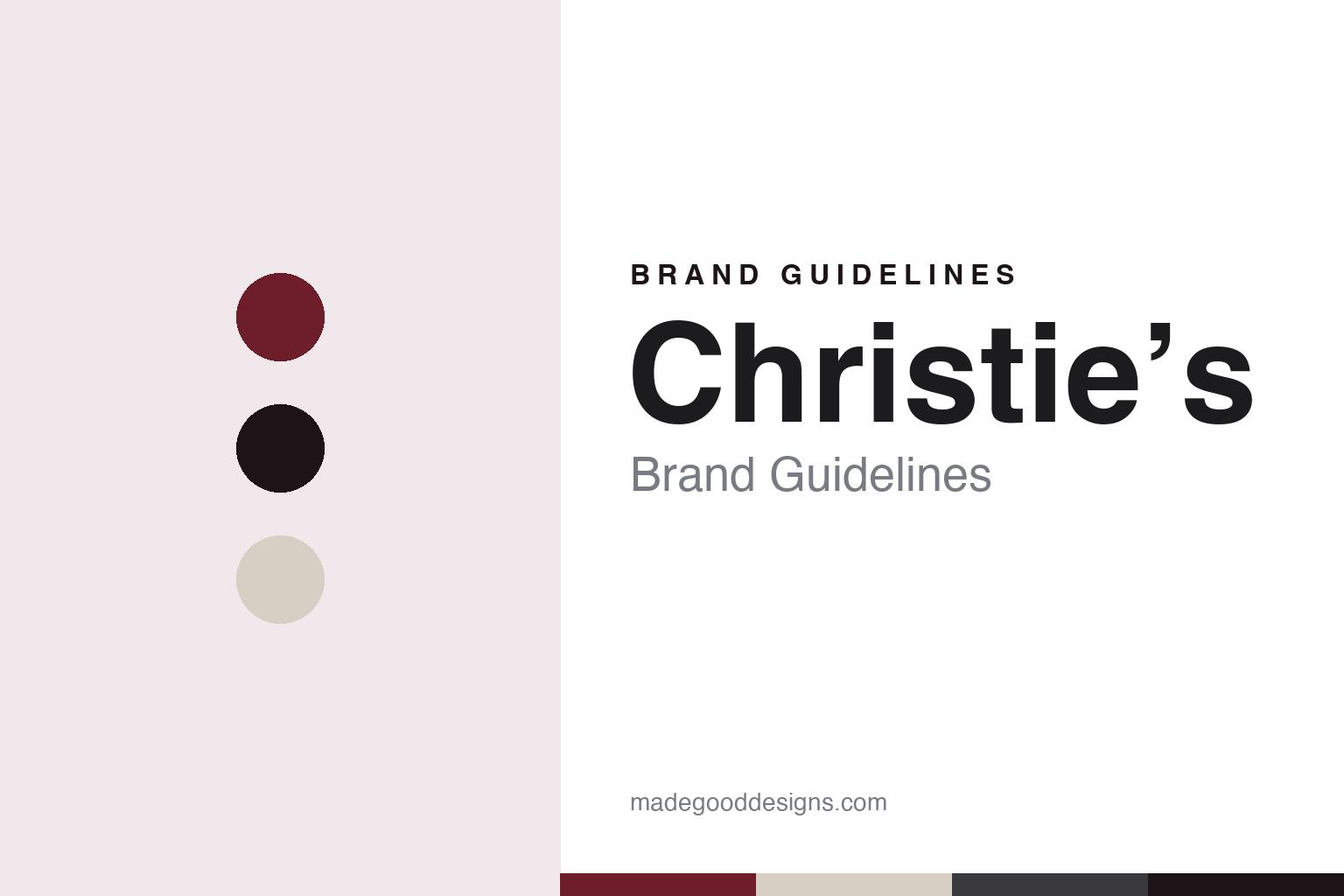
Christie’s Brand Guidelines
A sale room in St James’s since 1823.
Aa
Two constants: a claret, slate and stone palette and an old-style serif register. Abstract homage — not a Christie’s asset or mark; no logo, icon or wordmark is reproduced.
James Christie and King Street
London, 1766 to 1999.
Christie’s carries its founder’s name. Wikipedia says the house was founded in London by James Christie, and that the company’s own literature dates his opening sale to 5 December 1766, with the earliest auction catalogue in its archive dating from the same month. Wikipedia adds that other sources trace Christie renting auction rooms from 1762 and newspaper advertisements for his sales from 1759. The firm later passed to his son, James Christie the Younger.
The address became part of the name. Wikipedia says Christie’s flagship saleroom has been on King Street in St James’s since 1823, and describes King Street as the main premises of the business. Wikipedia lists the other salerooms as New York, Paris, Geneva, Milan, Amsterdam, Dubai, Hong Kong and Shanghai.
London once had a second Christie’s room. Wikipedia says a saleroom in South Kensington opened in 1975 and mainly handled the middle market, and that the company closed it permanently in July 2017 as part of restructuring plans announced in March 2017, alongside a move towards online sales. In The Art Newspaper of 15 January 2025, the then chief executive Guillaume Cerutti named the shutting of South Kensington as one of the low points of his time in charge.
For much of the late twentieth century Christie’s was a listed company. Wikipedia says it was quoted on the London Stock Exchange from 1973 to 1999. It says Jo Floyd was appointed chairman in 1974 and chaired Christie’s International plc from 1976 to 1988, before handing over to Lord Carrington. Wikipedia also says Christie’s bought the London gallery Spink & Son in 1993 and ran it as a separate entity, merging it with the Leger Gallery in 1996 to form Spink-Leger, which closed in 2002.
Colour
New York, a sale of the company and a French owner.
Christie’s crossed the Atlantic in the 1970s. Wikipedia says Christie’s International Inc. began holding sales in the United States in 1977, when the company, led by chairman Stephen Lash, opened a branch on Park Avenue in the former grand ballroom of Delmonico’s Hotel. In 1997, Wikipedia says, it took a 30-year lease on space at Rockefeller Center, which became its New York saleroom. Until 2001 a division called Christie’s East sold lower-priced art and objects from 219 East 67th Street, and in 1996 the company bought a townhouse on East 59th Street as a separate gallery for private sales.
On the West Coast, Wikipedia says Christie’s opened a Beverly Hills saleroom in 1997 and in April 2017 moved to a two-storey space there designed by the architecture studio wHY.
The present ownership dates from 1998. Wikipedia says that in December 1997, under chairman Lord Hindlip, Christie’s put itself up for sale but did not receive a bid it was prepared to accept after two months of talks with a consortium led by SBC Warburg Dillon Read. The Art Newspaper, in a report published in June 1998 under the headline “Christie’s falls to the French”, said that François Pinault had bought a shareholding early the previous month from the investor Joe Lewis, and that on 18 May 1998, through his holding company Artemis, he issued an agreed offer for the whole company. It named Christopher Davidge as chief executive at the time. Groupe Artémis has owned Christie’s since 1998.
The Art Newspaper reported on 15 January 2025 that Artémis was founded in 1992 by François Pinault and is now led by his son, François-Henri Pinault, with holdings that include the Pinault Collection and a controlling stake in Kering. It said Cerutti was stepping down as chief executive after eight years to oversee the group’s art activities, and that Bonnie Brennan, president of Christie’s America since 2021, would succeed him from 1 February 2025. Brennan would stay in New York, but said London remained the headquarters of Christie’s. Wikipedia lists the chief executives since the Pinault purchase as Edward Dolman, Steven Murphy, Patricia Barbizet, Cerutti and Brennan.
Typography
A street address, a lease and a Hong Kong tower.
Art-market names often begin as people. A gallery or saleroom may carry a founder’s surname, a pair of joined surnames or a family name, and that name then has to work at very different sizes: on a street-level sign, on the spine of a catalogue, on a press release and on a small icon in a browser tab. Many houses set the name in a restrained typeface and leave plenty of space around it, so the word sits quietly beside the artworks rather than competing with them.
The printed catalogue is one of the main brand surfaces. Cover layouts, the grid of lot or plate pages, captions and the paper itself can all signal a house style from one season to the next. At a sale, a numbered bidding paddle is a small, repeated object that carries the name into photographs of the room.
Buildings matter too. Facades, entrance lettering, white walls, grey floors and even light can become part of how a gallery is recognised. Many galleries and auction houses also publish magazines, journals, podcasts and websites, where typography, photography and colour carry the identity between exhibitions.
Aa
An old-style serif — after a house name set in a classical text face. (Specimen set in EB Garamond, a serif STAND-IN; NOT the Christie’s logo or any Christie’s typeface.)
Christie’s
Salerooms as the visible brand.
Christie’s presents itself through its rooms as much as its marks, and its newest room is in Hong Kong. ArtAsiaPacific reported on 23 September 2024 that Christie’s had opened its Asia Pacific headquarters on 20 September 2024 in The Henderson, an office tower in the Central district designed by Zaha Hadid Architects. It said the house occupies the sixth to ninth floors, with a salesroom, galleries, a client hub, offices and a pillar-free floor plan that lets it hold sales and exhibitions in-house through the year, and a lift running directly to the tower’s glass rooftop ballroom.
The same report said the previous Hong Kong office, in Alexandra House in Central, was on the 22nd floor and required visitors to collect a temporary pass from security. It quoted Francis Belin, Christie’s president for Asia, and said the opening sales in the new room, of twentieth- and twenty-first-century art, were scheduled for 26 and 27 September 2024. Wikipedia says Christie’s had operated from Alexandra House since 2014 and announced the move in 2021.
Elsewhere the network has kept growing by acquisition and by city. Wikipedia says Christie’s France began holding auctions in Paris in 2002, that the Haunch of Venison gallery became a subsidiary in 2007, and that in September 2024 Christie’s agreed to acquire the American classic-car auction house Gooding & Company. It also says that, with Bonhams, Christie’s is a shareholder in the London-based Art Loss Register, and that Christie’s Education runs non-degree programmes in London, New York, Hong Kong and Amsterdam.
The catalogue runs through the house’s printed identity from the start: Wikipedia says the earliest one the company keeps dates from December 1766, the same month as the sale it counts as its beginning.
For a design guide, Christie’s shows how an auction house can let a founder’s surname and a fixed London street carry its identity while its owners and rooms change around them. Compare Sotheby’s and Phillips, two other auction houses in this collection. For this guide we use King Street claret, slate and stone with an old-style serif, an unofficial interpretation; no product or logo is reproduced.
Explore & save
Keep Christie’s’s identity on hand — save it to a board in the Made Good inspiration library.
Christie’s identity set
Pin the Christie’s claret, slate and stone palette and the old-style serif register to your own board.