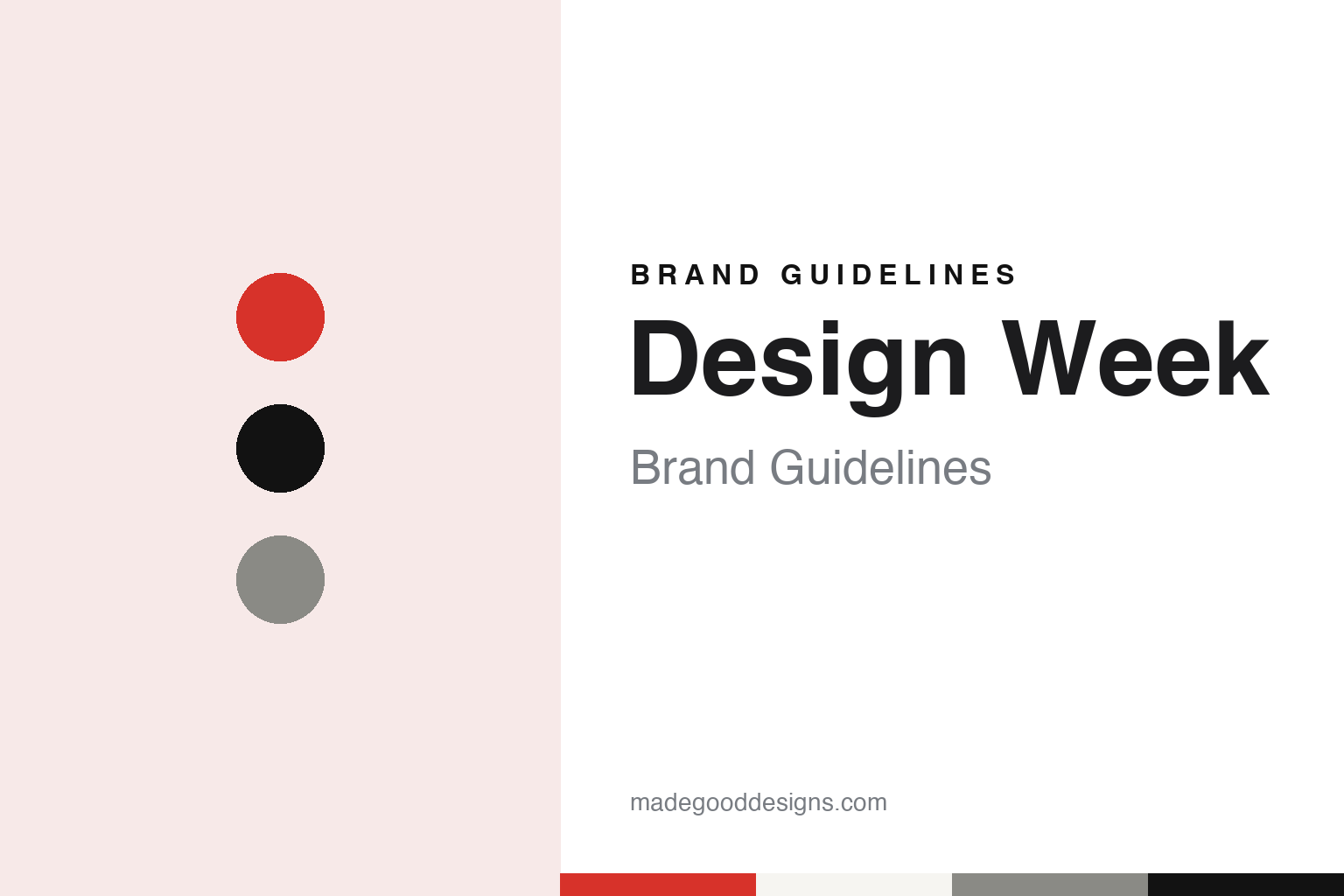
Design Week Brand Guidelines
A weekly name that kept going online.
Aa
Two constants: a deadline red, black and proof grey palette and a humanist sans register. Abstract homage — not a Design Week asset or mark; no logo, icon or wordmark is reproduced.
A weekly for the business of design
London, 1986 to 2011.
Design Week was named for its rhythm. It began as a weekly printed magazine about the business of design, published in London by Centaur Communications, later Centaur Media. Wikipedia says the first issue appeared in October 1986. The architecture and design site Dezeen, reporting on the title in May and October 2024, says it launched in print in 1986 with the writer Jeremy Myerson as its founding editor.
Its subject set it apart from titles about finished objects and interiors. Wikipedia describes Design Week as a business publication, written for people in commercial design disciplines: retail, products and packaging, graphics, interiors, exhibitions and, later, digital work. Dezeen likewise describes it as a magazine focused on the business of design.
Wikipedia says the title was then edited for more than twenty years by Lynda Relph-Knight. Over that period the weekly built up an archive of design news, interviews and retrospectives, and Wikipedia notes that back issues from 1995 include profiles of designers active since around 1960.
The print weekly ended in 2011. Dezeen says the magazine printed its last physical edition that year as it switched to digital-only publishing, and Wikipedia gives the same year for the move. Wikipedia says Angus Montgomery, editor until 2016, took the title online-only.
Through those years the publisher kept the title within a group of marketing and media brands. Wikipedia says that on 22 January 2019 Centaur Media announced that Design Week had become part of Xeim, the new name for its marketing division. Dezeen says Xeim also ran Marketing Week and Creative Review. Wikipedia names Tom Banks as the final editor while the brand was owned by Centaur.
Colour
Closure and a new owner, 2023 to 2024.
In December 2023 Design Week announced that it would close. Wikipedia dates Centaur Media’s announcement to 22 December 2023, with publication ceasing with immediate effect. Dezeen reported in May 2024 that the website had at first been due to be taken offline by mid-January, as Centaur, through Xeim, had decided to refocus on its core audience of marketers through its other publications. The website stayed online in the months that followed.
The title was then bought by the company that had been building its website. Dezeen reported on 17 May 2024 that Design Week had been acquired by its web development company, Interconnect, from Xeim, after Interconnect had worked as Design Week’s service provider since 2015. Interconnect has owned Design Week since May 2024. Dezeen describes it as a Liverpool-based business that had worked as a web development and design studio in recent years, and says its director, David Coveney, told it the company had been founded as a digital-only publisher in 1996 before moving into technology services. Coveney told Dezeen that Interconnect also operates under a studio name, Standfirst.
In a statement quoted by Dezeen, Coveney said taking ownership was meant to “inject new vitality into the brand”, and that Interconnect intended to keep the publication’s analysis and coverage of the design sector while investing in a new design and content strategy. Dezeen reported that the plan was to recruit staff and relaunch the title later in 2024, and that Interconnect had been working with several former members of staff on the relaunch.
Typography
A business weekly that became a website.
A design publication is read as much as it is looked at, and its identity has to work across every surface it touches. The masthead is the anchor: a wordmark that sits at the top of a cover, a website header and a social avatar, and has to stay legible at the width of a phone screen as well as on a newsstand. Around it, covers and grids carry the voice from issue to issue. A cover system might fix the masthead position and leave the image to change, or treat each cover as a commission and let only the type stay constant. Inside, the grid, the body face and the caption style set the pace of reading.
Online, the same identity is stretched across websites and newsletters, where it has to survive templates, thumbnails and inbox previews. Many titles also run events, talks and annuals, and each of these becomes a brand surface in its own right, with its own posters, stage graphics and printed books. Read together, these pieces show how a publication keeps one recognisable voice while its formats keep changing.
Aa
A humanist sans — after the capitalised humanist sans logo Design Week adopted in 2024. (Specimen set in Fira Sans, a sans STAND-IN; NOT the Design Week logo or any Design Week typeface.)
Design Week
The October 2024 identity.
Design Week came back with a new face. Dezeen reported on 7 October 2024 that the online magazine had relaunched that day, after closing in January, with an updated visual identity informed by the Bauhaus. The relaunch was led by the publisher David Coveney and the designer Chris McInerney, who worked together on the identity for the website.
The change is easiest to see in the logo. Dezeen says the new identity centres on a capitalised logo set in a humanist sans serif, a typeface that references the clean, functional shapes associated with the Bauhaus. It describes the previous branding as having the word “design” in lowercase, with “week” written vertically in smaller lettering beside it. McInerney told Dezeen he wanted to give each word equal prominence, because Design Week is known by its full name, and to make it “as loud and proud as possible”. He said the aim was to take the DNA of the old branding while accepting the title was in a new place, keeping a connection with the past while being more confident.
A new editorial team arrived with the identity. Dezeen reported that the new editor was Rob Alderson, formerly editor-in-chief of It’s Nice That, and that the senior writer was Clare Dowdy, who had previously been part of the Design Week team. Alderson told Dezeen he saw the team as “raucous cheerleaders for design and designers”. He said the title wanted to cover more digital design, give more space to design made outside London, from Brighton and Bradford to Dublin and Dundee, and keep and expand its traditional business focus. He also described a community-led approach, connecting designers and looking at the highs and lows of running a design business.
Design Week has published online only since 2011, under Centaur and Xeim until 2023 and under Interconnect since 2024.
For a design guide, Design Week shows how a publication can keep its name while changing its owner, its format and its wordmark, here by setting two words at equal weight. Compare Creative Review, which shared an owner with it under Xeim, and Dezeen, an online design title from London. For this guide we use deadline red, black and proof grey with a sans, an unofficial interpretation; no product or logo is reproduced.
Explore & save
Keep Design Week’s identity on hand — save it to a board in the Made Good inspiration library.
Design Week identity set
Pin the Design Week deadline red, black and proof grey palette and the humanist sans register to your own board.